
Payment terms are a critical part of contracts that directly impact your cash flow and financial health. Mismanaging them can lead to delayed payments, strained relationships, and operational challenges. Here’s a quick guide to analysing payment terms effectively:
- Extract Key Details: Use tools like AI-driven platforms to identify terms such as Net payment periods, early payment discounts, late penalties, and invoicing procedures.
- Standardise Data: Ensure consistency in formats, currencies, and terminology to avoid errors or misinterpretations.
- Calculate Metrics: Track Days Payable Outstanding (DPO), Days Sales Outstanding (DSO), and Cash-to-Cash Cycle (C2C) to assess cash flow efficiency.
- Benchmark Terms: Compare your payment terms against industry standards and competitors to identify areas for improvement.
- Optimise Terms: Look for opportunities to extend payment periods, renegotiate unfavourable terms, or take advantage of early payment discounts.
- Monitor Regularly: Use contract management software features to track deadlines, flag risks, and maintain compliance.
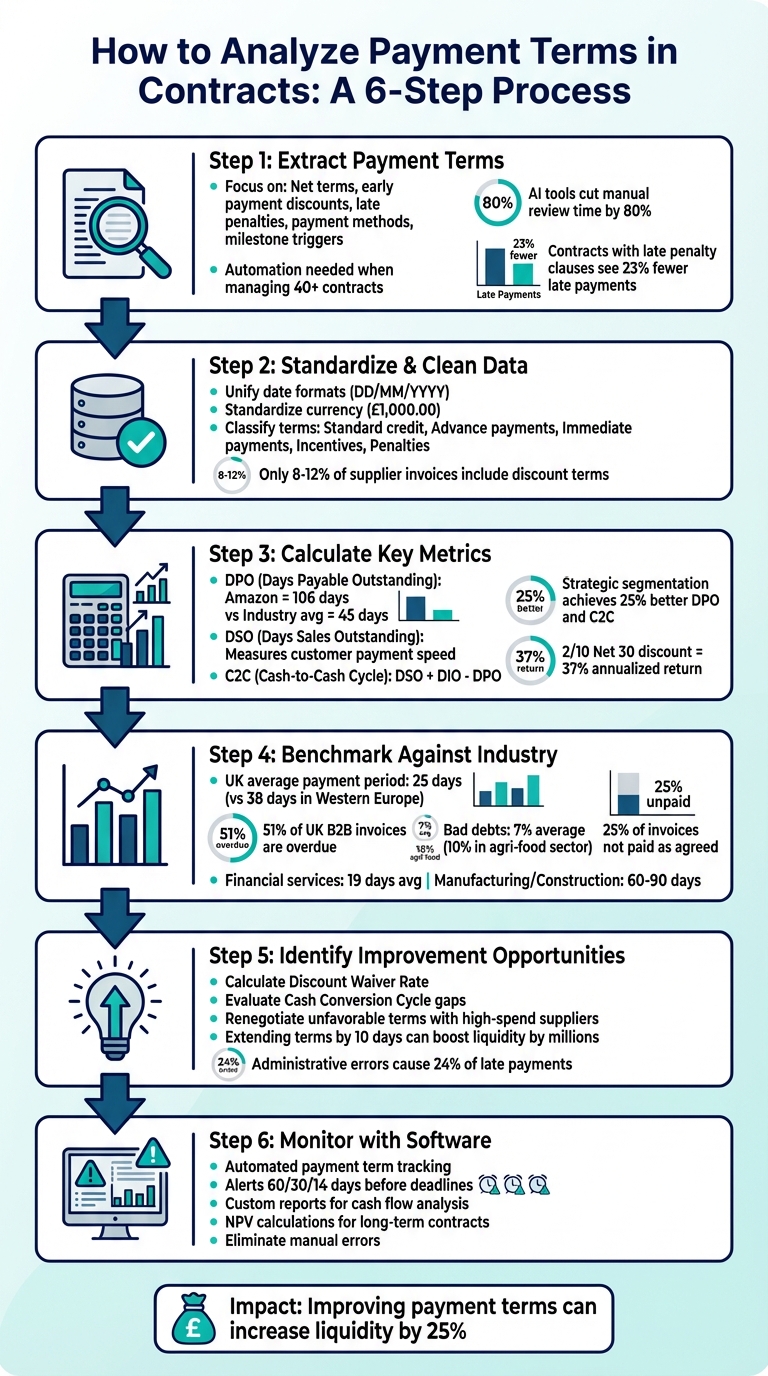
6-Step Process for Analyzing Payment Terms in Contracts
Step 1: Extract Payment Terms from Contracts
The first step in analysing payment terms is pulling out the relevant details from your contracts. For businesses dealing with a large number of agreements, manually reviewing each one is simply not practical. Automated data extraction can cut manual review time by as much as 80%. This step lays the groundwork for evaluating critical payment metrics in the following stages.
Once a company manages more than 40 active contracts, manual review becomes increasingly inefficient and prone to mistakes. Errors, missed clauses, or inconsistent interpretations are more likely to occur. At this point, AI-driven tools become invaluable.
Payment Terms to Focus On
When extracting data, prioritise clauses that directly impact cash flow and compliance. Here are some key terms to pay attention to:
- Net terms: These specify when payment is due after an invoice is issued – common examples include Net 30, 60, or 90.
- Early payment discounts: Terms like "2/10 Net 30" allow for a 2% discount if payment is made within 10 days. These can strengthen vendor relationships and save money.
- Late payment penalties: Contracts with clear late penalty clauses experience 23% fewer late payments compared to those without.
- Payment methods and currency: These details help avoid delays and disputes over exchange rates or transfer methods.
- Milestone triggers: For project-based work, identifying payment milestones is essential.
- Invoicing procedures: Look for clauses that clarify whether payment periods start from the invoice date or the date the invoice is received. This distinction can significantly impact cash flow, potentially delaying it by several days.
Save Time with Automation
AI tools like Trackado can simplify this process by using machine learning and OCR to extract data from various file formats, including PDFs, DOCX files, and scanned images. Unlike basic keyword searches, these tools understand the context of clauses. For example, they can identify that "thirty days written notice" is related to payment terms, even if specific keywords are missing.
Trackado also supports bulk uploads, standardizes extracted data into consistent formats, and reduces the chance of human error. It processes large batches of contracts in seconds or minutes, drastically cutting down review time compared to manual methods. Pricing starts at $39 per month for the Starter plan, which accommodates up to three users and 60 contracts, making it a cost-effective option for small teams managing growing contract volumes.
Once you’ve extracted and standardised the payment data, the next step is to clean and organise it for further analysis.
sbb-itb-49df6ae
Step 2: Standardise and Clean Payment Data
After extracting payment terms from contracts, the next step is to standardise and clean the data. This ensures accuracy and allows for meaningful analysis. The challenge? Payment data often comes in wildly different formats. For instance, a single supplier might be listed as "IBM", "IBM Corp", or "International Business Machines" across documents. Similarly, payment terms may appear as "PT 35", "35 days", or "Net 35". Without standardisation, comparisons become meaningless, like trying to match apples with oranges. These inconsistencies can also have financial consequences.
Why Data Consistency Matters
Inconsistent data introduces risks. Tommy Laupsa, Co-Founder and Partner at Calculum Inc, highlights the importance of clean data:
"Consistently cleaned data allows for more accurate classification metrics which gives the company more arguments during negotiations or decision-making situations which ultimately positively influences the company’s working capital and revenue".
Failing to address data inconsistencies can lead to what’s known as "contract value leakage". This happens when businesses lose out on savings due to missed milestones or misunderstood payment terms. For example, procurement might negotiate 90-day payment terms with a supplier, but if accounting’s system defaults to 14 days, payments are made 76 days earlier than agreed. This misalignment can put unnecessary strain on working capital. Implementing contract management software can help mitigate these risks by centralising data and ensuring terms are applied consistently.
Standardize Formats and Currencies
Start by unifying date formats. Using a consistent date format across all contracts facilitates automated calendar integration. Currency formatting should also be consistent – use a single format throughout (e.g., $1,000.00 or €1,000.00) instead of mixing abbreviations, punctuation styles, or written-out amounts. Consistent formatting ensures accurate financial tracking and reporting.
When dealing with international contracts, clarify who bears currency conversion costs and how exchange rate changes will be managed. Additionally, specify whether prices include VAT.
Once formats and currencies are standardized, you can move on to categorizing payment terms for deeper insights.
Classify Payment Terms by Type
Organising payment terms into categories makes them easier to analyse. Common categories include:
- Standard credit terms: Net 7, 30, 60, 90 days
- Advance payments: Cash in Advance, Payment in Advance
- Immediate payments: Cash on Delivery
- Incentives: Early payment discounts, such as 2/10 Net 30
- Penalties: Late fees and interest charges
This classification helps finance teams forecast cash flow and spot trends in supplier behaviour. It also highlights opportunities for savings. For instance, only 8–12% of supplier invoices typically include discount terms, meaning businesses often miss out on cost-saving opportunities. By categorising and analysing payment terms, you can uncover these hidden chances to improve cash flow and reduce expenses.
Step 3: Calculate Key Metrics
Turn your standardised data into meaningful metrics that shed light on cash flow performance. These calculations transform raw contract details into actionable financial insights.
Metrics to Track
Days Payable Outstanding (DPO) indicates how many days, on average, you take to settle payments with suppliers. The formula is:
(Average Accounts Payable ÷ Cost of Goods Sold) × Number of Days in Period.
A higher DPO means you’re holding onto cash for longer. For example, Amazon reported a DPO of roughly 106 days for the fiscal year ending 31st December 2024. By comparison, the industry average is about 45 days, though this varies significantly by sector: retail averages 15 days, technology 30 days, manufacturing 45 days, and construction 65 days.
Days Sales Outstanding (DSO) measures how quickly your customers pay you. The formula is:
(Average Trade Receivable ÷ Total Sales) × Days.
The difference between DSO and DPO is a critical cash flow indicator. For instance, if your DSO is 60 days but your DPO is 30 days, you’re left with a 30-day working capital gap.
Cash-to-Cash Cycle (C2C) calculates the total time your cash is tied up in operations. Use the formula:
DSO + Days of Inventory Outstanding (DIO) – DPO.
Companies that segment suppliers strategically often achieve DPO and C2C levels 25% better than those that don’t. This metric helps identify suppliers offering more flexibility versus those requiring prompt payments.
Early Payment Discount Usage measures whether taking discounts for early payments is cost-effective. For example, under "2/10 Net 30" terms, a 2% discount for payment within 10 days equates to an annualised return of about 37%. Compare this return to your borrowing costs or cash reserve yields. If your borrowing rate is 6% and your cash earns only 2%, taking the discount could be a smart financial move.
Create Comparison Tables
Compile these metrics into a table for easy comparison across contracts. Include columns such as Contract ID, Contractual Days, Actual Days, Variance, and Value at Risk. The variance – calculated as actual days minus contractual days – highlights inefficiencies. For example, if a contract specifies Net 45 terms but payments are made in 28 days on average, you’re losing 17 days of cash float.
Calculate Value at Risk by multiplying the variance by your daily spend:
(Variance in Days) × (Annual Purchases ÷ 365).
For instance, if a supplier has an annual spend of £730,000 and a 17-day variance, this costs approximately £34,000 in working capital. Segment the table by supplier importance to prioritise renegotiation efforts. Focusing on high-volume suppliers can have a big impact – extending terms from Net 30 to Net 45 could unlock substantial cash flow improvements. These consolidated metrics provide the foundation for targeted negotiations and better cash flow management.
Step 4: Compare Payment Terms Against Benchmarks
After calculating your key metrics, the next logical step is to measure your payment terms against industry standards and regional norms. This comparison can highlight whether you’re potentially losing out on cash flow opportunities or exposing your business to unnecessary risks. With these benchmarks, you can better identify areas that may require adjustments.
Industry and Regional Benchmarks
Many jurisdictions publish payment practice data that can serve as useful benchmarks. In the UK, for example, the Payment Practice Reporting portal tracks payment performance for large companies. Check whether a similar resource exists in your country or region. By searching for specific suppliers or competitors, you can uncover average payment times and the percentage of late payments. This data provides a clear snapshot of current industry practices.
Another useful reference is the Atradius Payment Practices Barometer, which offers detailed insights into sector-specific trends, such as credit sales, overdue invoices, and bad debt. Payment performance varies significantly by market. In the UK, for instance, a majority of B2B invoices are reportedly overdue, with bad debts a persistent issue in sectors like agri-food. Check regional data sources for benchmarks relevant to your market. While 30-day payment terms are common, variations exist. Financial services typically average around 19 days, while manufacturing and construction sectors often see terms stretching to 60 or even 90 days. Payment periods vary by region – European markets tend to average longer payment windows than some other markets, so it’s worth understanding the norms in the countries where your suppliers and customers operate.
These benchmarks provide a foundation for evaluating supplier performance.
Assess Supplier Performance
Using these benchmarks, you can evaluate individual supplier relationships and identify opportunities for renegotiation. For example, if a supplier operates in a high-risk sector like agri-food, where 47% of invoices are overdue, you might consider tightening payment terms. Alternatively, if your business consistently pays faster than the industry average, you could be missing a chance to optimise your working capital.
Liz Barclay, the Small Business Commissioner, sums it up well:
"Paying late, extending payments, pushing more invoices into the disputed pile not only damages reputations but gets people thinking that the financial health of your firm may not be as robust as it was".
It’s also worth comparing your actual payment behavior to the terms outlined in your contracts. Across markets, a significant proportion of invoices are not paid as agreed – particularly in manufacturing and construction sectors where longer payment cycles are common. If your payment practices deviate significantly from these norms, investigate the root causes. Are delays due to administrative errors (which can be mitigated by implementing a contract management solution) (which account for 24% of late payments) or deliberate cash flow strategies?
Keep in mind that payment practices are increasingly viewed through an ESG (Environmental, Social, and Governance) perspective. Consistently late payments can harm your reputation, not just with suppliers but also with investors who are paying closer attention to these factors.
Step 5: Find Opportunities to Improve
Once you’ve compared your benchmarks, it’s time to pinpoint areas where inefficiencies are draining your cash flow. Look out for warning signs like rising Days Sales Outstanding (DSO), late payments becoming the norm, or customers repeatedly asking for extended terms. These issues suggest that too much cash may be tied up in receivables, rather than working to grow your business.
It’s also a good idea to evaluate your Cash Conversion Cycle (CCC) – the time it takes to pay suppliers (DPO) versus the time needed to collect from customers (DSO). A large gap between these two can put pressure on your liquidity. As Cartesian FinOp Partners explains:
"A rising DSO metric means your money is stuck in receivables. That’s a direct indicator that your invoice payment strategies and collection processes need tightening".
The aim is to synchronise these cycles so you’re not paying out cash before it’s coming in.
Identify Missed Discounts
Early payment discounts can lead to considerable savings if you take advantage of them. Start by calculating your Discount Waiver Rate, which measures the percentage of unused early payment discounts compared to your total purchase volume. This metric reveals the potential cost savings you might be leaving on the table. Gaining contract performance transparency is essential to identifying these gaps.
For instance, a typical 2/10 Net 30 discount (2% off if paid within 10 days) can translate into an effective annual rate of 44% to 70%. Compare this rate to your company’s cost of alternative financing to decide if paying early is a smart financial move.
In addition to capturing discounts, reassess other contractual terms to see if there’s room for improvement.
Renegotiate Unfavourable Terms
Focus your renegotiation efforts on payment terms that are unfavourable, especially with high-spend suppliers. Even small adjustments in these contracts can unlock significant cash. Use sector-specific data to support your case – for example, UK agriculture and food businesses typically settle invoices in 14 days, while ICT and electronics sectors average 27 days.
When negotiating, it’s important to reassure suppliers that your request for extended terms is about optimising cash flow, not a sign of financial trouble. Simon Brooke offers this advice:
"You can explain honestly that you’re looking to help your cash flow but also point out that you might, as a result, be able to spend more with them".
If better pricing isn’t on the table, consider offering non-monetary incentives like referrals, testimonials, or committing to a specific purchase volume over time. Extending payment terms by just 10 days can boost a large company’s liquidity by millions of euros. For example, moving from Net 30 to Net 60 terms could effectively double liquidity from that transaction.
Step 6: Monitor and Report with Software
Once you’ve identified areas for improvement, keeping a close eye on your contracts is key to maintaining smooth operations. Effective monitoring ensures you stick to improved payment terms, respond promptly, and optimise cash flow. Relying on spreadsheets for this process can limit visibility and make oversight challenging. That’s where contract management software like Trackado steps in, centralising your payment data and automating the entire monitoring process.
Automate Payment Term Tracking
Trackado brings all your billing details into one place, offering a clear view of your finances and commitments. By using AI, the platform keeps critical contract details updated, cutting down on manual data entry and reducing errors.
You can set up alerts to notify you 60, 30, or 14 days before payment or renewal deadlines. These reminders give you plenty of time to plan finances or renegotiate terms, helping you avoid unexpected situations. As Yiannis Karavassilis, COO at CloudKid, puts it:
"The moment we knew we had made the right choice with Trackado was when we received email notifications that gave us a heads-up when something was ending or renewing. This really helped us to keep on top of things and avoid sticky situations."
For long-term agreements, Trackado’s Contract Value Analyzer calculates the Net Present Value (NPV) of contracts. This tool provides a deeper understanding of how payment timing affects cash flow, accounting for factors like inflation and opportunity costs.
By automating these processes, you’re better positioned to gather meaningful insights through tailored reporting.
Create Custom Reports
Customised reports in Trackado go hand-in-hand with your monitoring efforts, offering proactive alerts on contract risks and cash flow. With features like custom fields and workflows, you can generate reports that break down contract values into specific payment amounts and due dates. These reports also flag late payments and compliance issues, giving you a clearer picture of your financial health.
For instance, Good Energy transitioned from spreadsheets to a centralised system, enabling their legal and procurement teams to analyse contracts more effectively and find efficiencies. Similarly, Rakuten Europe shared how, during an audit, they could instantly export a list of all new contract partners for the year – something that would have been far more time-consuming without software.
Conclusion
Understanding payment terms goes beyond simply reading through contracts – it’s about transforming that contract data into actionable financial insights. By using AI-driven tools to extract payment data, standardise formats and currencies, calculate metrics like Days Payable Outstanding (DPO) and the Cash-to-Cash cycle, and compare these figures against industry benchmarks, businesses gain the clarity needed to make smarter financial decisions. This process highlights where capital is tied up and uncovers areas ripe for improvement.
Once the data is extracted and standardised, centralised monitoring becomes a game-changer for financial strategies. Tools such as Trackado help eliminate manual errors, ensure renewal dates aren’t missed, and offer the insights needed to renegotiate unfavourable terms. As mentioned earlier, consistently cleaned and organised data leads to more reliable classification metrics, which strengthens negotiation positions and has a direct impact on working capital and revenue.
The financial benefits are hard to ignore. Improving payment terms can increase liquidity by as much as 25%, while taking advantage of early payment discounts can deliver impressive annualised returns. But the advantages don’t stop at numbers. Analysing payment terms in a structured way fosters better supplier relationships by promoting transparency, reducing disputes, and creating mutual benefits through dynamic discounting.
Shifting from reactive spreadsheet management to a strategic approach in handling contracts transforms cash flow management. This shift allows for more accurate forecasting, unlocks working capital stuck in inefficient cycles, and provides a stronger position during negotiations. With data-driven insights and automated monitoring, your business is better equipped to maintain strong supplier relationships and ensure steady cash flow.
FAQs
Which payment clauses matter most for cash flow?
Payment clauses play a crucial role in shaping cash flow, particularly those that outline due dates, payment terms (like ‘Net 30′ or ’60 days’), and penalties for late payments. These clauses establish clear expectations for when payments should be made, ensuring a steady and predictable inflow of cash. Additionally, provisions such as late fees, early payment discounts, and accepted payment methods can encourage prompt payments and offer flexibility. Together, these elements help businesses maintain a stable financial position.
How do I calculate DPO, DSO, and the cash-to-cash cycle?
DPO (Days Payable Outstanding) shows the average number of days a company takes to pay its suppliers. The formula is:
DPO = (Average accounts payable / Cost of goods sold) × 365
DSO (Days Sales Outstanding) tracks how long it takes, on average, to collect payments from customers. The formula is:
DSO = (Accounts receivable / Total credit sales) × Days in period
Finally, the Cash-to-Cash Cycle ties these elements together, reflecting the time it takes to convert investments in inventory into cash received from sales. The formula is:
Cash-to-cash cycle = DIO + DSO – DPO
When should I renegotiate payment terms vs take early payment discounts?
If your current payment terms are putting a strain on your cash flow or delaying access to funds, it might be time to revisit and renegotiate those arrangements. This is especially important if your financial circumstances or market conditions have shifted.
Offering early payment discounts can be a smart move if you have enough liquidity and want to speed up cash inflows. These discounts are most effective when the advantage of receiving payments sooner outweighs the cost of providing the discount.