
Contracts are at the heart of the hospitality industry, covering everything from vendor agreements to employment terms. Mismanaging them can lead to financial losses, legal risks, and operational disruptions. For instance, businesses lose an average of 9% of annual revenue due to poor contract oversight, and 76% of professionals report inefficiencies in their processes.
Key compliance areas include:
- Data Privacy: GDPR, CCPA, and PCI DSS demand strict guest data handling.
- Labor Laws: FLSA sets wage, overtime, and tip regulations.
- Licensing: Expired permits or liquor licenses can result in fines or closures.
- Renewals: Missing deadlines can lead to higher costs or service interruptions.
To avoid these pitfalls:
- Centralize contracts in a secure, searchable system.
- Use automated reminders for renewals and compliance deadlines.
- Regularly audit agreements for regulatory and performance standards.
- Implement clear terms and measurable KPIs in contracts. Using a contract renewal planner can help you stay ahead of these dates.
Tools like Trackado streamline contract management by automating tracking, ensuring compliance, and simplifying workflows across multiple properties. By staying organized and proactive, you can save money, reduce risks, and keep operations running smoothly.
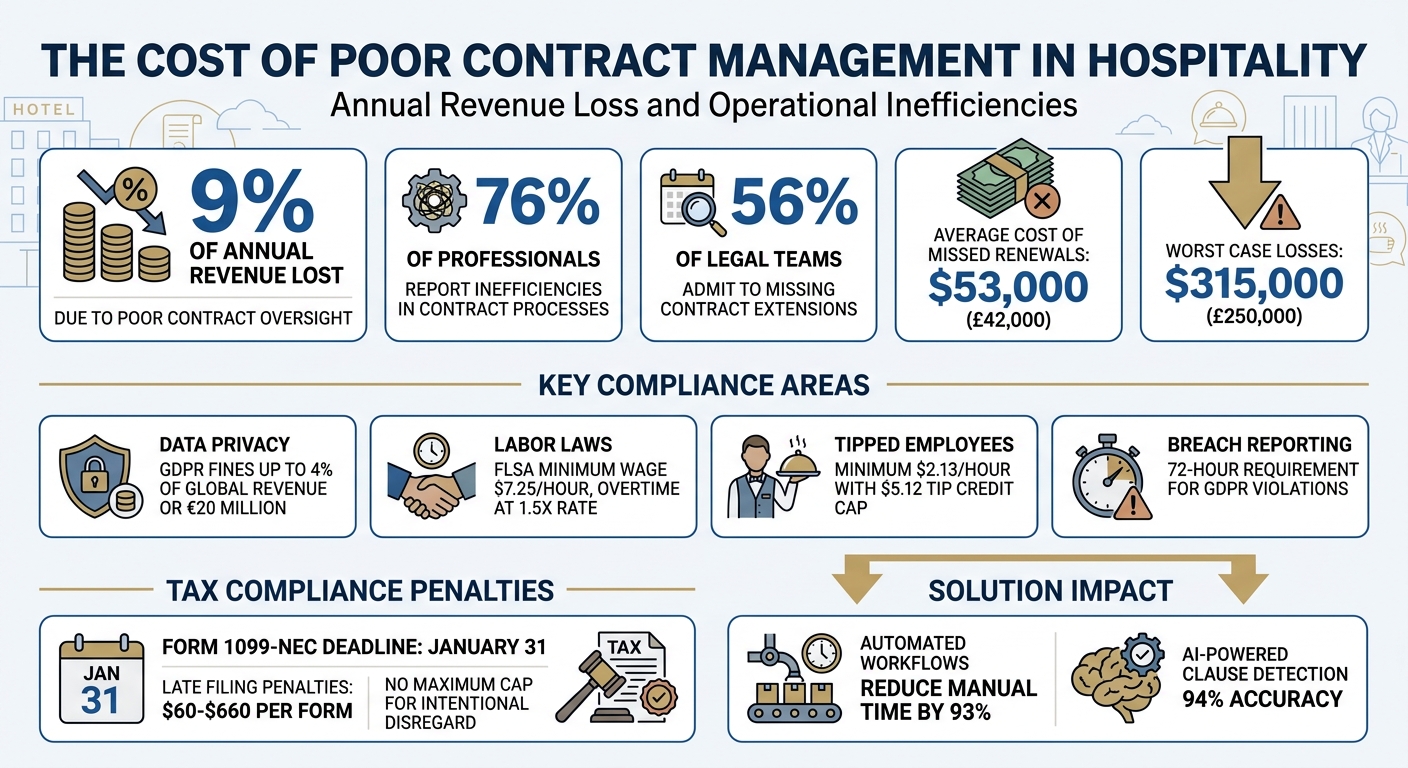
Hospitality Contract Compliance: Key Statistics and Financial Impact
Key US Regulations Affecting Hospitality Contracts
The hospitality industry operates under a complex web of federal, state, and local regulations. To avoid penalties, lawsuits, or even operational shutdowns, it’s crucial to weave these legal requirements into your contracts. A solid grasp of these rules is essential for effective contract management, as they touch every aspect of your agreements.
Data Privacy and Security Requirements
If your hotel or restaurant serves guests from the European Union, GDPR applies to you, no matter where your business is located. Sara H. Jodka, an attorney at Dickinson Wright PLLC, clarifies:
The GDPR applies to any organization, no matter where it has operations, if it offers goods or services to, or monitors the behavior of, EU individuals.
For hospitality businesses, protecting guest data is non-negotiable. Contracts with third-party services – like booking platforms, payment processors, or cloud storage providers – must include a Data Processing Agreement (DPA). This document outlines how data is handled, the duration of processing, security measures, and breach notification requirements. Establishing standardized contract workflows ensures these DPAs are consistently included in every vendor agreement. Violating GDPR can result in fines as high as 4% of global annual revenue or €20 million, whichever is greater, with breaches required to be reported within 72 hours.
If your business operates in California or serves California residents, the CCPA mandates specific clauses in contracts. These include provisions that allow customers to opt out of data sharing and request data deletion. Other states, including Texas, Virginia, and Oregon, have enacted their own privacy laws, adding another layer of complexity to vendor and customer agreements.
For any business processing credit card payments, PCI DSS compliance is essential. Contracts with payment processors must require secure handling and encryption of financial data. Additionally, the Federal Trade Commission enforces rules against deceptive data practices, so marketing and reservation agreements must clearly explain how customer information will be used.
Before signing any vendor contract, conduct a data mapping exercise to identify what information you collect, where it’s stored, and who has access. Update your privacy notices to require explicit consent – use unchecked boxes rather than implied consent. Also, ensure you have robust data retention and breach reporting protocols in place.
Labor and Employment Laws
Labor laws introduce another layer of compliance for hospitality contracts. The Fair Labor Standards Act (FLSA) applies to businesses with annual sales of $500,000 or more, or those whose employees engage in interstate commerce, such as processing out-of-state credit card payments. Employment agreements must guarantee non-exempt workers a minimum wage of $7.25 per hour and overtime pay at 1.5 times their regular rate for hours worked beyond 40 per week.
For tipped employees, employers can pay as little as $2.13 per hour if they claim a tip credit, which is capped at $5.12 per hour. Contracts must clearly inform employees about the direct wage, the claimed tip credit, and their right to keep all tips. The U.S. Department of Labor emphasizes:
Deductions from wages for items such as required uniforms are illegal if they reduce the employee’s wages below the minimum wage or cut into any overtime pay.
Employment agreements must also prohibit deductions for uniforms, cash register shortages, or customer walkouts if these deductions would lower wages below the minimum. Additionally, managers and supervisors cannot participate in tip pools or take a share of employee tips unless they are directly providing service themselves.
If you rely on temporary staffing agencies or leasing firms, you could be classified as a joint employer, making you responsible for FLSA compliance for those workers. Carefully review these arrangements and maintain accurate wage and hour records, as required by 29 CFR Part 516.
Licensing and Permit Requirements
Compliance with licensing and permit requirements is equally critical. Vendor contracts should include clauses that require suppliers to maintain valid health certifications and food safety permits. Vendors must provide updated certifications as a condition of service. If health department inspections uncover expired certifications, your business risks fines, failed inspections, or temporary closures.
Liquor licensing is another area that demands attention. State-specific regulations must be reflected in your beverage supplier contracts. Violations, such as serving alcohol without a valid license, can lead to immediate revocation. Contracts for construction, renovation, or facility services must also address federal ADA accessibility standards and local building codes.
Additional permits may be necessary for services like valet parking or hosting events. Insurance requirements are another key consideration – most contracts require vendors to carry minimum liability coverage and to provide valid insurance certificates. These certificates must be renewed before they expire.
To stay ahead, set 45-60 day reminders for insurance renewals and 90-day windows for vendor contract renewals. This gives you time to renegotiate or rebid contracts. Centralize all licenses, permits, and insurance certificates in a searchable system using contract management software features designed for compliance. Many compliance issues arise not from willful neglect but from poor tracking, which can lead to expired certifications being uncovered during inspections.
sbb-itb-49df6ae
Common Contract Types in Hospitality
After understanding the regulatory framework, it’s just as important to grasp the various types of contracts that ensure compliance in hospitality operations. From managing food suppliers to hiring seasonal staff and working with tech vendors, hospitality businesses handle numerous agreements daily. Each contract comes with its own set of rules, and missing even a small detail can lead to fines, service interruptions, or unhappy guests.
Supplier and Vendor Contracts
These agreements cover essentials like food and beverage deliveries, linen services, HVAC maintenance, and equipment leasing. They need to clearly outline delivery schedules, quality expectations, and service timelines. For example, a linen service contract might specify daily pickups for high-occupancy properties, acceptable thread counts, and policies for replacing damaged items.
Suppliers must also meet compliance standards. This includes maintaining valid health certifications, food safety permits, and liquor licenses as required by state laws. Maintenance contracts should ensure adherence to ADA requirements and local building codes.
Another key consideration is managing price escalation clauses. Missing a renewal deadline could mean unexpected rate increases. In one case, a hospitality property avoided a 12% price hike – saving $50,000 for the year – by catching a linen contract renewal notice in March 2026 using automated tracking systems. Payment terms, like Net 30 or Net 60, also impact cash flow, so keeping track of these deadlines can prevent late fees and strained vendor relationships.
Liability and insurance requirements are non-negotiable. Contracts should require vendors to carry liability insurance and workers’ compensation coverage, with proof provided before any work begins. Setting measurable KPIs, such as a 30-minute response time for urgent repairs or maintaining 99% uptime for critical systems like elevators, can also help evaluate vendor performance during quarterly reviews.
Clear definitions around worker roles and responsibilities are equally important, highlighting the need for well-structured employment agreements.
Employee and Independent Contractor Agreements
Managing your workforce – whether full-time staff, seasonal employees, or freelance contractors – requires carefully crafted agreements. A major compliance risk here is worker misclassification. The IRS uses a multi-factor test to determine whether someone is an employee or an independent contractor. This test evaluates:
| Factor | Employee Indicators | Independent Contractor Indicators |
|---|---|---|
| Behavioral Control | Employer dictates procedures and provides detailed training | Worker decides methods to achieve the end result |
| Financial Control | Employer supplies tools and assumes risk | Worker invests in their own tools and carries their own insurance |
| Relationship | Ongoing, permanent with benefits like health insurance | Project-based with no benefits provided |
Employment agreements must address wage, overtime, and benefit requirements in clear terms to avoid legal issues. For unionized properties, contracts should align with collective bargaining agreements that cover seniority rights, grievance procedures, and wage scales. Seasonal contracts may include fixed-term dates, layoff procedures, and provisions for rehire priority or end-of-season bonuses.
Tax compliance is another critical area. Businesses must file Form 1099-NEC for non-employees paid $600 or more in a tax year, with a deadline of January 31, 2027. Penalties for late filings range from $60 to $660 per form, depending on how late the filing is, with no maximum cap for intentional disregard. Collecting completed W‑9 forms upfront can help avoid last-minute issues. You can also e-sign your contracts to speed up the onboarding process.
Restrictive covenants, like non-compete clauses and confidentiality agreements, are also vital. These protect your business by preventing staff from joining competitors and safeguarding sensitive information, such as guest databases and pricing strategies. However, these clauses must be reasonable in scope and duration to hold up under state laws.
As internal agreements are fine-tuned, external service contracts also require careful attention to compliance.
Third-Party Service Agreements
Third-party agreements bring in external vendors for specialized tasks like property management systems (PMS), IT support, insurance, pest control, and laundry services. These contracts often come with unique compliance challenges, especially regarding data protection and liability.
For technology providers, contracts should include Data Processing Agreements (DPAs) to specify how guest data is handled, how long it’s stored, security measures, and breach notification protocols. Service-level agreements (SLAs) should outline uptime guarantees, response times for technical issues, and remedies for service failures.
Insurance contracts need to specify liability coverage requirements and renewal timelines. Setting reminders 45 to 60 days before expiration can help avoid lapses in coverage. Maintenance and pest control contracts should detail response times, such as 30 minutes for urgent issues or 24 hours for routine repairs.
Increasingly, vendor contracts are also incorporating environmental and ethical sourcing requirements, especially for brands focused on sustainability. These might include meeting specific certifications or adhering to fair labor practices.
Tim Cummins, President of World Commerce & Contracting, emphasizes:
Contracts are more than just legal safeguards; in many situations, they should be dynamic tools that support collaboration, mitigate risk, and create value.
Force majeure clauses are now essential in hospitality contracts. These provisions clarify how obligations change during extraordinary events – like pandemics, natural disasters, or government lockdowns – helping to avoid disputes over refunds, rescheduling, or liability in unpredictable situations.
Common Compliance Mistakes and How to Prevent Them
Even with well-drafted contracts, hospitality businesses can face serious risks when execution falters. Real-world compliance errors often turn manageable issues into costly disruptions. The key to effective compliance lies in identifying and addressing common contract management mistakes before they escalate. Let’s look at some frequent pitfalls and how to fix them.
Missed Renewal Deadlines
Failing to meet renewal deadlines can be incredibly costly. When deadlines are overlooked, businesses risk automatic renewals at unfavorable rates or, worse, service interruptions that directly affect guests.
The financial toll is significant. In the UK, 56% of legal teams admitted to missing contract extensions, with average costs reaching £42,000 (about $53,000) and some cases soaring to £250,000 (around $315,000). Missing these windows also means losing leverage to renegotiate, often leaving businesses stuck with last-minute terms.
The fallout doesn’t stop at financial loss. Overlooking renewals for liquor licenses, health certifications, or insurance policies can lead to fines, license revocation, or even temporary closures – disrupting vital services.
Sofia Tyson, Senior Content Manager at Juro, highlights this risk:
Automatic renewals aren’t inherently bad – but without proper tracking, they lock you into unnecessary spend and leave no room to renegotiate terms.
To prevent these issues, set up automated reminders 30, 60, and 90 days before renewal deadlines. Centralize all dates in a searchable digital system with metadata tags that trigger alerts automatically. For high-value contracts (over $25,000), implement tiered approval processes involving legal or financial oversight. Ensuring your contract terms are clear and precise is just as important.
Vague Contract Terms
Unclear contract language often leads to misunderstandings and disputes. Barbara Dunn, an attorney and meeting industry expert, warns:
Failing to use terms consistently can expose the parties to interpretations which were not intended.
Common issues include inconsistent terminology (e.g., switching between "contract" and "agreement"), failing to capitalize defined terms, or leaving handwritten changes unsigned. Under the "mirror image" rule, acceptance must match the offer exactly – silence doesn’t count as acceptance. Handwritten notes without proper signatures can even create a counteroffer rather than a binding agreement.
Another frequent problem is vague scope of work clauses. Without specific, measurable standards – like a 99% system uptime or a 30-minute response time for urgent repairs – it’s nearly impossible to enforce quality expectations or hold vendors accountable.
To avoid these problems, use standardized templates for recurring agreements like vendor contracts and event bookings. Digital tools can help perform a global search to ensure no outdated terms or client names remain in your agreements. Always include clear Key Performance Indicators (KPIs) in service contracts to turn subjective expectations into enforceable standards. When changes are necessary, formalize them through proper amendments rather than handwritten notes, and update all related provisions accordingly.
Equally critical is safeguarding sensitive data within your contracts.
Data Protection Failures
Weak data security clauses can leave hospitality businesses vulnerable to regulatory penalties. Guest information flows through property management systems, payment processors, and third-party vendors, making robust data handling policies essential. Often, the problem lies in missing or insufficient Data Processing Agreements (DPAs) with technology vendors. This leaves businesses liable for mishandling guest data – even when the fault lies with a third party.
The solution is to standardize confidentiality and data handling clauses across all vendor agreements. Use AI-powered tools to identify non-standard or missing clauses and centralize all documentation in a single repository. This ensures you’re audit-ready when inspectors request proof of compliance. Additionally, implement vendor scorecards to monitor data security performance alongside other KPIs, helping identify risks before contract renewals.
| Compliance Area | Common Mistake | Prevention Method |
|---|---|---|
| Renewals | Auto-renewal at higher rates | Automated 30/60/90-day notification alerts |
| Service Quality | Lack of measurable standards | Inclusion of specific KPIs (e.g., 99% system uptime) |
| Regulatory | Expired liquor/health licenses | Centralized compliance calendar with expiration tracking |
| Data Privacy | Weak non-disclosure terms | Standardized confidentiality and data handling clauses |
| Financial | Untracked price escalations | AI-powered metadata extraction of pricing terms |
Contract Management Methods for Hospitality Businesses
Managing contracts effectively is crucial for hospitality businesses to stay compliant and avoid unnecessary risks. By organizing agreements and streamlining processes, you can turn potential pitfalls into opportunities for efficiency and cost savings. Here’s how to create a solid contract management framework that works seamlessly for your business.
Centralized Contract Storage and Tracking
When contracts are scattered across email inboxes, shared drives, or filing cabinets, it’s easy to lose track of critical details. A cloud-based repository solves this problem by providing a single, accessible location for all agreements. With this system, procurement and legal teams can instantly access contracts across multiple properties, ensuring consistency in terms and unlocking potential savings like volume discounts. Plus, AI-powered search tools make it easy to locate agreements by vendor name, contract type, or renewal date within seconds.
To maintain security, role-based access control ensures only authorized personnel can view sensitive documents, while audit trails track who accessed what. This setup becomes especially helpful when health inspectors or investors need quick access to agreements. The stakes are high – inefficient contract management costs businesses an average of 9% in annual revenue due to poor visibility and missed opportunities.
| Approval Tier | Contract Value | Required Stakeholders |
|---|---|---|
| Low-value/Low-risk | Under $5,000 | Department Manager only |
| Medium-value | $5,000 – $25,000 | Purchasing Department + Manager |
| High-value/High-risk | Over $25,000 | Legal Review + CFO/General Manager |
Centralized storage is just the starting point. Automated reminders can take your contract management to the next level.
Automated Deadline Reminders
With contracts stored in one place, automated reminders ensure no critical dates slip through the cracks. Manual tracking often fails when juggling multiple agreements with varying renewal dates, price adjustments, and compliance deadlines. Automated alerts prevent costly auto-renewals by notifying teams 30, 60, or 90 days before a contract expires.
The International Hospitality Institute highlights the importance of this approach:
Hotel contracts and agreements are the backbone of successful operations, ensuring clarity and protection for all parties involved. By ensuring compliance with relevant laws, hotels can minimize legal risks and promote positive relationships.
Set reminders tailored to your needs: 90 days for vendor contracts to allow for rebidding, 45–60 days for insurance renewals to maintain continuous coverage, and 30–60 days for employment agreements to handle seasonal staffing or executive renewals. Platforms with automated workflows can cut manual administrative time by up to 93%, freeing your team to focus on higher-value tasks.
You can even align contract reminders with your business cycles. For instance, if a linen supplier’s contract ends during a slower season, like January, you’ll have better leverage for renegotiation. Similarly, alerts for rate increases from vendors allow procurement teams to reassess market competitiveness before accepting higher costs.
Regular Contract Audits
Routine audits are essential to ensure contracts meet current regulations and operational needs. Quarterly Business Reviews (QBRs) provide an opportunity to evaluate vendor performance using metrics like 99% uptime for HVAC systems or 30-minute response times for urgent repairs. Vendor scorecards tracking quality and resolution times offer data-driven insights for deciding whether to renew or terminate agreements.
Audits should also verify compliance with insurance and legal requirements. For example, confirm that vendors maintain liability insurance, workers’ compensation, and professional indemnity coverage. Require proof of insurance at the start of the contract and at every renewal to avoid coverage gaps. Focused compliance checks can target specific contract types:
- Vendor agreements: Ensure food safety certifications and health permits are up to date.
- Guest booking contracts: Review liability insurance requirements and deposit schedules.
- Employment agreements: Verify adherence to wage, hour laws, and labor protections.
Modern contract management systems with AI-powered tools can identify non-standard clauses or missing compliance terms with about 94% accuracy. Centralizing contracts in a searchable repository ensures you’re always prepared for audits, whether it’s for health inspections, liquor license renewals, or insurance reviews. This proactive approach protects your business from penalties and disruptions while keeping your compliance strategies aligned with evolving regulations.
How Trackado Supports Hospitality Contract Compliance
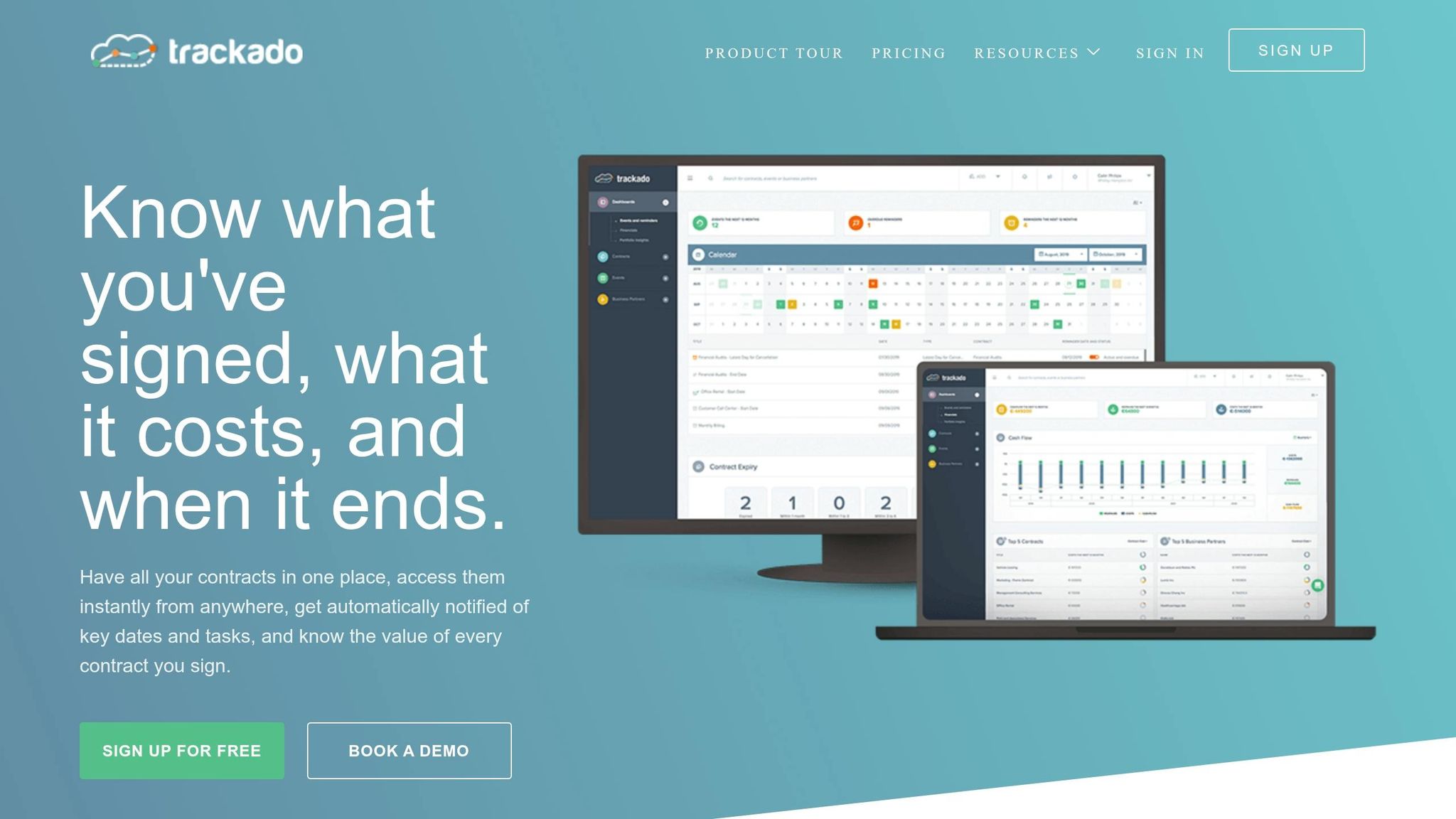
Trackado simplifies contract compliance for hospitality businesses by combining established management practices into a single, user-friendly platform. Designed for small to mid-sized operations, it centralizes handling of vendor, employment, and service agreements across multiple properties.
Centralized Repository and AI Metadata Extraction
Trackado brings all types of agreements – vendor, guest, employment, and franchise – into one secure, cloud-based repository. With AI-powered metadata extraction, it automatically identifies and organizes key clauses and data, making it easy for managers to quickly locate specific agreements. This setup helps prevent common compliance issues, such as missed renewal dates or unclear contract terms.
For businesses managing multiple properties, the platform offers corporate-level oversight, enabling teams to standardize terms across locations and identify duplicate vendors. Contracts can be categorized by property, department, or business unit. Security is a priority, with encryption, role-based access, and GDPR-compliant processing hosted in European data centers.
Automated Deadline and Obligation Tracking
Trackado doesn’t just store contracts – it actively tracks deadlines and obligations. It supports three main contract types: fixed term with renewal, fixed term without renewal, and open-ended agreements. Key fields, such as Start Date, End Date, Notice Term (for cancellations), and Prolongation Period (for automatic extensions), ensure all critical details are covered.
You can configure automated reminders by selecting the "Please remind the contract owner" option, ensuring notifications are sent well before cancellation deadlines. The system automatically updates contract statuses, marking agreements as "Expired" or triggering "Auto-prolongation" based on preset terms. Real-time status labels like "Active", "Pending", "In Negotiation", "Expired", and "Terminated" provide instant clarity on contract standings. Custom fields also allow tracking of hospitality-specific needs, such as health certifications, liquor licenses, and insurance renewals.
Customizable Workflows and E-Signing
Trackado’s approval workflows can be tailored to fit your organization’s risk management approach. For example, vendor contracts can be routed to specific departments for compliance checks, such as verifying food safety certifications or health permits, before final approval. Approval thresholds are easy to define: department managers might handle contracts under $5,000, while deals over $25,000 require sign-off from legal and the CFO.
Integrated e-signing features make contract execution faster and more efficient – especially useful for seasonal or temporary employment agreements during busy periods. automated workflows and digital audit trails provide clear proof of compliance for inspections, audits, and reviews by regulatory bodies. Standardized templates ensure all agreements meet required standards, like ADA accessibility, wage protections, and food safety regulations. With mobile access, executives can review and sign critical compliance documents from anywhere, ensuring nothing slips through the cracks.
Conclusion
Contract compliance in the hospitality industry goes beyond simply avoiding penalties – it’s about safeguarding revenue, ensuring smooth operations, and fostering trust with both guests and business partners. Poor contract management can result in serious revenue losses and operational disruptions. For hotels and resorts managing a variety of agreements – vendor contracts, employment terms, event bookings, or licensing requirements – these inefficiencies can mean missed opportunities and heightened risks.
Taking a proactive stance on contract management doesn’t just help dodge penalties; it also delivers measurable operational and financial benefits. The good news? Modern contract management doesn’t have to be overly complicated. Tools like centralized document storage, automated renewal reminders, and standardized templates can lay the groundwork for staying compliant. As Tim Cummins, President of World Commerce & Contracting, puts it:
Contracts are more than just legal safeguards; in many situations, they should be dynamic tools that support collaboration, mitigate risk, and create value.
Shifting from a reactive approach to a proactive one is what sets successful hospitality businesses apart from those constantly scrambling to address compliance issues.
Trackado offers a solution tailored specifically for small and mid-sized hospitality businesses. With features like AI-powered metadata extraction, automated notifications, and customizable workflows, the platform transforms contract management into a competitive advantage. Whether you’re overseeing a single property or managing contracts across multiple locations, Trackado ensures that nothing slips through the cracks.
FAQs
What clauses should I include in vendor contracts to comply with GDPR, CCPA, and PCI DSS?
To meet the requirements of GDPR, CCPA, and PCI DSS, your agreements should include detailed clauses covering data privacy, security, and processing responsibilities. Clearly outline how personal data is:
- Collected: Specify the methods and purposes for data collection.
- Used: Explain the intended uses of the data.
- Stored: Describe storage practices, including retention periods.
- Shared: Define conditions under which data may be shared with third parties.
It’s also crucial to include provisions on consent requirements, ensuring users are informed and provide explicit permission where necessary. Address breach notifications, detailing the timelines and processes for informing affected parties and authorities. For data transfer procedures, outline protocols for handling cross-border transfers, including compliance with international regulations.
For PCI DSS compliance, emphasize safeguards like encryption, access controls, and regular monitoring to protect payment data. Additionally, include terms that address:
- Liability for breaches: Define responsibilities and penalties in the event of a data breach.
- Cross-border data transfers: Ensure compliance with applicable laws when transferring data internationally.
- Data return or destruction: Specify how data will be securely returned or destroyed when the contract ends.
These measures not only ensure compliance but also build trust with stakeholders by demonstrating a commitment to protecting sensitive information.
How can I prevent auto-renewals and missed notice deadlines across multiple properties?
Missing deadlines or dealing with unexpected auto-renewals can cause unnecessary headaches. A contract management system can simplify this process by automating reminders and tracking key dates.
Here’s how it works: use a platform to centralize all your contracts in one place. Organize them into categories – like by partner or department – so they’re easy to find. Then, set up alerts for important dates, such as renewal periods or expiration deadlines.
Don’t forget to regularly update your contract data. Keeping everything current ensures your deadlines are accurate and nothing slips through the cracks. With automation in place, you can stay compliant and avoid costly oversights across all your properties.
What’s the fastest way to audit licenses, permits, and insurance certificates for compliance?
The quickest way to review these documents is by using a contract management tool to keep everything centralized and well-organized. For instance, tools like Trackado can handle tasks like automating reminders, tracking renewal dates, and simplifying compliance checks.
If you’d rather go the manual route, start by collecting all your documents in one location. Then, check for compliance standards, confirm expiration dates, and set up regular audits to ensure nothing falls through the cracks. Adding automated alerts to your system can make this process even easier.