Contract analytics transforms complex contracts into structured, searchable data, helping businesses cut costs and improve financial planning. By centralizing contracts and using AI to track key details like renewal dates, payment terms, and pricing, companies can avoid common pitfalls like missed renewals, overpayments, and unused services. Here’s how it works:
- Avoid Missed Renewals: Auto-renewals with price hikes can quietly inflate costs. Alerts ensure businesses renegotiate or cancel on time.
- Spot Overpayments: AI identifies billing errors, pricing inconsistencies, and missed discounts, saving thousands annually.
- Cut Redundant Services: Analytics reveal unused subscriptions or overlapping contracts, reducing waste by 10–30%.
- Streamline Processes: Automating workflows saves time and reduces administrative overhead, improving efficiency.
With tools like Trackado, businesses gain clear visibility into contract obligations, enabling better budgeting, smarter negotiations, and fewer financial surprises.
How Contract Analytics Reduces Business Costs: Key Statistics and Savings
Main Cost Drivers in Unmanaged Contracts
Missed Renewals and Auto-Renewals
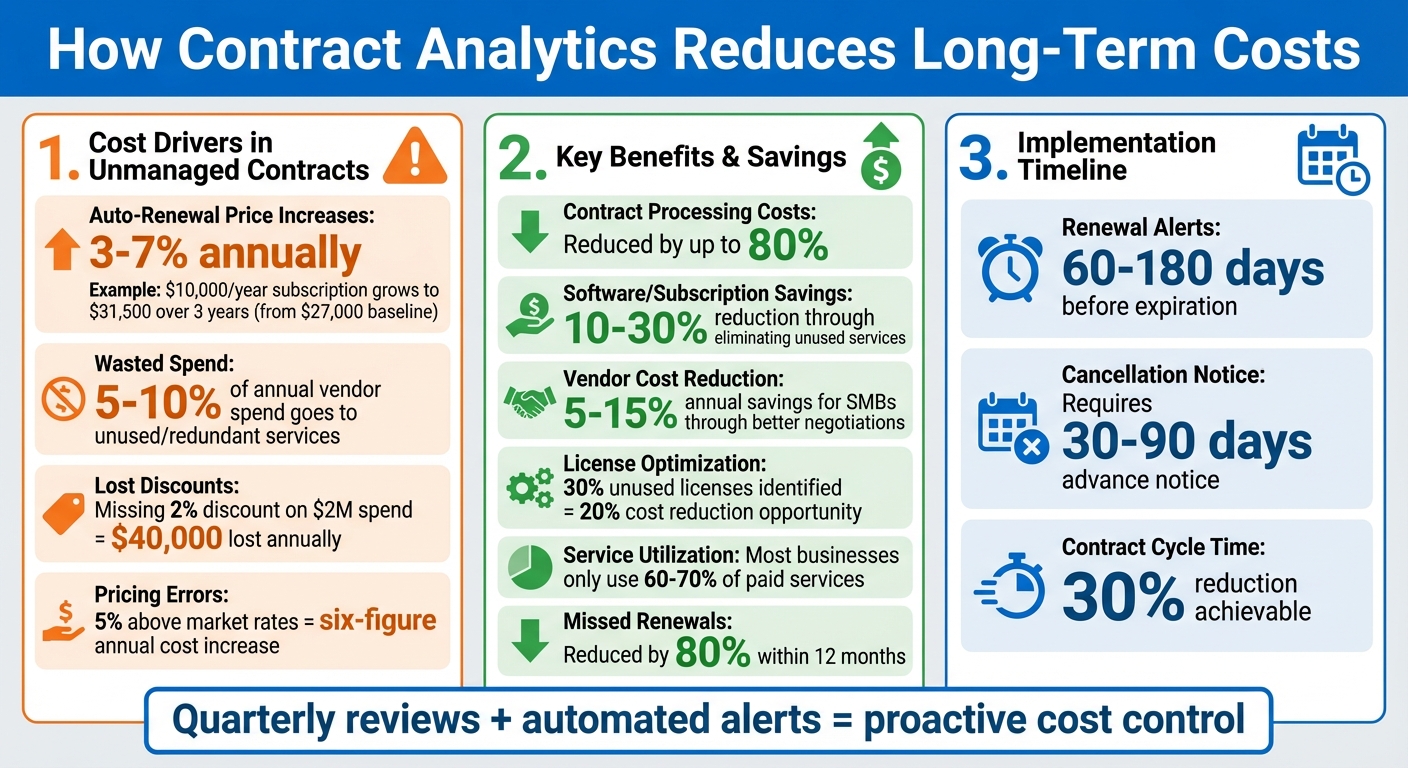
Without a centralized system to track contracts, auto-renewals can quietly extend agreements at higher rates, often with annual increases ranging from 3–7%. Many U.S. SaaS and service contracts require 30–90 days’ advance notice to cancel. Miss that window, and you’re locked into another term – sometimes for a year or longer. Take this example: a $10,000/year software subscription with a 5% annual price increase can grow from $27,000 to $31,500 over three years if left unchecked. For mid-sized businesses juggling 300–500 vendor agreements, 5–10% of their annual vendor spend often goes to unused or redundant services due to poor oversight. Pricing inconsistencies only add to the financial strain.
"Before using Trackado, managing our contracts was frustrating. We had a structure in place to store our contracts, but we didn’t have a nice overview which also gave us timely notifications of when they were expiring. This caused deals to renew or end automatically without us having the right infrastructure to avoid this from happening."
– Yiannis Karavassilis, COO, CloudKid
Lost Discounts and Pricing Errors
Missed opportunities for savings – like early-payment discounts, volume rebates, or tiered pricing – can lead to significant financial losses. For instance, failing to claim a 2% discount on $2,000,000 in spending translates to $40,000 lost annually. Similarly, paying just 5% above market rates could inflate costs by six figures each year. Billing errors, such as being charged higher-than-agreed rates or billed at on-demand pricing instead of discounted bundles, further chip away at savings. Tools that analyze contracts can help verify terms and prevent these costly mistakes.
Manual Processes and Administrative Overhead
Pricing issues aside, manual workflows bring hidden expenses of their own. Teams waste valuable hours searching through scattered contracts or re-entering data, which can add up to the equivalent of a full-time employee’s labor costs for companies managing hundreds of agreements. Beyond labor, inefficiencies in manual processes delay vendor onboarding, slow down time-to-market, and result in missed early-payment discounts due to approval bottlenecks. For example, if it takes an extra 30 days to finalize a revenue-generating contract because of manual routing, a business could delay tens of thousands of dollars in income – or accept less favorable terms to meet internal deadlines. Digitizing workflows with analytics tools streamlines these processes, saving time and money while speeding up approvals.
How Contract Analytics Reduces Long-Term Costs
Centralized Data for Complete Contract Visibility
When contracts are scattered across email inboxes, filing cabinets, and shared drives, staying on top of costs becomes a daunting challenge. By centralizing all contracts into a single, accessible repository, businesses gain instant access to critical details like payment terms, renewal dates, and financial obligations. This consolidation doesn’t just simplify access – it shines a light on inefficiencies, such as duplicate services or missed opportunities for volume discounts. With a clear view of financial commitments, companies can quickly identify and eliminate unused subscriptions or redundant agreements, ultimately making smarter spending decisions. Plus, this centralized setup creates the perfect starting point for using advanced AI tools to uncover actionable insights.
AI-Powered Insights for Cost Savings
AI tools take contract analysis to the next level by automatically extracting key details – like pricing, payment schedules, renewal terms, and discount clauses – from large volumes of documents. Using natural language processing, these tools compare contract terms against industry standards, highlighting areas like pricing inconsistencies or overlooked discount opportunities. For instance, AI can uncover early-payment discounts or flag unfavorable terms, potentially reducing contract processing costs by as much as 80%. Platforms like Trackado streamline this process by organizing extracted financial data into an easily analyzable format, freeing teams from time-consuming data entry and enabling them to focus on more strategic decisions. Beyond extraction, automation simplifies cost management even further with alerts and workflows.
Automated Alerts and Workflows
Automated alerts ensure you never miss critical deadlines, such as contract expirations or renewal windows. These timely notifications help businesses avoid unwanted renewals, penalties, or unfavorable auto-renewals. With these alerts, you can take a proactive approach – evaluating whether it’s better to renew, renegotiate, or terminate agreements. Automated workflows further enhance efficiency by routing contracts through approval chains without the need for manual follow-ups. This eliminates delays that could lead to missed early-payment discounts or stalled negotiations. By addressing compliance issues early and ensuring timely actions, businesses can minimize legal costs and consistently secure the most favorable contract terms.
Measurable Benefits of Contract Analytics
Better Renewal Negotiations
Contract analytics gives you a solid advantage when it’s time to renew. By sending alerts 60–180 days before a contract is up for renewal, you have plenty of time to review the vendor’s performance, assess how much of the service you’re actually using, and check current market rates. Instead of rushing through last-minute decisions or settling for automatic renewals that might not favor your business, you can negotiate with data-backed insights. For instance, if analytics reveal that 30% of your software licenses are unused, you can push for a 20% reduction in license volume, cutting your annual expenses significantly. Small and medium-sized businesses often see reductions of 5–15% in yearly vendor costs when they benchmark contracts and adjust terms. Tools like Trackado provide early alerts, making proactive contract reviews possible and improving your chances of securing better terms.
Elimination of Unused Services
Cutting costs can be as simple as identifying services that aren’t being fully used. Contract analytics helps by comparing actual usage to what’s outlined in your agreements. It can uncover things like inactive software licenses, overlapping subscriptions between departments, unused support tiers, or maintenance contracts for equipment you no longer have. Many businesses discover that they’re only utilizing 60–70% of what they’ve paid for, pointing to inefficiencies. By conducting quarterly reviews of service usage and canceling or resizing these agreements, companies can save 10–30% in software and subscription expenses. Tools like Trackado provide financial insights and track key milestones, helping you spot these inefficiencies and route cancellation decisions to the right stakeholders before renewal deadlines.
Improved Compliance and Risk Reduction
Overlooking a contractual obligation can be costly. Whether it’s penalties for not meeting minimum purchase volumes, service credits for missed SLAs, or regulatory fines tied to data protection clauses, the financial risks are real. Contract analytics automates the tracking of these obligations, sending alerts before deadlines or thresholds are missed. It also flags potentially risky clauses – like uncapped liability, unilateral termination rights, or aggressive auto-renewal terms – for legal review. Over time, this proactive monitoring minimizes late fees, disputes, and legal costs, while also ensuring smoother compliance with audit requirements.
"And Trackado also improves our audit processes! We are a subsidiary of a listed company, so our audit requirements are high and at a recent audit, when I was able to access Trackado and simply export a list of new contract partners for the year I knew we have made the right choice."
– Kieran Lynch, Head of Legal and Compliance, Rakuten Europe
These benefits demonstrate how contract analytics can deliver real cost savings, reduce risks, and streamline processes, making it a valuable tool for strategic financial planning.
sbb-itb-49df6ae
How to Implement Contract Analytics
Centralize and Digitize Contracts
The first step in implementing contract analytics is to centralize all your contracts. Start by gathering every agreement your company has – this includes all types of contracts. Organize them systematically by counterparty, department, contract type, and value in USD. For older, paper-based agreements, scan them into searchable PDFs and automatically pull key details like effective dates, expiration dates, renewal terms, total contract value, and payment terms.
Using a cloud-based repository ensures that everyone accesses the same, up-to-date contract data. Features like role-based access, audit trails, and encryption reduce administrative headaches and help avoid overlooked obligations. For instance, Trackado offers a centralized storage solution hosted in secure European data centers. It also includes automated reminders and financial insights into costs, revenues, and key dates. One of its standout features is the ability to email signed contracts directly to the platform, where they are automatically uploaded to the repository.
"The email-in feature is also something we use extensively, when our sales team confirms a new contract, they simply copy in the Trackado email address, and the contract is then uploaded directly to our repository."
– Daisy Miller, Project Coordinator, Zapmap
Once your digital repository is up and running, the next task is to set clear, measurable objectives.
Define Key Metrics and Goals
Establishing key metrics is crucial for effective contract management. Focus on tracking annual spend, renewal exposure, and discount realization. Other important metrics include contract cycle time, missed or auto-renewed contracts, and savings from canceling unused services.
Set specific, time-bound goals to measure success. For example: "reduce missed auto-renewals by 80% within 12 months" or "cut contract cycle time by 30%". Tie these key performance indicators (KPIs) to specific budget categories, such as IT subscriptions or professional services, so their impact is clearly reflected in your financial reports. Tools like Trackado allow you to monitor these metrics in real time through customizable fields and financial dashboards, making it easier to demonstrate cost savings and efficiency gains.
"With Trackado, we were able to analyze and draw insights from our contract library, seeing common types of contracts and being able to draw efficiencies from this."
– Peter Skeen, Head of Legal, Procurement and Company Secretarial, Good Energy
These metrics serve as the connection point between your contract data and your broader financial strategy.
Integrate Analytics with Financial Planning
The final step is integrating your contract data into your financial planning processes. By linking contract details – such as subscription fees and pricing terms – with your budgeting tools, you can base future cash flow projections on actual contract terms rather than rough estimates. This enables finance teams to model scenarios like renegotiating vendor contracts, consolidating suppliers, or taking advantage of early payment discounts, while immediately seeing the impact on operating expenses and EBITDA.
Dashboards that outline quarterly and annual contract obligations can significantly improve cash flow planning. Predictive analytics, based on vendor performance and historical spending, can highlight which contracts are likely to lead to cost overruns or savings. This information feeds directly into long-term forecasts and capital budgeting decisions. By aligning contract analytics with financial planning, businesses can address key cost drivers head-on. Tools like Trackado simplify this process by offering financial insights and milestone tracking, enabling U.S. small and medium-sized businesses to align their contract obligations with strategic financial goals – without needing to build custom systems.
"The moment we knew we had made the right choice with Trackado was when we received email notifications that gave us a heads-up when something was ending or renewing. This really helped us to keep on top of things and avoid sticky situations with partners we didn’t want to continue to work with."
– Yiannis Karavassilis, COO, CloudKid
Conclusion
Contract analytics has transformed the way organizations manage long-term costs by turning contract data into actionable insights. It provides businesses with a clear view of recurring expenses, upcoming renewals, and hidden cost drivers. These capabilities directly address challenges like missed renewals, lost discounts, and inefficiencies caused by manual processes.
The financial benefits are clear: reduced legal and administrative costs, better renewal negotiations, less wasteful spending, and fewer compliance issues. With accurate, contract-driven data, finance teams can confidently budget, forecast, and align obligations with strategic goals. This allows businesses to plan effectively in USD over multi-year periods, ensuring contracts contribute to ongoing cost control and protect profit margins.
When implemented effectively, contract analytics also simplifies financial planning. For small and medium-sized businesses in the U.S., tools like Trackado centralize contract management, automate reminders, and provide real-time financial insights – all in an easy-to-use, affordable platform. Starting with a small pilot in one or two departments can quickly highlight savings from renegotiated contracts, canceled unused services, and improved compliance.
Beyond cost savings, contract analytics strengthens negotiations, improves vendor relationships, and equips decision-makers with reliable data for strategic financial planning. Even small reductions in unused subscriptions or better renewal terms can easily outweigh the cost of implementing such tools, especially for businesses handling hundreds or thousands of contracts. By treating contract analytics as a smart investment in cost control, organizations can achieve stronger financial results and greater operational flexibility.
FAQs
How can contract analytics help avoid missed renewals and unnecessary costs?
Contract analytics keeps businesses ahead of crucial dates and responsibilities by providing automated reminders for milestones like contract renewals and payment deadlines. These reminders help ensure timely actions, reducing the risk of expensive mistakes like missed renewals or accidental overpayments.
By organizing all contract data in one place and offering clear insights into terms and timelines, these tools simplify the management of obligations and help prevent unexpected financial issues. This forward-thinking approach not only saves time but also helps cut down on unnecessary costs over time.
How does AI-powered contract analytics help businesses save money in the long run?
AI-driven contract analytics can help businesses cut costs over time by identifying overlooked opportunities for savings and offering detailed financial insights. These tools simplify tasks like monitoring contract renewals, tracking obligations, and staying on top of key deadlines, helping companies avoid extra expenses and penalties.
By taking over repetitive tasks and offering better financial transparency, AI-powered analytics support smarter decisions and more precise financial planning. This allows businesses to use their resources wisely and fine-tune their budgets for long-term efficiency.
How can businesses use contract analytics to improve financial planning?
Businesses can improve their financial planning by leveraging contract analytics to centralize and organize agreements. Tools like Trackado offer clear insights into billing details, critical dates, and milestones, helping businesses stay on top of obligations and renewal deadlines.
With automated reminders and contract data analysis, companies can identify ways to cut costs, prevent avoidable expenses, and align spending with their long-term financial objectives. This efficient method not only helps manage budgets but also supports more informed decision-making.