
Managing financial risks in contracts is critical for businesses of all sizes. Missed deadlines, overlooked clauses, or auto-renewals can lead to costly surprises. For example, failing to cancel a SaaS contract on time can result in $120,000 in unplanned expenses. Small and midsize businesses are particularly vulnerable due to reliance on manual tools like spreadsheets and email.
Here’s a quick breakdown of the 5 steps to reduce financial risk in contracts:
- Audit Contracts: Gather all active agreements, rank them by risk level (e.g., high-value over $100,000), and document key financial terms like payment deadlines and liability caps.
- Centralize Data: Use a digital repository to store contracts and enable automated deadline alerts and a contract renewal planner to avoid missed renewals or payments.
- Standardize Clauses: Create a library of approved financial terms (e.g., payment terms, liability caps) to ensure consistency and reduce disputes.
- Approval Workflows: Set up cross-team processes so legal, finance, and procurement teams can review contracts collaboratively, avoiding costly oversights.
- Monitor Risks: Regularly review contracts, track performance metrics like on-time payments, and maintain a risk log to address potential issues proactively.
Why it matters: Poor contract management can cost businesses up to 9.2% of their revenue annually. By following these steps, you can improve visibility, reduce risks, and protect your bottom line. Tools like Trackado simplify this process with features like automated reminders, centralized storage, and customizable tracking fields.
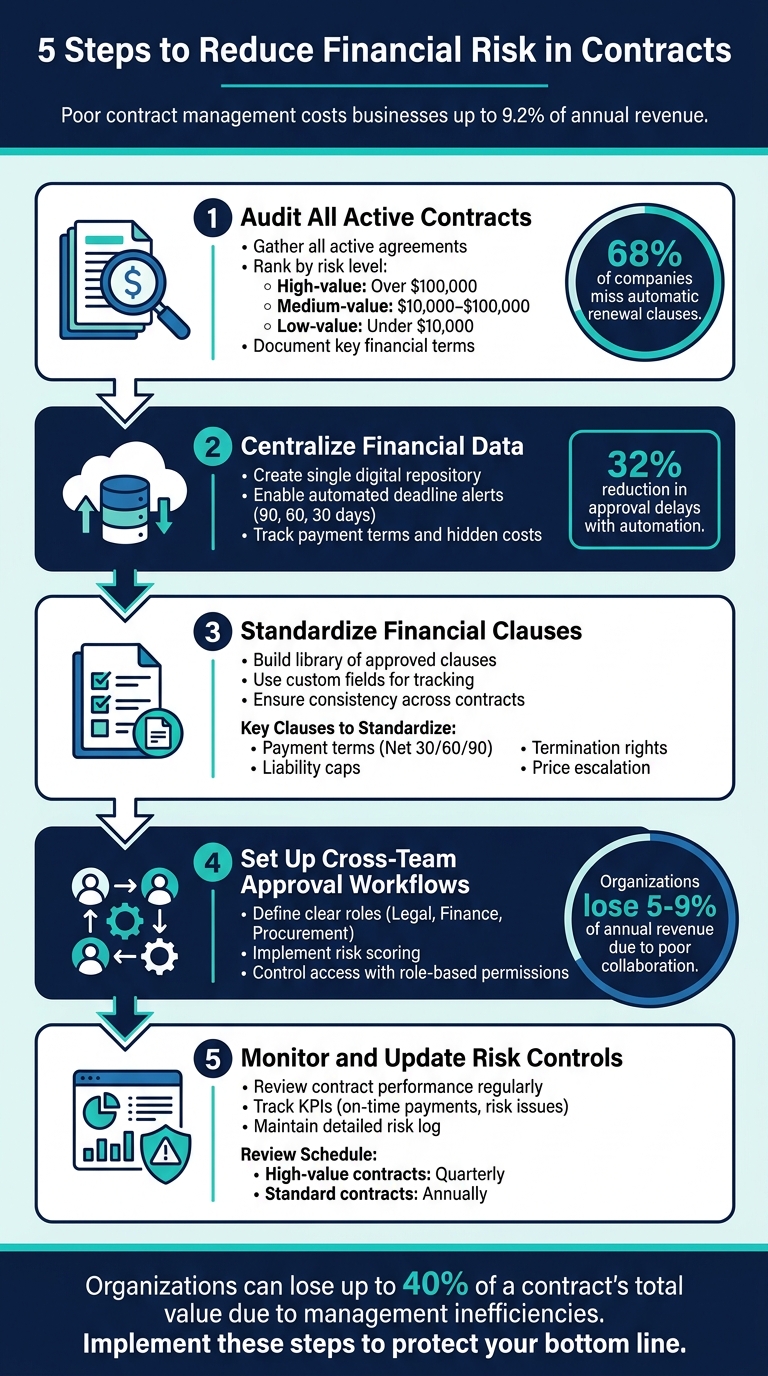
5 Steps to Reduce Financial Risk in Contracts
Step 1: Audit All Active Contracts
Start by gathering all your active contracts. When contracts are scattered across different locations, it increases risks and makes it harder to manage them effectively. Without a clear view of all your agreements, you could be exposed to hidden costs or unfavorable terms. In fact, management inefficiencies can lead organizations to lose up to 40% of a contract’s total value. This is why conducting a thorough audit is so important.
Collect every active contract your business is involved in – whether it’s vendor agreements, client contracts, leases, service agreements, or subscription renewals. Include both low-value and high-value agreements. Once you’ve centralized them, you can identify high-risk contracts and classify them. Documenting key financial details will help you take immediate action where needed.
Rank Contracts by Risk Level
Not all contracts pose the same level of financial risk. By categorizing your agreements, you can focus your time and resources on the ones that matter most. A straightforward way to do this is by classifying contracts based on their value:
- High-value: Over $100,000
- Medium-value: Between $10,000 and $100,000
- Low-value: Under $10,000
But don’t just look at dollar amounts. Other risk factors are just as critical. For example, contracts with automatic renewal clauses are often overlooked – 68% of companies miss these during reviews. You should also flag agreements with aggressive penalty terms or unlimited liability exposure, as these can lock you into unfavorable conditions. Using a simple risk matrix that evaluates both the likelihood and financial impact of risks (low, medium, high) can help you prioritize effectively.
Record Critical Financial Terms
After ranking your contracts, shift your focus to the financial terms that could directly impact your business. Pay attention to payment terms like "Net 30" and any early payment discounts offered.
Be on the lookout for hidden costs that might not be obvious initially. These could include setup fees, maintenance charges, or price increases linked to the Consumer Price Index (CPI). Another area to review is liability caps – 52% of organizations fail to notice when these are set too low, leaving them exposed to greater risks. Create a structured record that includes payment deadlines, penalty clauses, termination fees, and survival clauses that extend financial obligations beyond the contract’s term.
sbb-itb-49df6ae
Step 2: Centralize Financial Data in One Place
After auditing your contracts, the next logical step is to centralize them all in a single digital repository. When agreements are scattered across email inboxes, shared drives, and filing cabinets, it’s easy to lose track of critical financial details. By consolidating this information, you build on your audit findings and improve your ability to manage risks effectively.
A centralized digital repository becomes your single source of truth for all contracts. With everything in one place, you can monitor obligations through a single dashboard, eliminating the need for time-consuming manual searches. This improved visibility helps you identify potential risks – like unwanted auto-renewals or missed payment deadlines – before they become costly problems.
Modern contract management platforms offer more than just storage. Features like AI-powered metadata extraction can automatically pull out key financial details, such as payment amounts, due dates, and penalty clauses, without requiring you to comb through every page. Instead of dealing with unstructured PDFs, you’ll have searchable, structured data at your fingertips. For example, you could quickly locate all vendors with upcoming price increases by querying your contract portfolio – saving time and reducing the chance of oversights. Centralizing this data also lays the groundwork for proactive tools like automated deadline alerts.
Enable Automated Deadline Alerts
Missing a crucial contract deadline can be costly. Poor visibility into notice periods often results in unplanned expenses. Automated reminders solve this issue by notifying you well in advance of critical dates.
Set up multi-stage alerts – for example, 90, 60, and 30 days before a renewal or termination deadline. This approach gives your team enough time to assess the relationship, renegotiate terms, or decide to part ways. The same system works for payment deadlines, helping you avoid late fees and maintain strong vendor relationships. For instance, one business reduced approval delays by 32% after implementing automated reminders through their centralized contract platform. These alerts turn your contract repository into an active tool for managing financial risks.
Capture and Track Payment Terms
Centralizing contracts isn’t just about storage – it’s also about capturing the financial details that impact your cash flow and budget. This includes recording payment amounts, due dates (e.g., "Net 30"), early payment discounts, and price escalation clauses tied to inflation or other factors.
Use custom fields within your repository to track these terms consistently across all agreements. This structured approach eliminates the version confusion and errors that often occur when managing contracts in spreadsheets. Don’t overlook hidden costs like setup fees, maintenance charges, or termination penalties. Tools like Trackado allow you to organize contracts by partner, category, or department, while also tracking all relevant financial data in one place. This makes it easy to view your total financial exposure at a glance.
Step 3: Standardize Financial Clauses
After centralizing your contracts, the next step is to address inconsistencies in financial terms. Variations in how payment terms, liability caps, or termination rights are defined can introduce risks. Such inconsistencies lead to differing interpretations during reviews, creating compliance gaps and unpredictable outcomes. These inefficiencies can result in significant financial losses for organizations. With your data centralized, the focus should shift to standardizing clauses to reduce risks effectively.
By standardizing financial terms, you ensure your contracts align with your organization’s risk tolerance. This approach minimizes disputes caused by unclear language. For instance, in April 2021, the European Union sued AstraZeneca over COVID-19 vaccine delivery issues. The disagreement stemmed from the ambiguous phrase "best reasonable efforts" in their contract, which lacked clear, standardized service level agreements. This ambiguity led to legal battles, public criticism, and strained relationships.
Build a Library of Approved Clauses
Start by developing a centralized library of pre-approved language for your key financial clauses. This library ensures your contracts are consistent with your established risk policies. Focus on clauses that directly impact financial outcomes, such as:
- Payment terms (e.g., Net 30/60/90, late fees)
- Limitation of liability (caps based on contract value)
- Indemnification (responsibility for third-party claims)
- Termination rights (e.g., 30–90 days’ notice)
- Price escalation (e.g., CPI adjustments or renegotiation triggers)
Organize the library by contract type – such as SaaS, vendor, or employment agreements – since each carries unique financial risks. Include both preferred language for critical clauses and fallback options to streamline negotiations while maintaining your risk standards.
Use Custom Fields for Consistent Tracking
A clause library is only effective if contracts consistently use the approved language. This is where custom fields become essential. Instead of manually combing through PDFs, extract key financial terms into structured fields like "Notice Period", "Total Contract Value", "Liability Cap Amount", "Renewal Date", and "Price Escalation Percentage." This approach ensures uniformity and helps avoid "visibility failures", where critical dates or obligations are overlooked.
With nearly half (48%) of business agreements including automatic renewal clauses, tracking these terms across departments is crucial. Tools like Trackado allow you to use custom fields to organize contracts by partner, category, or department. This ensures that every agreement captures the same financial data points. You can generate reports to monitor total committed spend or identify contracts with liability caps below approved thresholds, transforming your repository into an active tool for managing financial risks.
Step 4: Set Up Cross-Team Approval Workflows
Standardized clauses are only effective if the right people are reviewing them. Poor collaboration between departments can lead to major financial oversights, with organizations losing 5% to 9% of their annual revenue due to inadequate contract management practices. When teams like finance, legal, and procurement operate in silos, critical risks often go unnoticed. For instance, a legal team might approve liability terms without considering their financial impact, while finance could overlook compliance issues buried in payment clauses.
The fix? Establish cross-functional approval workflows to ensure that every financial obligation is reviewed by the appropriate stakeholders before any contract is signed. This isn’t about creating unnecessary red tape – it’s about avoiding costly mistakes. When finance and legal teams operate in silos, risks go unnoticed and deals slow down, critical financial obligations can be approved without the right eyes ever seeing them.
Create Clear Approval Processes
Once you’ve standardized financial terms, it’s essential to have the right people reviewing them. Start by defining clear roles and responsibilities. Legal teams should focus on compliance and liability, while finance teams handle penalty clauses, payment terms, and budget implications. Procurement and operations can step in to identify workflow risks and assess vendor feasibility. A RACI framework can help clarify roles: for example, the finance manager might be Responsible for reviewing payment terms, the CFO Accountable for final approval, procurement Consulted for vendor history, and sales Informed once the process is complete.
For more complex contracts, implement risk scoring to determine the level of review required. High-value agreements or those with unusual financial terms should automatically trigger senior-level review. Centralized platforms can further streamline this process by ensuring all teams work from the same, up-to-date contract version in real time.
Control Access to Financial Data
To minimize errors and unauthorized changes, limit access to sensitive contract details. Role-based permissions allow only the relevant stakeholders to review critical financial obligations. This approach not only protects sensitive data but also reduces delays. For example, finance teams can be granted direct read access to contract repositories, enabling them to retrieve data for forecasting and audits without waiting on legal.
Contracts exceeding $50,000 or containing non-standard terms should automatically be routed to the CFO for review. Controlled access also creates a detailed audit trail, which is crucial for maintaining accuracy and compliance. Automating this transparency helps reduce reliance on manual oversight and ensures that risk controls remain up to date. With these measures in place, your team is better equipped to manage financial risks effectively.
Step 5: Monitor and Update Risk Controls
Once you’ve implemented your audit process, centralized contracts, standardized terms, and established cross-team workflows, the next step is to ensure ongoing vigilance. Risk management doesn’t end when a contract is signed – it’s a continuous process. Without consistent oversight, post-signature inefficiencies can lead to costly consequences. Many organizations mistakenly treat risk assessment as a one-off task, but shifting business conditions and changing regulations can quickly turn once-acceptable terms into potential liabilities.
The key to avoiding this is continuous monitoring. Contracts should be reviewed at various stages – before signing, at renewal, and during scheduled audits. For high-value agreements (those over $100,000), quarterly reassessments are ideal. Standard contracts, on the other hand, typically require annual reviews or updates when regulatory changes occur. Additionally, contracts should be revisited whenever your business model evolves or after significant amendments.
Review Contract Performance Regularly
It’s essential to keep an eye on contract performance using clear KPIs. Metrics like on-time payments, the number of risk issues by contract type, and the percentage of agreements needing legal review are crucial. Alerts for key triggers – such as price changes, notice periods, and expiration dates – help prevent surprises. This is especially critical since 68% of companies often miss automatic renewal clauses during reviews.
A risk matrix can help you prioritize issues by categorizing them as Critical, High, Medium, or Low based on their likelihood and potential impact. Critical risks should be addressed immediately, while lower-level risks can be documented and monitored. This structured approach enhances the contract controls you’ve already put in place.
"Using the scorecards, you can consolidate individual scores into a worksheet and report on your risk profile over time, by product, by deal size, or other metrics important to your leadership team." – Hebe Doneski, Founder, 108 Legal PLLC
Maintain a Risk Log
To ensure no risks are overlooked, maintaining a detailed risk log is essential. This centralized log serves as a single source for tracking all identified risks. Each entry should include the severity rating, mitigation actions taken, reasons for accepting any residual risk, and a clear monitoring plan. Assign accountability by specifying who is responsible for managing each risk. This not only ensures follow-through but also provides a defensible audit trail for contract compliance reviews or disputes.
The risk log should be updated regularly – during contract renewals, after material amendments, or when new regulations come into play. Be sure to track financial triggers like CPI adjustments, automatic price increases, currency exchange rate changes, payment terms (e.g., Net 30/60/90), hidden fees, and uncapped liability exposures. Tools like Trackado can streamline this process by automating risk tracking with customizable fields and deadline reminders. This ensures critical dates and obligations are never missed. Additionally, logging every change creates a reliable audit trail for future reference.
Conclusion
Managing financial risk in contracts isn’t something you can set and forget – it’s an ongoing effort that demands structure, clarity, and accountability. The process involves five key steps: auditing, centralizing, standardizing, streamlining approvals, and monitoring. Together, these steps create a solid framework for minimizing risk. Auditing uncovers current vulnerabilities, centralization provides the visibility to address them, standardization ensures consistency during drafting, automated workflows maintain proper oversight, and monitoring helps catch performance issues before they escalate into costly problems.
The risks of inefficiency are too big to ignore. Poor contract management can lead to significant financial losses, making a structured approach essential. Beyond avoiding losses, businesses that tackle these risks often see impressive efficiency improvements. For instance, companies using automated workflows report an 80% reduction in contract processing times and 32% fewer delays in approvals.
"Before using Trackado, managing contracts without a proper solution was frustrating and inconsistent. We used a spreadsheet, which made it difficult to gain any insights or analysis from the data. There was also little central legal team oversight of key contract dates. With Trackado, we were able to analyze and draw insights from our contract library – it proved to be the right choice for our business." – Peter Skeen, Head of Legal, Procurement and Company Secretarial, Good Energy
Modern tools like Trackado make this process more accessible, especially for small and mid-sized businesses. Trackado offers features like centralized contract storage, automated reminders for deadlines, customizable fields for tracking financial terms, approval workflows, and AI-driven metadata extraction. These tools allow businesses to gain control over contracts in days rather than months. Whether you’re organizing 15 contracts on a free plan or managing hundreds on an enterprise tier, Trackado helps transform contracts from potential liabilities into well-managed assets.
FAQs
Which contracts should I audit first?
When tackling contract audits, start by focusing on agreements that pose the greatest financial or compliance risks. These might include high-value contracts, those containing risk-heavy clauses, or ones approaching renewal or expiration.
Begin with an initial assessment to uncover potential vulnerabilities. From there, rank contracts by their risk level so you can address the most critical ones first. A detailed review of these high-priority agreements helps minimize financial risks and ensures compliance, setting a solid foundation for better contract management.
What contract dates and money terms should I track?
To stay on top of contracts, it’s crucial to keep an eye on important dates like renewals, expirations, and milestone deadlines. Missing these can lead to unwanted automatic renewals or overlooked actions. Also, pay close attention to financial terms – things like payment schedules, due dates, and compliance deadlines. Missing a payment or failing to meet a compliance requirement can lead to costly breaches. By actively monitoring these details, you can minimize risks tied to cash flow, compliance, and contract obligations.
How often should I review contract risk after signing?
It’s crucial to keep an eye on contract risks even after the ink has dried. While there’s no hard rule about how often to do this, taking a proactive stance is key. Regular reviews help you spot emerging risks, ensure compliance stays on track, and update your strategies to handle potential issues. This approach not only aligns with smart risk management practices but also helps protect your business from surprises down the road.