
Hotels often lose control over their budgets due to unclear vendor pricing. Supplier cost transparency is the solution, offering clarity in pricing, fees, and contract terms. Without it, costs can rise by 10–15% due to disputes or delays. Here’s what you need to know:
- Opaque pricing models bundle costs, hiding details and making negotiation difficult.
- Partial transparency models disclose base costs but often leave surcharges unexplained.
- High transparency models provide full visibility, including contract terms, performance metrics, and detailed pricing data.
Key takeaway: Greater transparency leads to better cost management, stronger vendor relationships, and potential savings of 20–40%. However, achieving high transparency requires significant effort, including contract renegotiation and data management.
| Model | Cost Visibility | Negotiation Power | Budget Predictability | Implementation Effort |
|---|---|---|---|---|
| Opaque | Low | Low | Poor | Low |
| Partial Transparency | Moderate | Moderate | Moderate | Moderate |
| High Transparency | High | High | High | High |
Actionable tip: Start with unbundled pricing and centralized contract management tools like Trackado to streamline processes and reduce errors.
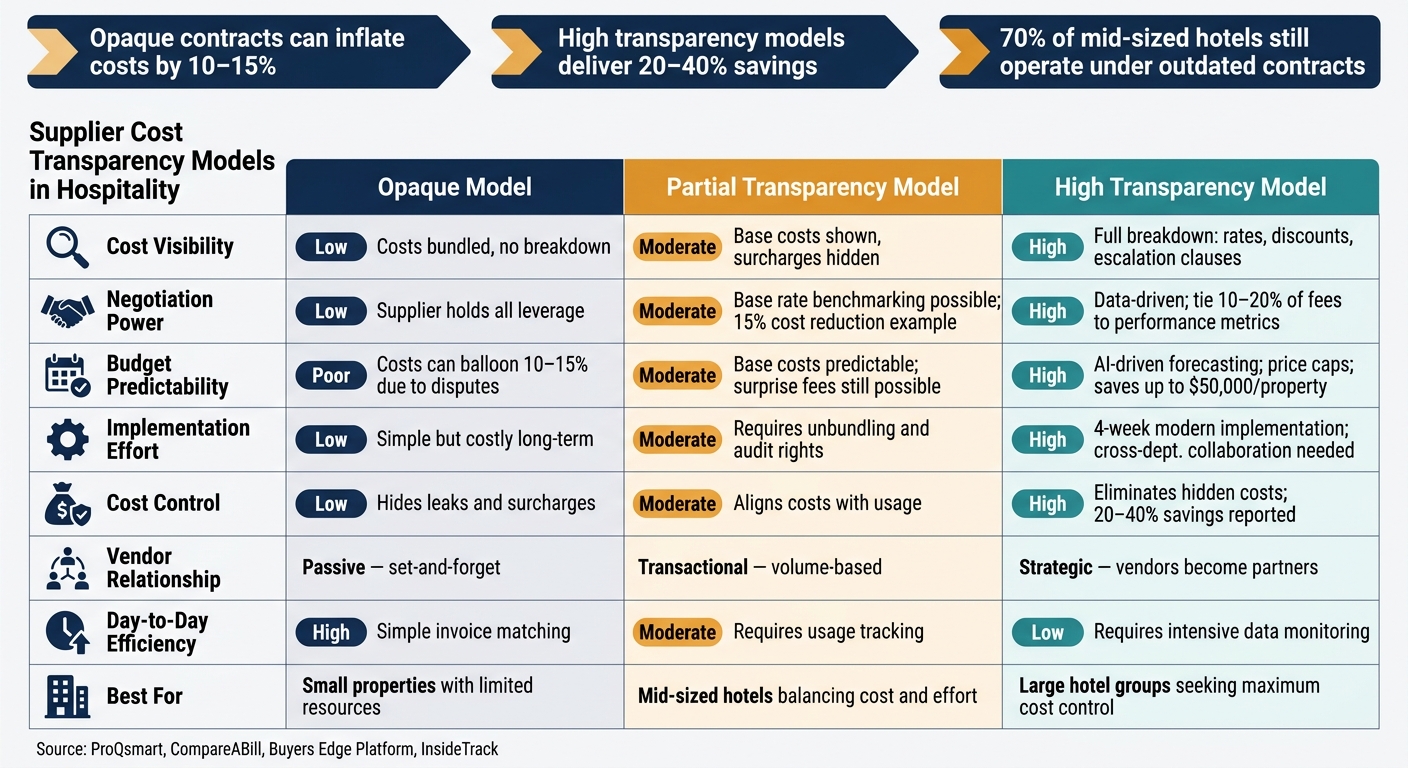
Supplier Cost Transparency Models in Hospitality: A Side-by-Side Comparison
1. Opaque Pricing Models
An opaque pricing model is when vendors provide a total price without breaking down the individual components of the costs. Essentially, everything is bundled together, leaving the finer details hidden.
Cost Visibility
This lack of transparency is a major drawback. Imagine receiving an invoice labeled simply as “food service management” or “facilities maintenance” with no further breakdown. It’s nearly impossible to tell if there are hidden fees, markups, or surcharges buried in that single figure.
Ambiguous terms in supplier contracts show up in many forms: unclear delivery dates, vague product specifications, or undefined responsibilities for each party, all of which make it harder to hold vendors accountable or dispute unexpected charges.
Without a clear breakdown of costs, procurement teams are left in the dark. They can’t compare prices effectively or identify overcharges before it’s too late. This lack of detail also makes it harder for hotels to negotiate better terms.
Negotiation Power
When cost structures are unclear, hotels lose leverage in negotiations. If you don’t know what makes up the total price, how can you challenge it? This puts suppliers in a stronger position, making it easier for them to dictate terms. Without transparency, buyers are left at a disadvantage during contract renewals or pricing discussions.
Budget Predictability
Opaque pricing also complicates financial planning. Unexpected fluctuations in charges from one billing cycle to the next often come with little to no explanation. In fact, ambiguous contract terms can lead to project costs ballooning by 10–15% due to disputes and delays. This kind of uncertainty increases operational risk and disrupts budget predictability.
Implementation Effort
On top of the hidden costs, opaque models create extra work for hotel teams. Without clear pricing details, staff must conduct time-consuming manual audits. This involves cross-referencing purchase orders, chasing down explanations for unexpected charges, and trying to piece together the actual costs. For properties managing dozens of vendor contracts, this administrative burden quickly adds up.
Without centralized oversight, opportunities for strategic procurement and cost benchmarking are lost and the same pricing errors recur across every renewal cycle.
Opaque pricing models not only obscure the true costs but also drain time and resources, making them a less-than-ideal choice for efficient hotel management.
sbb-itb-49df6ae
2. Partial Transparency Models
Partial transparency pricing models aim to address some of the challenges of opaque pricing. These models disclose core costs, like base rates, but still keep certain charges – such as markups and surcharges – hidden.
Cost Visibility
With partial transparency, businesses gain insight into core service costs, though additional fees often remain unclear. For example, a vendor might disclose the base price for linen services but include handling fees or fuel surcharges as separate, unexplained charges. While this approach offers more clarity than bundled pricing, the undisclosed fees can still create confusion.
Without visibility into base costs and surcharges, pricing errors and inefficiencies often go unnoticed, directly impacting profitability across every property.
Negotiation Power
Having access to base pricing gives hotels the ability to compare rates against market benchmarks and negotiate better deals. For instance, one multi-property hotel chain successfully reduced vendor costs by 15% through this approach. This transparency enhances bargaining power and supports more precise budgeting.
Budget Predictability
Partial transparency improves forecasting by making base costs more predictable. However, unexpected fees can still surface during a contract’s term. To mitigate this, hotels can negotiate pass-through clauses that require vendors to obtain approval before adding third-party costs. Additionally, including renewal-price caps tied to the Consumer Price Index (CPI) or fixed percentages can help finance teams plan with greater confidence.
Implementation Effort
Shifting to a partial transparency model requires considerable effort. A major hurdle is unbundling costs – convincing vendors to separate software, support, labor, and materials into individual line items rather than a single, consolidated charge. To ensure compliance, hotels should secure audit rights to verify that vendors adhere to agreed pricing terms. Many existing contracts lack cost breakdowns, making this transition a complex but necessary step for hotels seeking clearer cost structures.
3. High Transparency Models
Taking the idea of partial transparency further, high transparency models go beyond clarifying costs – they also enhance control over contracts. These models disclose every detail, including negotiated rates, invoiced amounts, escalation clauses, volume discounts, vendor performance metrics, and renewal terms. With all vendor records stored in a single, searchable repository, teams gain a comprehensive view of their procurement landscape.
Cost Visibility
High transparency allows direct comparisons between agreed pricing and invoiced amounts. This level of clarity helps operators spot pricing changes caused by factors like pack size adjustments, product substitutions, or gradual rate increases that might otherwise slip through the cracks. It also highlights unauthorized spending, where individual properties bypass approved agreements and pay higher costs.
"In hospitality, the difference between good procurement and great procurement is visibility." – Melissa Evans, Content Marketing Manager, Buyers Edge Platform
The table below provides an overview of the data typically disclosed in high transparency models:
| Data Category | What Gets Disclosed |
|---|---|
| Pricing Data | Negotiated vs. invoiced rates, price escalation clauses, volume discounts, commodity benchmarks |
| Vendor Performance | On-time delivery rates, quality scores, SLA compliance, issue resolution speed |
| Contract Terms | Auto-renewal dates, termination notice periods, force majeure provisions |
| Operational Data | Product specifications, delivery frequency, minimum order requirements |
This detailed data shifts procurement from relying on estimates to making precise, informed decisions.
Negotiation Power
When cost comparisons across multiple properties are easily accessible, negotiations become data-driven rather than speculative. For instance, if bandwidth costs vary significantly – say $2,000 at one property versus $1,200 at another – this discrepancy becomes a strong point of leverage. High transparency also allows businesses to connect 10–20% of annual vendor fees to measurable performance indicators, such as maintaining 99.9% system availability. If these targets aren’t met, it provides a clear basis for renegotiation.
This approach doesn’t just enhance negotiation power; it also improves financial planning.
Budget Predictability
By providing insight into price escalation clauses and annual adjustment terms, high transparency enables finance teams to forecast expenses more accurately. Tools like Trackado centralize contract data and automate renewal alerts, ensuring that critical details – like a linen vendor’s 12% auto-renewal price hike – don’t go unnoticed. This kind of tracking can surface significant savings, particularly on high-value or auto-renewing vendor agreements that would otherwise roll over without review.
Implementation Effort
Adopting a high transparency model requires significant effort. Teams must clean up legacy contract data, train staff on new processes, and renegotiate contracts to include unbundled pricing and audit rights. Success depends on collaboration across legal, finance, procurement, and operations teams. Despite the challenges, the payoff is substantial. Modern platforms can be implemented in as little as four weeks, compared to six months for older systems. Companies that complete the transition often report savings of 20–40% through better sourcing practices and reduced pricing errors.
Pros and Cons
Every transparency model comes with its own set of trade-offs. The best choice depends on factors like property size, staff resources, and the complexity of operations. Here’s a breakdown of the key differences between the models:
| Feature | Opaque (Fixed/Flat) | Partial (Unit/Variable) | High Transparency (Performance/TCO) |
|---|---|---|---|
| Cost Predictability | High; fixed monthly expenses | Moderate; fluctuates with occupancy | Low; tied to specific outcomes/savings |
| Cost Control | Low; hides leaks and surcharges | Moderate; aligns costs with usage | High; eliminates hidden costs and aligns incentives |
| Vendor Relationship | Passive; "set-and-forget" | Transactional; based on volume | Strategic; vendors become partners in success |
| Day-to-Day Efficiency | High; simple invoice matching | Moderate; requires usage tracking | Low; requires intensive data monitoring and audits |
| Budget Predictability | Poor; vulnerable to hidden leaks | Moderate; better renewal tracking | High; AI-driven forecasting and price caps |
Opaque models are straightforward for daily operations but often conceal pricing issues that can quietly erode profits. As InsideTrack explains:
"Many margin leaks don’t come from obvious cost spikes. They come from small pricing errors, contract terms that aren’t enforced, or locations buying outside approved agreements."
Partial transparency strikes a balance. Costs are more closely tied to actual usage, which is helpful during periods of low occupancy. However, managing this model across multiple departments can lead to inconsistencies in pricing within the same property group.
High transparency models provide the most control over costs but require significant effort, including cross-department collaboration, staff training, and thorough data management. Companies that adopt this approach often report savings of 20–40% by improving sourcing practices and reducing pricing errors. Tools like Trackado simplify this process by centralizing contract data, using a contract renewal planner to automate reminders, and highlighting key terms for easier management.
In an industry where small pricing changes can significantly impact margins, vendor contract optimization is one of the most powerful – and most underused – levers available to hotel leaders.
These insights provide a foundation for making informed decisions about managing supplier contracts in the hospitality sector.
Conclusion
Looking at opaque, partial, and high-transparency models, one takeaway stands out: greater visibility into vendor contracts means greater control over costs. Hidden clauses and outdated agreements quietly eat into revenue, with misaligned terms driving costs up by 10–15%. A significant share of hotel properties still operate under contracts that haven’t been reviewed or renegotiated in years, leaving money on the table at every renewal cycle.
How can hotels of different sizes act on this? Independent properties should start with 12–18 month pilot agreements that include clear exit clauses. Mid-sized hotels can streamline processes by automating renewals and auditing older contracts. Larger hotel groups, on the other hand, benefit from centralized contract repositories and tiered approval systems to catch pricing discrepancies before they snowball.
Across the board, one thing is essential: demand unbundled pricing from vendors. When software, support, implementation, and hardware costs are packaged together, it becomes nearly impossible to identify overcharges or inefficiencies.
For those ready to take action, tools like Trackado can make a huge difference. By centralizing contracts, automating reminders, and flagging critical terms, these platforms help teams shift from reactive contract management to proactive cost control.
"Visibility is the backbone of every effective hotel sourcing strategy. Without it, even the most well-negotiated contracts can lose value through inefficiency and non-compliance." – Joseph Friedmann, ReadyBid
FAQs
What contract terms often hide extra vendor costs?
Extra vendor costs often lurk in automatic renewal clauses, which can result in unnoticed price hikes or restrictive conditions. Contracts may also sneak in additional fees such as delivery charges, upgrade fees, fuel surcharges, or even environmental costs. Payment processors sometimes rely on blended rates, making it hard to pinpoint individual markups. Ambiguous terms, like market-based pricing without clear audit rights, add another layer of complexity when verifying costs. Tools like Trackado can make a difference by centralizing contracts and keeping tabs on financial obligations across multiple properties.
How do I get suppliers to agree to unbundled pricing and audit rights?
To get unbundled pricing, ask for a clear breakdown of costs for things like software, hardware, support, and implementation. Make sure to include pass-through clauses for third-party expenses and establish pre-approval limits for these charges.
When it comes to audit rights, your contract should outline reporting requirements, allow audit access, and set clear performance standards. Stay away from unclear terms like "market-based pricing." Using a centralized tool such as Trackado can simplify managing obligations, keeping track of important dates, and staying prepared for audits.
What’s the fastest way to centralize hotel vendor contracts and renewal dates?
The fastest way to organize and manage hotel vendor contracts and renewal dates is by using a contract management platform like Trackado. This tool allows you to create a searchable digital repository for all agreements, making it easy to find what you need. It also automates important tasks like tracking renewal dates, payment terms, and obligations. Plus, with proactive alerts for upcoming expirations, your team can stay ahead of deadlines, simplify operations, and keep tighter control over budgets and vendor relationships.