
If you run hotel vendor contracts in spreadsheets, you are leaving room for missed deadlines, price gaps, and file chaos. I’d fix it with shared contract management software, one owner per contract, and renewal reminders at 120, 90, and 30 days before notice dates.
Here’s the short version:
- I’d keep all vendor contracts in one place across every property.
- I’d sort each contract by department and risk.
- I’d track the terms that hit cost, liability, service, and data.
- I’d assign one named person to each contract.
- I’d use standard fields for dates, notice deadlines, SLAs, insurance, and annual spend.
- I’d review vendor performance and invoices before renewal.
- I’d use shared templates and playbooks to cut repeat work across properties.
A few numbers show why this matters. One survey found 56% of in-house lawyers said their company had missed an automatic renewal, and 46% had done so in the prior 12 months. Another estimate puts revenue lost from poor contract management at 9.2% a year.
The contracts I’d watch most closely in hotels are:
- F&B
- Laundry and linen
- Maintenance and facilities
- Insurance
- Hotel tech
These categories do not carry the same risk. For example, a laundry rate of $0.90 per pound affects daily cost, while an insurance policy with a 60-day cancellation notice can create legal trouble if nobody tracks it.
A fast way to think about it:
| Contract Type | What I’d Watch First | Main Risk |
|---|---|---|
| F&B | Pricing, delivery windows, substitutions | Cost and guest impact |
| Laundry/linen | Turnaround time, par levels, shrinkage | Room readiness and cost |
| Maintenance | Response times, PM schedules | Safety and uptime |
| Insurance | COIs, additional insured status, notice dates | Liability and compliance |
| Tech | Uptime, data terms, auto-renewal, exit terms | Data, downtime, and lock-in |
Bottom line: if I were managing a hotel portfolio, I’d treat the notice deadline as the control point and build the whole process around it.
The rest of the guide shows how I’d set that up in a plain, repeatable way across 1–25 U.S. hotel properties.
Categorize hotel vendor contracts by department and risk level
Once your contracts are in one place, sort them by department and risk.
That matters because not every vendor agreement needs the same level of review. Start by grouping contracts by department: F&B, Rooms/Housekeeping, Engineering/Facilities, IT/Technology, and Risk/Finance. Then tag each one by its main risk type:
- guest experience impact
- safety or liability exposure
- financial exposure
- data and privacy risk
This gives hotel teams a clearer view of what needs an operational review, what should go to legal, and what needs a portfolio-level review.
F&B, laundry, and maintenance contracts: terms that affect daily operations
These contracts shape day-to-day hotel operations. The language in them doesn’t just sit on paper. It affects service, staffing, costs, and guest satisfaction.
For F&B agreements, pay close attention to delivery windows, minimum order volumes, price escalators, service levels, product substitutions, returns or shrinkage allowances, and penalties for missed deliveries.
With laundry and linen contracts, the stakes are just as direct. Terms like par levels, turnaround times, minimum charges, shrinkage allowances, and volume discount tiers can affect room readiness and cost control. If those thresholds aren’t spelled out, it becomes much harder to challenge overbilling or poor service.
Maintenance and facilities contracts need close review around emergency response language. The agreement should set response and resolution times for emergency, urgent, and routine issues. In hotel operations, emergency response for critical systems such as elevators and fire safety equipment is often set at 2–4 hours, while non-critical equipment may allow 24–48 hours. Preventive maintenance schedules for systems like elevators, HVAC, fire suppression, and kitchen equipment should also appear in the contract itself, rather than being handled through side conversations or informal habits.
Insurance and technology contracts: compliance, liability, and data obligations
Some contracts create less day-to-day friction, but the downside can be much worse if the terms are off.
For insurance, track the policy period, coverage limits, certificates of insurance (COIs), additional insured status, indemnification language, waivers of subrogation, and cancellation notice terms. For vendors working on-site, hotels commonly require $1M–$5M per occurrence in general liability coverage, with the hotel named as an additional insured using CG 20 10 and CG 20 37 endorsements, plus primary and non-contributory wording. If a vendor’s COI expires and an incident happens, the hotel may end up carrying liability it didn’t plan for.
Technology contracts bring a different set of risks. Track uptime commitments, support hours, implementation milestones, and data security duties. That includes who owns the data, whether the vendor can subcontract processing, and what happens to the data when the relationship ends. Also review breach notification timelines, termination rights, and data return or deletion procedures at contract end. With multi-year subscriptions, auto-renewal windows and early termination rights need extra attention, often requiring a contract renewal planner to stay on schedule. Miss that window, and a property can get stuck paying for a system that no longer fits.
| Contract Category | Primary Risk Type | Key Terms to Track |
|---|---|---|
| F&B supply | Guest experience, financial | Price escalators, substitution rules, missed-delivery penalties |
| Laundry/linen | Room readiness, financial | Turnaround times, shrinkage allowances, volume tiers |
| Maintenance/facilities | Safety, uptime | Response tiers, resolution times, PM schedules |
| Insurance | Liability, compliance | COIs, additional insured status, cancellation notice |
| Technology | Data, compliance, uptime | Uptime SLAs, breach notification, termination and data return rights |
sbb-itb-49df6ae
Build a centralized contract system for multi-property hotel teams
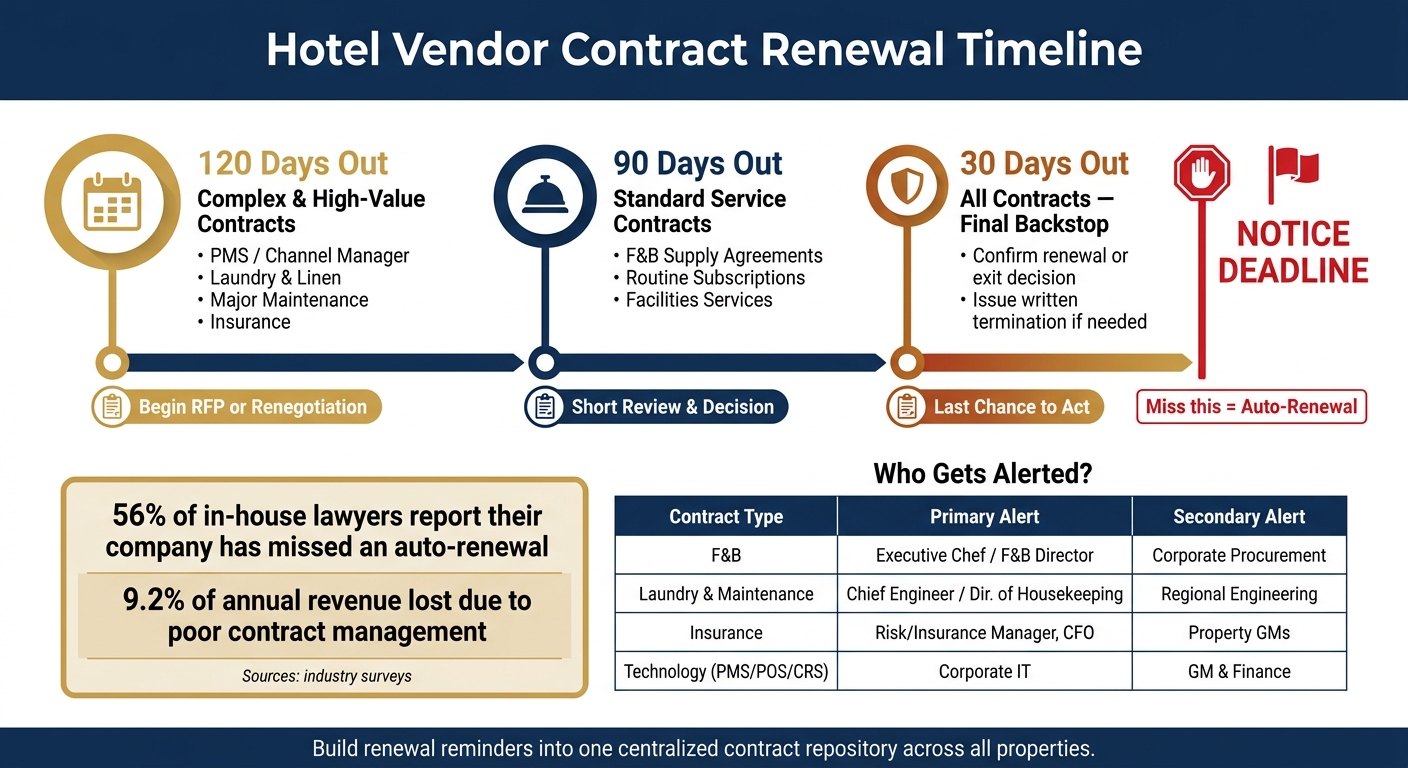
Hotel Vendor Contract Renewal Timeline: 120-90-30 Day Framework
Department and risk tags only help when they live in one shared contract system. If contracts sit across property drives, email threads, and local folders, teams lose time and miss deadlines.
Set up one contract repository with standard fields across every property
Use one portfolio repository that each property updates and corporate can search. Those fields power renewal alerts, owner assignment, and reporting. They also give regional teams one view of spend, obligations, and renewals across the full portfolio.
At a minimum, standardize these fields across every property:
- Vendor name: Legal entity name exactly as it appears on the contract, plus a consistent internal ID. For example, "ABC Linen Services LLC" vs. "ABC Linen – Miami".
- Department: Use a controlled list, such as F&B, Housekeeping/Laundry, Engineering/Maintenance, IT/Technology, and Insurance/Risk.
- Property: Standardized property code and full name. For example, "HOU01 – Houston Downtown Hotel".
- Contract start and end dates: Use MM/DD/YYYY across the portfolio, and define whether dates reflect service start or signature date.
- Notice deadline: Store the actual calendar date, not a formula.
- Auto-renewal status: Yes/no, plus renewal term length. For example, "12 months; auto-renews unless terminated in writing".
- Annual value (USD): Fixed or variable spend in U.S. dollars for portfolio reporting.
- Insurance expiry: COI expiration dates for general liability, liquor liability, workers’ comp, and any other required coverage.
- SLA terms: Response times, uptime targets, and delivery frequency stored as structured fields.
- Assigned owner: One named person who is responsible for the contract.
Trackado supports this setup with a centralized repository, customizable fields, assistive AI for metadata extraction, and category filters for portfolio reporting.
Set up renewal tracking and notice reminders before contracts roll over
Once the repository is in place, shift to deadline control.
Most missed renewals happen because reminders fail, not because teams meant to let a contract roll. The fix is a renewal calendar with tiered lead times. Use 120 days for complex or high-value contracts like PMS, channel manager, laundry, major maintenance, and insurance, where renegotiation or an RFP may take time. Use 90 days for standard service contracts and subscriptions where a short review is enough. Use 30 days as a last backstop before the notice deadline passes.
Who gets the alert matters just as much as timing. F&B vendor renewals should go to the Executive Chef or F&B Director, the property GM, and corporate procurement for major supply or distribution agreements. Laundry and maintenance renewals should go to the Chief Engineer or Director of Housekeeping, plus regional engineering and procurement. Insurance renewals should reach the Risk/Insurance Manager, CFO, and property GMs. Technology contracts, especially PMS, POS, or CRS, should go to Corporate IT, the property GM, and Finance.
| Approach | Effort | Risk Exposure |
|---|---|---|
| Spreadsheets & shared drives | High manual effort; version conflicts; no automated alerts | High – missed notice deadlines, silent auto-renewals, inconsistent terms |
| Structured cloud repository | Lower ongoing effort once configured; automated reminders; scalable | Significantly lower – deadlines tracked, obligations visible, compliance easier to manage |
The World Commerce & Contracting association estimates that organizations lose 9.2% of annual revenue due to poor contract management. A structured renewal calendar tied to automated reminders is one of the most direct ways to get some of that back.
Assign contract owners and give each property the right level of visibility
After renewal tracking, set clear ownership and access.
Every contract needs a named owner. Not a department. Not a job title. One specific person. Without that, renewals slip, performance issues sit unresolved, and nobody knows who to call when a vendor misses the mark.
Use RACI: property/category leads are Responsible, corporate or regional leaders are Accountable, legal/risk/IT are Consulted, and GM/Finance are Informed.
Property teams should have access to their own contracts, while corporate should have visibility across properties. That split works well in practice. Corporate can compare contracts across hotels, and property teams can handle local execution. Property managers and department heads can view and add notes. Legal and Finance can control clause and pricing edits. Audit trails keep a record of who viewed or changed what, which matters for compliance, especially on insurance and technology contracts. Property filters and department tags make this usable day to day. A regional engineering lead, for example, can filter for HVAC, elevator, and fire-life-safety contracts across assigned properties without digging through unrelated agreements.
Standardize terms, track performance, and cut duplicate work
Use consistent contract clauses and SLAs across vendor categories
Use the same repository fields and owner assignments from the previous section to keep clauses aligned across properties. The goal is simple: the same core terms should live in the same contract record for every hotel.
That means standardizing scope of work, SLAs, pricing, escalation, insurance, confidentiality/data security, renewal language, and termination rights across every hotel vendor agreement. If those clauses sit in different places, or only exist in side emails and local files, consistency falls apart fast.
The table below shows which clauses matter most by category and what can go wrong when they’re missing.
| Clause Type | Most Critical For | If Missing |
|---|---|---|
| Scope of work | All categories | Scope creep, unauthorized charges, service gaps |
| Service levels (SLAs) | Maintenance, laundry, technology | Missed response times disrupt operations and guest experience |
| Pricing method & escalation | F&B, maintenance | Variable pricing hides cost inflation; uncontrolled surcharges |
| Insurance requirements | Insurance | Coverage gaps expose the property to liability |
| Data security & confidentiality | Technology | Guest data exposure and compliance risk |
| Renewal language | All categories | Missed exit windows |
| Termination rights | Technology and other strategic services | Limits flexibility when vendor performance drops |
Then layer in addenda by vendor type. For example, use category-specific addenda for:
- F&B delivery windows and substitutions
- Laundry loss thresholds and turnaround times
- Maintenance response and preventive maintenance
- Technology uptime, incident response, and data return or deletion on exit
Track vendor performance and verify invoices against contract terms
Once terms are standardized, use them to track performance and check invoices. Renewal decisions shouldn’t rest on gut feel. They should come from SLA performance, incidents, and invoice accuracy.
The best metrics tie straight to guest impact and cost control. That includes delivery accuracy for F&B, linen loss rate and turnaround time for laundry, equipment uptime and first-response time for maintenance, implementation milestone completion for implementation projects, and guest-impact incidents for technology vendors.
A quarterly review cadence usually works well. It gives teams enough data to spot patterns before auto-renewals hit or rebids start. Each review should track SLA attainment, service tickets, invoice variances, unresolved incidents, and corrective actions.
That same review data should guide the next move: renew, renegotiate, or rebid. If a maintenance vendor keeps missing response times, or a laundry vendor’s linen loss rate is climbing, the team has time to act before the contract rolls over. That might mean a pricing reset, a corrective action plan, or a full rebid.
Contract data also makes invoice validation much easier. Compare billed rates, surcharges, and labor hours against the signed agreement and any amendments. For recurring vendors, check that discounts or rebates were applied as promised and that any SLA-miss credits were issued. When terms sit in one centralized system, AP and procurement can review invoices faster and catch overbilling before it snowballs.
Reduce duplicate work with templates, shared playbooks, and portfolio-wide reviews
Those same metrics should feed reusable templates and category playbooks. When each property negotiates and stores contracts on its own, teams end up doing the same legal review again and again. They also rewrite the same terms from scratch. That’s time lost for no good reason.
A centralized setup gives everyone a standard starting point. Use one approved template set across the portfolio so each property only fills in local commercial terms. Shared templates and clause libraries let legal approve master language once per category. Property teams then fill in only local variables like site name, pricing schedule, service location, and local insurance limits, while risk and SLA language stays the same. Trackado supports this with a structured repository and approval workflows.
| Factor | Decentralized (Property-by-Property) | Centralized (Standardized Workflow) |
|---|---|---|
| Time spent on contracts | High – repeated drafting and searches | Lower – templates and shared repository |
| Legal involvement | Frequent, per-property review | Approve once; reuse across properties |
| Procurement overhead | Negotiate similar terms multiple times | Preferred terms applied portfolio-wide |
| Portfolio visibility | Fragmented; hard to compare vendors | Single view of spend, SLAs, and renewals |
| Risk control | Inconsistent; gaps common | Consistent clauses and compliance tracking |
Build vendor category playbooks for F&B, laundry, maintenance, insurance, and technology with pre-approved clauses and KPI sets. Then route every new vendor contract through the same approval steps: operations, procurement, finance, and legal.
Conclusion: A working model for hotel vendor contract management
This model boils down to five habits: centralize, classify, assign owners, track deadlines, and standardize terms.
Once those habits are in place, the day-to-day wins tend to show up fast. Fewer auto-renewals slip by without review. Invoice variances get spotted before they snowball. Compliance records – insurance certificates, data processing terms, and licensing – stay current and easy to audit. And when a vendor falls short, renewal choices can lean on performance data instead of guesswork.
The main control point is the notice window. A renewal calendar with reminders at 120, 90, and 30 days before the notice deadline – earlier for high-value or high-risk agreements – helps hotel teams stay in control before contracts roll over.
For multi-property groups, the payoff builds over time. Shared templates, portfolio-wide approval workflows, and cross-property benchmarking cut duplicate work and make term comparisons across sites much easier. Procurement can negotiate from a stronger position, and regional teams can consolidate where it makes sense.
Trackado supports this model by centralizing contracts, automating reminders, tracking ownership and obligations, and giving property-level visibility; 19 Rosewood hotel properties use it worldwide. Built for self-serve adoption and quick rollout, it’s designed for hotel teams ready to move off spreadsheets.
FAQs
How should I prioritize high-risk hotel vendor contracts first?
Prioritize contracts based on financial impact and operational criticality. Start with agreements worth $25,000 or more per year, contracts tied to core systems like payroll or ERP, and anything set to expire in the next 3 to 6 months.
Also review any contracts marked critical or high-risk, along with those that don’t have an assigned owner. Those are the ones most likely to lead to missed deadlines or accidental auto-renewals.
Who should own vendor contracts at the property level?
Vendor contracts should sit with the property team that runs that supplier category and deals with renewals and day-to-day commitments.
In most cases, the Property General Manager owns property-level vendor agreements, like maintenance, local SLAs, and F&B. Department heads should own contracts tied to their area, such as F&B or laundry.
Each contract should have:
- a primary owner
- a backup owner
That simple setup helps prevent missed deadlines when staff changes happen.
What should I review before renewing a hotel vendor contract?
Start 90 to 180 days early. That gives you time to stop unwanted auto-renewals and leaves room to renegotiate or run a new bid process.
Look at how the vendor actually performed, not just what the contract said on paper. Review usage, check service levels, and compare current pricing against both market rates and your own internal data. Make sure compliance documents are up to date, and watch for hidden fees, fuzzy termination terms, and auto-renewal clauses that can slip by if you wait too long.
If you want one place to manage all of this, Trackado can help centralize documents and automate renewal alerts.