
Contract compliance monitoring ensures all parties fulfill their obligations, reducing risks like missed deadlines, financial losses, or legal issues. Small and mid-sized businesses (SMBs) often struggle with scattered contracts, unclear ownership, and missed obligations, leading to potential revenue losses of up to 9% annually.
This checklist simplifies the process into five actionable steps:
- Organize Contract Data: Centralize contracts in a searchable repository, record key metadata (e.g., dates, owners, terms), and set automated reminders.
- Track Obligations: Log deliverables, deadlines, and responsibilities to ensure accountability and prevent oversight.
- Monitor Payments: Verify payment terms, track invoices, and set reminders to avoid penalties or missed financial obligations.
- Stay Compliant: Identify legal and regulatory requirements, assign responsibilities, and schedule regular compliance checks.
- Manage Changes and Risks: Document amendments, log risks, and regularly review contract performance to ensure ongoing alignment with business goals.
Following these steps helps SMBs avoid costly mistakes, improve accountability, and maintain control over their contracts.
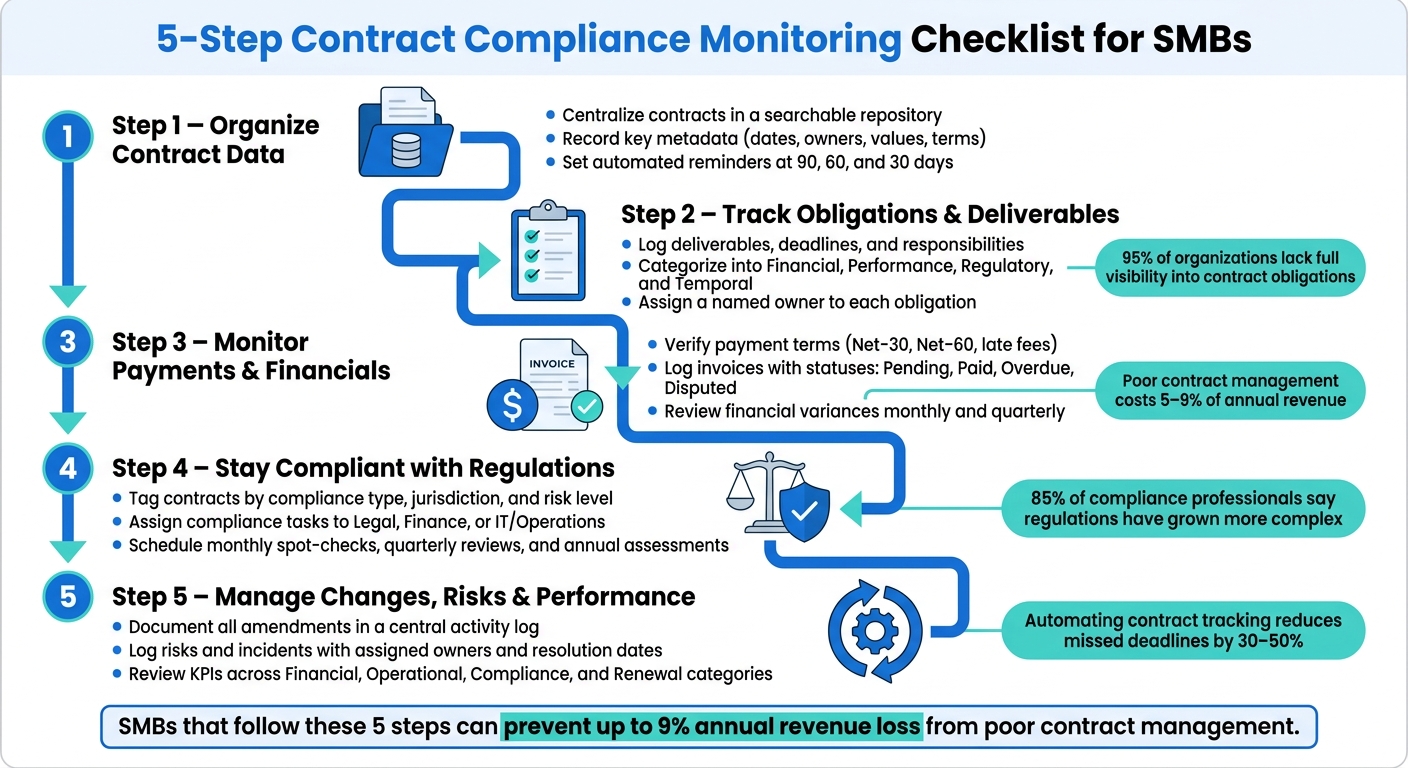
5-Step Contract Compliance Monitoring Checklist for SMBs
Step 1: Organize Your Contract Data
The first step to effective contract management is consolidating your contracts. Many small and medium-sized businesses (SMBs) don’t miss deadlines due to negligence but because their contracts are scattered – across emails, desktops, and shared drives – without proper version control. If your team can’t locate a specific contract in under a minute and confirm it’s the latest version, you’re not ready to monitor contracts effectively. Start by creating a centralized repository that connects all contract components in one place.
Centralize Contract Storage
Your goal should be a single, searchable repository that holds all signed agreements, amendments, addendums, statements of work, and other related documents. Everything should be linked so reviewers can easily see the full scope of an agreement. A good repository allows your team to search by counterparty, department, or category – not just by file name.
Tools like Trackado can make this process easier. Designed for SMBs, it organizes contracts by partner, department, or type while offering role-based access to protect sensitive agreements. Its straightforward setup means your team can get organized in days rather than months.
Record Key Contract Details
Once your contracts are centralized, focus on capturing the metadata your team needs to take action. At a minimum, each contract record should include:
| Field | Why It Matters |
|---|---|
| Contract title & parties | Identifies the agreement |
| Effective & expiration dates | Tracks renewals and terminations |
| Auto-renewal terms & notice period | Prevents unwanted rollovers (e.g., a 60-day opt-out window) |
| Internal owner & backup owner | Clarifies accountability |
| Contract value (in $) | Supports financial oversight |
| Governing department | Ensures obligations are routed correctly |
Always double-check metadata against the signed PDF to avoid costly mistakes. A single incorrect expiration date, for instance, could lead to an unintended auto-renewal or a missed termination notice.
After documenting critical metadata, ensure no important dates are overlooked by setting up automated alerts.
Set Up Automated Reminders
With your data in order, configure alerts for key dates like renewal deadlines, notice-of-nonrenewal windows, payment due dates, and compliance reviews. A single reminder on the deadline isn’t enough – set alerts at 90, 60, and 30 days in advance so your team has plenty of time to act, not just react.
For instance, if a vendor contract requires 60 days’ written notice to cancel, an alert on day 59 won’t help. Alerts should also cover milestone dates and certificate expirations, as compliance obligations often arise throughout the contract’s lifecycle.
An organized contract database is the foundation for staying on top of obligations, assessing performance, and ensuring regulatory compliance.
Step 2: Track Obligations and Deliverables
Now that your contract data is well-organized (thanks to Step 1), it’s time to dive into the specifics: tracking commitments. Contracts are more than just deadlines and renewal dates – they’re packed with deliverables, service-level agreements (SLAs), payment schedules, and performance milestones. Yet, research shows that 95% of organizations lack full visibility into these obligations. This blind spot contributes to companies losing an average of 9% of their annual revenue due to poor contract management.
List All Contractual Obligations
Start by reviewing each contract carefully. Look for action-oriented language like "shall", "must", "will", or phrases such as "within X days" to identify commitments. Each obligation should be logged with the following details:
- A clear description
- A clause reference
- The due date
- An assigned owner
- The current status (e.g., "Pending", "In Progress", "Completed", "At Risk", or "Overdue")
Assigning ownership is crucial. Alarmingly, 40% of organizations aren’t clear on who is responsible for contract-related tasks. By naming a specific person for each task, you reduce ambiguity and ensure accountability.
To keep things manageable, group obligations into four main categories:
| Obligation Type | Examples | Typical Owner |
|---|---|---|
| Financial | Payment schedules, late fees, minimum spend | Finance / Accounts Payable |
| Performance | Delivery dates, project milestones, SLAs | Operations / Project Management |
| Regulatory | Data handling, audit rights, certifications | Legal / Compliance |
| Temporal | Renewal notice windows, termination dates | Procurement / Legal |
Using AI tools can make this process much faster. For instance, platforms like Trackado use AI to extract key dates, financial terms, and performance conditions from your contracts. This kind of automation ensures no obligation slips through the cracks and works seamlessly with your centralized repository.
Schedule Milestone Review Dates
"The date that actually matters isn’t the renewal date… An obligation tells you what you have to do before then." – PactAlert
This quote highlights a common oversight: focusing on deadlines instead of the steps leading up to them. For example, if a vendor SLA requires 99.9% monthly uptime, it’s better to review performance during the month rather than waiting until it’s over.
Set up milestone reviews ahead of deadlines – say, 14 days and then 3 days before each due date. Automated tracking can help here, reducing missed deadlines by 30% to 50% compared to manual methods. And if the primary task owner doesn’t respond to reminders, escalate the issue to their manager or a backup contact. This is especially important during times of staff turnover.
These proactive scheduling practices lay the groundwork for accurate financial tracking, which is the focus of Step 3.
Step 3: Monitor Payments and Financials
After tracking obligations, the next step is making sure financial terms align with the contract. Poor contract management can cost organizations between 5% and 9% of their annual revenue, and in more complex industries, this can jump to 15% or higher.
Confirm Payment Terms
Before approving an invoice, double-check that it follows the contract terms. This includes verifying net terms (like Net-30 or Net-60), pricing, late fee clauses, and any minimum spending requirements. These details often slip through the cracks when contracts aren’t well-organized.
Tools like Trackado can simplify this process by using AI to extract financial clauses from contracts. These tools convert complex language into clear, actionable fields like "Late Fee %", "Invoice Frequency", or "Minimum Annual Spend."
Log Invoices and Payment Statuses
Every invoice should be tied to its corresponding contract and assigned a payment status – Pending, Paid, Overdue, or Disputed. To avoid missed payments, assign a specific person (not just a department) in Finance or Accounts Payable to manage each payment obligation.
Use tiered reminders to stay on top of payment deadlines:
| Event | First Alert | Second Alert | Final Alert | Escalation |
|---|---|---|---|---|
| Payment | 14 days prior | 7 days prior | 2 days prior | Day of |
This is especially critical for high-value contracts (over $10,000 annually), where missing a payment could activate penalty clauses. These steps ensure payments are handled systematically and set the groundwork for regular financial reviews.
Review Financial Variances
With accurate tracking in place, regular financial reviews can catch discrepancies early. Compare actual payments against contract terms monthly. Every quarter, review all contracts for potential issues like cost overruns, unauthorized price increases, missed discounts, or uncollected credits – problems that are easy to miss in manual systems.
"Poor contract management costs organizations about 9% of annual revenue, increasing to 15% or more in complex industries."
Focus first on contracts with variable pricing or volume-based tiers, as these are most prone to unnoticed financial changes. Keeping a time-stamped audit trail of every invoice and status update also ensures you have solid documentation if disputes arise.
sbb-itb-49df6ae
Step 4: Stay on Top of Regulatory and Policy Requirements
Contracts aren’t just about financial terms – they’re also packed with legal, regulatory, and internal policy obligations. And these obligations are becoming tougher to navigate. In fact, 85% of compliance professionals report that regulations have become more complex in the past three years.
Identify Applicable Compliance Requirements
The first step is to thoroughly review each contract for its specific compliance needs. These could include data privacy laws like GDPR or HIPAA, industry certifications, insurance clauses, audit rights, or reporting deadlines. To make this process easier, tag contracts based on compliance type, jurisdiction, and risk level. This way, you can quickly filter and prioritize tasks.
Tools like Trackado use AI to simplify this process. They can pull out critical clauses – such as certification deadlines or data handling standards – from dense legal text. This ensures you’re aware of obligations well before they become urgent.
This tagging and categorization also make it easier to assign responsibilities effectively in the next step.
Assign Compliance Responsibilities
Every compliance task needs a clear owner. Why? Because 92% of contract management errors are caused by human error. Assign responsibilities based on expertise:
- Legal can handle certifications and audit rights.
- Finance can manage tax and payment compliance.
- IT or Operations can oversee data handling standards and SLA performance.
"The person closest to the obligation’s subject matter should own it – financial obligations belong to finance, SLA monitoring belongs to operations, and regulatory commitments belong to legal." – Ironclad
It’s also important to have a backup plan. What happens if the primary owner is unavailable? Establish an escalation path with a secondary owner or manager to avoid compliance gaps caused by vacations, turnover, or role changes.
Schedule Regular Compliance Checks
Once you’ve got accurate data and clear ownership, the next step is to schedule routine compliance checks. One-time reviews won’t cut it. A structured audit schedule keeps things manageable:
| Audit Type | Frequency | Focus Area |
|---|---|---|
| Spot-Checks | Monthly | High-value or high-risk contracts; immediate issues |
| Comprehensive Review | Quarterly | All active contracts; systemic bottlenecks |
| Performance Assessment | Annual | Long-term outcomes; renegotiation opportunities |
| Ad-hoc Review | As Needed | Modified contracts or reported incidents |
Automated reminders are a lifesaver here. Set alerts 90, 60, and 30 days before key deadlines, like certificate expirations. And don’t forget – every time a contract is amended, it’s a signal to recheck compliance obligations. New terms often come with new requirements that can easily slip through the cracks.
These recurring checks are essential for staying ahead of compliance risks and keeping your contract management process running smoothly.
Step 5: Manage Changes, Risks, and Performance Reviews
Even the best contracts aren’t static. Terms may be renegotiated, project scopes can shift, and unexpected challenges often arise. Without a solid plan for handling these changes, minor issues can quickly spiral into major – and expensive – problems. Building on strong compliance and financial tracking practices, managing changes and risks ensures that contracts stay effective throughout their entire lifecycle.
Track Contract Amendments and Changes
Every contract change needs to be documented immediately and thoroughly. Keep all amendments stored in a single, secure location to ensure everyone has access to the most up-to-date version. A complete activity log – which tracks who made changes, when, and why – is your safety net in case of disputes.
Make sure all relevant stakeholders are notified as soon as updates are made. To keep the process transparent, establish formal approval workflows. These workflows should include stages like drafting, business review, and final sign-off, ensuring accountability at every step.
Log Risks and Incidents
Not every risk will turn into a problem, but every potential risk should be logged. Create a straightforward system where team members can record potential issues, near-misses, and actual incidents as they happen. Each log entry should include a description of the risk, the related contract, the person responsible for addressing it, and a target resolution date.
This is critical because the stakes are high. For instance, the global average cost of a data breach reached $4.88 million in 2024, and many of these breaches stem from overlooked contractual obligations regarding data security. By logging risks early and assigning clear responsibility, you can help prevent these issues from escalating. Once risks are identified, regular performance reviews ensure that contracts continue to deliver as intended.
Review Contract Performance Regularly
Staying compliant isn’t just about avoiding penalties – it’s about making sure your contracts deliver real value. Evaluate performance across three key areas: financial (e.g., payment timeliness, cost savings), operational (e.g., on-time delivery, quality standards, SLA adherence), and compliance (e.g., regulatory adherence, audit rights). Assign responsibility for each metric to a specific person to maintain accountability, even if roles shift over time.
| KPI Category | Key Metrics to Track | Typical Owner |
|---|---|---|
| Financial | Cost savings, ROI, payment timeliness | Finance / Accounts Payable |
| Operational | On-time delivery, quality standards, SLA adherence | IT / Operations |
| Compliance | Regulatory adherence, audit rights fulfillment | Legal / Compliance |
| Renewal | Notice periods, auto-renewal windows, opt-out deadlines | Legal / Procurement |
Organizations that automate contract tracking often experience a 30% to 50% drop in missed deadlines. Regular reviews should serve as checkpoints, using metrics like the average resolution time for non-compliance issues to measure and improve overall contract performance.
Conclusion: Keeping Contract Compliance Under Control
Managing contract compliance is a continuous effort. This checklist outlines five key steps to help streamline the process: organizing contract data, tracking obligations, monitoring payments, staying updated on regulations, and managing changes and risks. Together, these steps create a solid framework that empowers small and mid-sized businesses (SMBs) to handle contracts effectively and stay in control.
Why does this matter? Poor contract management can hit hard – causing organizations to lose up to 9% of their annual revenue, or even 15% in more complex industries. For SMBs, these losses can directly impact growth, disrupt cash flow, and threaten long-term stability.
Mark Zeise, CEO and founder of Trackado, emphasizes the importance of having a system in place:
"The main reason a company needs a contract management system is to gain full control over their contracts. A system will provide structure and allow necessary people to have knowledge of where contracts are stored and stay up to date on milestones, deadlines and renewal dates."
Trackado simplifies contract management by centralizing your contract repository, automating reminders for deadlines, tracking key milestones, managing approvals, and ensuring financial oversight. With a free plan for smaller portfolios and paid options starting at $39/month, it offers flexibility for businesses at various stages of growth.
FAQs
What contract data should we capture first?
To keep tabs on contract compliance, the first step is to gather all your agreements into a single, centralized repository. Pay close attention to capturing essential details such as expiration dates, auto-renewal clauses, payment schedules, termination rights, liability caps, and indemnification terms. Don’t forget to include regulatory requirements, service level agreements (SLAs), and key milestones as part of your tracking process.
Using tools like Trackado can make this process much easier. With AI-powered features, these tools can automate the extraction of important metadata, helping you stay organized and prepared for ongoing compliance monitoring.
How do we assign owners for contract obligations?
To keep things on track, assign every contract obligation to a specific person instead of leaving it to a team or department. Begin by organizing all contracts in a central repository. This makes it easier to track obligations, deadlines, and conditions. A contract management platform can help streamline this process – use it to formally assign tasks to individuals, set reminders for important updates, and set up escalation paths to address personnel changes or urgent deadlines.
How often should we run compliance reviews?
Regular compliance reviews are essential for catching potential issues before they become bigger problems. For smaller organizations, an annual review might be enough. However, larger companies handling numerous contracts may need to conduct reviews quarterly or semi-annually to stay on top of things.
To keep oversight consistent, combine these scheduled reviews with automated alerts for important milestones and deadlines. Tools like Trackado can help by centralizing contract management and automating reminders, ensuring you stay compliant even between formal audits.