Want to save time, reduce errors, and improve financial control? Integrating your ERP system with contract monitoring tools can make it happen.
Here’s what you’ll gain:
- Fewer errors: Automate data transfers between systems to eliminate manual entry mistakes.
- Real-time insights: Track financial obligations and cash flow instantly.
- Simpler compliance: Centralize records for stress-free audits.
- Better vendor management: Monitor performance and negotiate smarter.
- Cost savings: Catch missed discounts, duplicate payments, and pricing errors.
This integration not only streamlines processes but also directly impacts your bottom line. Companies report up to 40–60% higher ROI when they connect these systems. Let’s dive into how it works.
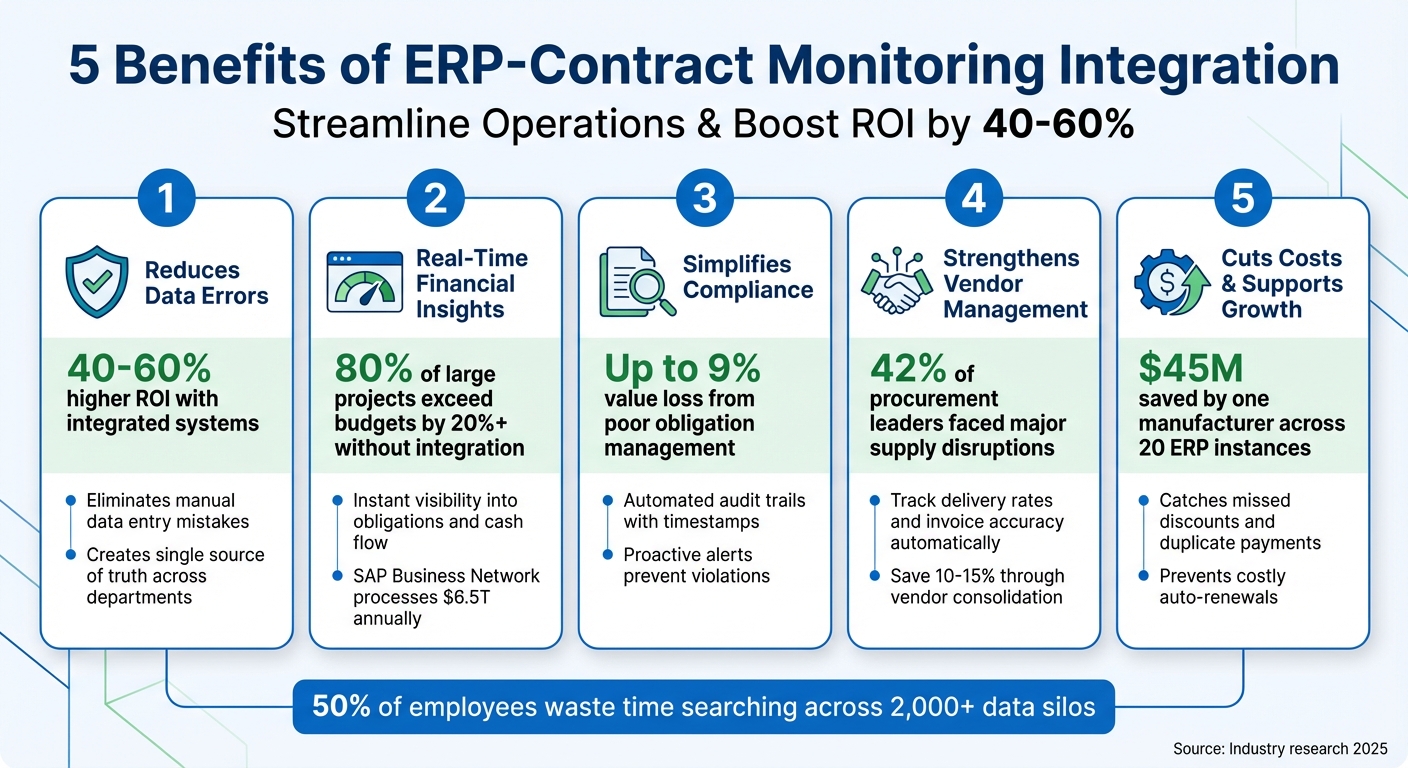
5 Key Benefits of ERP-Contract Monitoring Integration with ROI Statistics
1. Reduces Data Errors and Creates a Single Source of Truth
When contract data is stored in one system and financial records in another, someone has to manually connect the dots – usually by re-entering the same information. This process often leads to errors in vendor names, pricing, or payment terms, which can result in incorrect billing, missed obligations, and compliance issues.
Integration solves this problem by automating data synchronization. Key contract details automatically transfer from the contract management system to the ERP, eliminating the need for manual entry. Any updates made in one system are instantly reflected in the other. This ensures finance teams bill using the most up-to-date rates, while legal teams work with the latest contract terms. The result? A smoother flow of information that supports more accurate financial planning and better contract compliance.
By creating a single, reliable version of the truth, integration ensures that all departments – sales, procurement, and finance – are aligned. Everyone sees the same vendor IDs, pricing, and obligations, eliminating confusion and inefficiencies.
The benefits are clear. Companies with well-designed integration strategies report 40–60% better ROI and higher user adoption compared to those relying on disconnected systems. Yet, the average organization still struggles with over 2,000 data silos, with 50% of employees spending considerable time searching for information instead of focusing on productive tasks. These automated processes not only reduce errors but also set the stage for real-time financial insights, which are explored in the next section.
sbb-itb-49df6ae
2. Gives Real-Time View of Obligations and Cash Flow
When contract data flows directly into your ERP system, you gain instant clarity on your financial position. Payment schedules, revenue forecasts, and upcoming obligations are visible as soon as they’re updated. This kind of immediate insight reshapes how finance teams approach budgeting and spending decisions, paving the way for streamlined, automated financial processes.
Having a single source of truth is essential, and real-time updates take financial oversight to the next level. Integration ensures that contract milestones – like verifying deliverables, clearing invoices, and automating prepaid expenses or monthly accruals – are synced directly into your ERP’s financial reports. This seamless flow of information strengthens your financial reporting and decision-making.
"ERP systems are the backbone of financial management. When contract data flows directly into ERP, organizations can track obligations, payment terms, and revenue forecasts in real time." – SutiSoft Editorial Team
The importance of integration becomes even clearer when considering the risks of disconnected systems. For example, 80% of large construction projects exceed budgets by at least 20% due to fragmented cost data. Integrated systems flag unexpected contract changes, allowing finance teams to address budget risks immediately. This proactive approach is a core component of contract risk identification. The SAP Business Network, which links contract and spend data across systems, now processes over $6.5 trillion in annual transactions.
Real-time validation also prevents revenue leakage. By automatically checking invoices against negotiated rates, overbilling is caught, and discounts or penalty clauses are enforced on the spot. One global electronics manufacturer saved $45 million by using integrated contract intelligence across twenty ERP instances to identify pricing mismatches and enforce terms. Achieving this level of cost control is only possible when systems communicate without delay.
Trackado provides a solution by integrating contract monitoring with ERP systems, ensuring financial data stays current and empowering finance teams to manage budgets with confidence.
3. Simplifies Compliance and Audit Preparation
Integration doesn’t just enhance real-time financial insights – it also makes compliance and audit preparation much easier. By storing contract data in a centralized repository alongside ERP records, tracking compliance becomes a straightforward process. Every change, approval, and signature is automatically logged with timestamps and user IDs. This creates a detailed audit trail, eliminating the chaos of last-minute regulatory reviews. Plus, this centralized system helps detect potential issues early in the process, reducing risks down the line.
Automated alerts are another key feature that helps prevent compliance problems. The system keeps an eye on payment schedules, renewal clauses, and delivery milestones, sending notifications well before deadlines. This proactive approach helps catch potential issues – like clause violations or unauthorized spending – before they escalate into expensive penalties or legal troubles.
"Integration allows automated alerts for contract renewals, clause deviations, and obligation tracking, ensuring you’re always audit-ready." – SutiSoft Editorial Team
The financial stakes are high when compliance is poorly managed. Studies show that organizations can lose up to 9% of value through obligation mismanagement and compliance costs when systems aren’t connected. Integration tackles this by comparing real-time ERP data (like invoices and spending) against contractual terms, instantly flagging any discrepancies. This immediate detection not only supports audits but also reinforces financial accuracy.
Tools like Trackado take this a step further by syncing contract obligations with your ERP system. They maintain searchable records that auditors can access instantly. Instead of sifting through endless folders or email threads, your team can quickly filter and retrieve relevant contracts and financial documents. This transforms audit preparation from a stressful scramble into a manageable, routine process.
4. Strengthens Vendor Management and Performance Tracking
When your contract monitoring system integrates directly with your ERP, it gives you a clear view of vendor performance – not just their promises. Instead of manually cross-referencing invoices with contract terms or chasing delivery confirmations, the system tracks key metrics like on-time delivery rates, invoice accuracy, and adherence to service-level agreements automatically. Both procurement and finance teams work with the same real-time data, cutting out the confusion caused by disconnected spreadsheets and endless email chains. This shared, up-to-date information not only pinpoints performance gaps but also sets the stage for smarter negotiations.
The financial impact of this visibility is hard to ignore. Research shows that 42% of procurement leaders faced at least one major supply disruption in the past year. Integration helps tackle this problem by flagging issues early – whether it’s a vendor repeatedly missing delivery deadlines or charging above agreed rates. By monitoring these metrics proactively, you can avoid costly disruptions and keep your budget on track.
This centralized approach also changes the way you negotiate. When it’s time to renew contracts, you’ll have objective data that clearly shows which vendors deliver value and which fall short. Many businesses save 10–15% by consolidating duplicate vendor relationships or renegotiating based on consolidated spend data. With these insights, you can reward vendors who consistently meet quality standards with longer contracts and address underperformers with concrete, data-backed feedback. Trackado simplifies this process further, making vendor evaluation and procurement contract management more efficient.
Beyond improving vendor performance, this integration strengthens financial control and reduces risks. Trackado enhances this by organizing contracts by partner, category, or department, giving you quick access to vendor histories and financial obligations. Automated reminders ensure renegotiations happen on time and performance issues are resolved promptly.
5. Cuts Costs and Supports Business Growth
Integrated contract monitoring and ERP systems can uncover hidden expenses that quietly drain your budget. Issues like missed volume discounts, unclaimed rebates, and unenforced penalty clauses often chip away at contract value without notice. By syncing these systems, you can automatically compare contracted pricing with vendor invoices, catching costly discrepancies. For instance, a small hospital identified $50,000 in overcharges when its integrated system flagged that new, lower contract rates hadn’t been updated in the vendor’s billing system or its materials management software. Once the error was spotted, the vendor issued a credit. This is just one example of how integration helps control costs.
For larger operations, the savings can be even more dramatic. A global electronics manufacturer saved $45 million across twenty ERP instances by using integrated contract intelligence to flag pricing mismatches and risky terms. Modern systems often use AI tools for contract risk prediction to identify these issues before they impact the bottom line. This automation eliminates the need for manual cross-checks, which can eat up as much as 20% of engineering time.
Industry experts emphasize the risks of disconnected systems:
"Projects start bleeding cash the moment contracts slip outside the ERP system."
– Red Stag Labs
Automation doesn’t just save money – it also prevents costly mistakes like unwanted auto-renewals. Integrated systems send alerts 90, 60, and 30 days before renewal deadlines, giving you time to renegotiate or exit contracts that no longer align with your goals. This level of visibility is essential, especially since 80% of large construction projects exceed budgets by at least 20% due to cost data being trapped in disconnected tools. When contract obligations are directly synced with your general ledger, you can catch budget overruns before they escalate.
Integration also supports long-term growth. Take Brazilian utility CPFL as an example: by connecting contract and project management with their ERP, they achieved significant efficiency improvements. Integrated systems scale seamlessly across currencies and tax systems, enabling expansion without the headache of manual contract management. Tools like Trackado further simplify the process by centralizing financial data and automating reminders, freeing your team to focus on strategic initiatives rather than mundane administrative tasks.
Here’s a quick look at how integration can reduce common expenses:
| Expense Type | Integration Impact |
|---|---|
| Missed Discounts | Automatically applies negotiated vendor discounts to purchase orders in the ERP |
| Duplicate Payments | Cross-references invoices against contract IDs and past payments to prevent overpaying |
| Auto-Renewal Fees | Sends alerts for "evergreen" clauses, allowing timely termination of unused services |
| Penalty Clauses | Tracks vendor SLAs, calculating credits or penalties for non-compliance automatically |
| Manual Entry Errors | Syncs contract metadata with ERP fields, eliminating human error |
Conclusion
Bringing contract monitoring and ERP systems together turns business challenges into measurable results. This integration isn’t just a nice-to-have – it’s becoming essential for staying competitive. Teams gain real-time visibility into obligations, cash flow, and vendor performance, while compliance and audit processes become far more efficient.
The numbers speak for themselves: well-executed integration strategies result in 40–60% better ROI and higher user adoption compared to standalone tools. On the flip side, disconnected systems can be a major drain – 80% of large construction projects exceed budgets by at least 20% because critical cost data is scattered across different platforms.
"Seamless integration between contract management and ERP has become essential."
– SutiSoft Editorial Team
For small and mid-sized businesses, Trackado makes this integration accessible and practical. With features like AI-powered data extraction, manage contract renewals with automated reminders, and secure APIs, Trackado transforms static contracts into actionable insights that sync directly with your financial systems. Starting at just $39/month for the Starter plan, it is hosted in secure European data centers, offers customizable workflows, and integrated e-signing. It’s an affordable way to centralize your contracts, automate compliance tracking, and gain a clear view of costs and revenues.
FAQs
How does integrating contract monitoring with ERP systems enhance financial accuracy?
Integrating contract monitoring with ERP systems improves financial accuracy by providing real-time updates for financial commitments, costs, and invoices. This eliminates the risks associated with manual data entry, ensuring financial records remain consistent and trustworthy.
When systems are synchronized, businesses benefit from clearer insights into their financial obligations. This allows for more accurate cost tracking and budgeting, reducing discrepancies and enabling smarter decisions that drive better financial outcomes.
What are the benefits of real-time data synchronization in ERP systems?
Real-time data synchronization in ERP systems brings a host of advantages to businesses by ensuring accurate, up-to-date information is consistently available across all departments. This reduces the risk of errors, improves compliance, and helps avoid problems caused by outdated data. For example, with instant updates on contractual obligations, payment schedules, and renewal dates, businesses can make smarter decisions and stay on top of deadlines.
Another major perk is the boost to operational efficiency. By eliminating manual updates and fragmented data, teams like finance, legal, and procurement can work together more smoothly. This speeds up processes like approvals, renegotiations, and overall workflows. With real-time data integration, contract management evolves into a forward-thinking, strategic function, enabling better forecasting, tighter cost control, and greater flexibility for the organization.
How does integrating ERP systems with contract monitoring tools make compliance and audits easier?
Integrating ERP systems with contract monitoring tools makes compliance and audits much easier by offering real-time visibility into contracts, obligations, and performance metrics. By centralizing essential data – like deadlines, milestones, and financial details – it reduces manual errors and saves significant time during audits.
Automated data synchronization ensures that organizations can quickly produce accurate, audit-ready reports while keeping records consistent. This integration also enables structured workflows for handling regulatory documentation and corrective actions, allowing businesses to stay ahead of compliance needs. With these streamlined processes, companies can lower risks and respond efficiently to regulatory inquiries or audits.