
AI is transforming how hotels manage contracts, making processes faster, more accurate, and easier to oversee. Traditional methods rely on manual work, which can lead to missed deadlines, costly errors, and compliance risks. AI tools solve these issues by automating key tasks like data extraction, deadline tracking, and approval workflows. Here’s what you should know:
- Data Extraction: AI reads contracts, pulling out critical details like dates, payment terms, and clauses with over 90% accuracy.
- Deadline Tracking: Automated alerts notify teams 60–90 days before renewals or key dates, preventing revenue loss from missed deadlines.
- Workflow Automation: Contracts are routed to the right stakeholders, reducing manual errors and cutting review times by up to 65%.
- Risk and Compliance: AI flags non-standard terms, tracks regulatory changes, and ensures contracts meet legal requirements.
- E-Signing Integration: Secure digital signatures speed up execution and eliminate delays caused by physical paperwork.
For hotels, these tools simplify managing franchise agreements, vendor deals, and event contracts across multiple properties. Platforms like Trackado centralize all contracts into a searchable repository, ensuring secure storage and easy access. Whether you’re a small boutique hotel or a large chain, AI-powered solutions save time, reduce errors, and improve overall contract oversight.
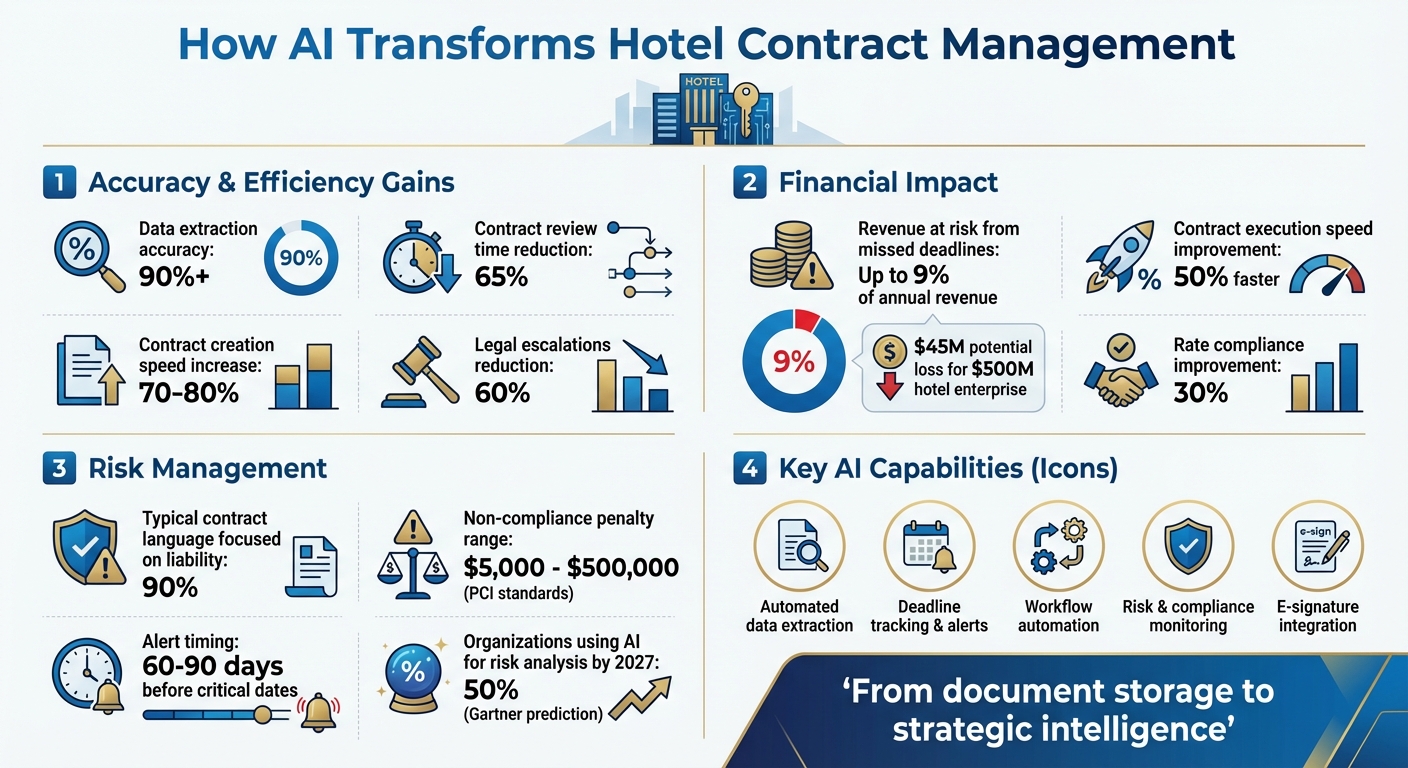
AI Contract Management Benefits for Hotels: Key Statistics and Impact
AI Features That Change Hotel Contract Management
AI is transforming how hotels handle contracts through three main capabilities: intelligent data extraction, automated deadline tracking, and streamlined approval workflows. Together, these features simplify and improve contract management, making it more efficient and reliable for hotel operations.
AI Data Extraction for Contract Details
Using Natural Language Processing (NLP), AI can automatically pull out key details from contracts, such as counterparty names, effective dates, payment terms, termination clauses, and governing laws. This technology achieves accuracy levels in the 90th percentile, making it a dependable tool for processing lengthy franchise agreements and vendor contracts.
This feature is especially helpful for hotels managing multiple properties. AI organizes extracted data into a searchable repository and keeps it updated with "True-Up" capabilities, ensuring that stored information always reflects the most current version of the signed contract.
Automated Deadline Reminders
AI also ensures that important dates – like renewal deadlines or termination windows – aren’t overlooked. Missing these deadlines can cost businesses up to 9% of their annual revenue due to penalties, lost discounts, or unfavorable auto-renewals. For a mid-sized hotel enterprise with $500 million in annual revenue, this could mean preventable losses of around $45 million.
AI mitigates this risk by actively monitoring contract lifecycles and sending timely alerts – typically 60 to 90 days in advance of critical dates. If reminders go unacknowledged, the system escalates alerts to ensure no deadlines are missed. For hotels managing over 30 active agreements across multiple properties, this function reduces last-minute scrambling. Alerts can be sent through multiple channels, including email, Slack, Microsoft Teams, or mobile apps, and can be customized to account for holidays or fiscal year-end periods.
Automated Workflows and Approvals
Once data is extracted and deadlines are tracked, AI speeds up the approval process by routing contracts to the right stakeholders based on pre-set rules. Every step is tracked to create a clear audit trail, which is essential for contract compliance and due diligence. For example, a vendor contract might automatically move from procurement to legal for compliance checks and then to finance for budget approval – all without manual involvement.
This intelligent routing ensures accountability while reducing unnecessary notifications. For instance, legal teams handle renewals, finance oversees payments, and operations manage deliverables. By focusing alerts only on relevant teams, AI prevents alert fatigue. Additionally, AI-enabled contract review can cut total review time by up to 65%, freeing hotel staff to focus on strategic tasks rather than administrative work.
How AI Affects Each Stage of Contract Management
AI doesn’t just handle individual tasks – it reshapes the entire contract lifecycle, from drafting agreements to execution and ongoing monitoring. By integrating intelligence at every phase, AI reduces manual workloads, cuts down on errors, and ensures contracts align with operational goals and legal requirements. This all-encompassing approach underscores AI’s transformative role in contract management.
AI Support for Contract Drafting and Negotiation
AI can quickly generate contracts based on basic parameters, saving time and effort. Instead of starting from scratch, teams can use prompt-based tools to create agreements like vendor, service, or consulting contracts. AI also pulls from approved clause libraries, suggesting language tailored to the contract type, jurisdiction, and business needs. This ensures consistency across departments and properties.
When it comes to negotiations, AI steps in to automate redlining. It compares vendor documents with internal templates, flags deviations, and suggests corrections. During renewals, specialized AI tools can benchmark terms to help secure better conditions. These tools can speed up contract creation by 70–80% and reduce legal escalations by up to 60%. Rachana Chotia, Content Marketing Manager at Signeasy, highlights this efficiency:
"Generative AI matters because it absorbs that mental load. It turns contract work from interpretation into action."
Even with these advancements, legal teams should always review AI-generated content to ensure compliance with local laws and address any nuanced risks. Setting up a secure digital contract repository for all existing agreements before using AI tools can also provide a solid foundation for accurate drafting.
Risk Analysis and Compliance Tracking
AI doesn’t just help with drafting – it strengthens contract integrity throughout its lifecycle. It identifies non-standard terms and deviations from approved guidelines, making it easier to track compliance with evolving regulations like FTC rules on junk fees, service charge disclosures, and privacy laws such as GDPR and CCPA. Risk scoring tools assess contracts dynamically, factoring in clause deviations, counterparty profiles, and the complexity of obligations. Predictive analytics also come into play, forecasting potential breaches, missed service-level agreements (SLAs), or unfavorable renewals, allowing for proactive intervention.
AI can extract key clauses specific to the hospitality sector, such as force majeure provisions, renovation clauses, and competitor exclusions. Since nearly 90% of typical contract language focuses on liability, this capability is crucial. Gartner predicts that by 2027, half of all organizations will rely on AI for contract risk analysis. Notably, HelloFresh and Chegg each faced $7.5 million settlements in January 2026 due to contract review failures. Lucy Bassli, Founder and Principal at InnoLaw Group, notes:
"If I think where I see AI making a really good substantive impact, it is definitely in contract extraction and contract review."
For hotels, AI alerts can flag auto-renewal terms 30 to 90 days in advance, giving teams time to renegotiate outdated provisions. While AI acts as a first-pass reviewer, final decisions on complex clauses should always involve legal experts.
Integrated E-Signing for Contract Execution
AI-powered e-signature tools bring everything full circle, seamlessly completing the contract lifecycle. These tools offer secure signing options, including eID verification, SMS authentication, and encrypted digital signatures. Automated workflows ensure contracts are routed to the right people, eliminating the hassle of chasing down signatures. AI can also generate summaries of lengthy agreements, giving decision-makers a quick overview of obligations and risks before signing.
Mobile apps make it easy for staff to review, approve, and sign contracts on the go, ensuring operations run smoothly even when team members are away from their desks. Real-time collaboration features allow teams to redline and update documents live, avoiding the chaos of juggling multiple PDF versions. As Austin Segal, CEO of Singlepane, puts it:
"AI brings meaningful benefits to hotel owners and asset managers through time savings and increased accuracy."
To maximize these benefits, hotels should standardize templates for hiring and vendor agreements. Configuring AI to send milestone notifications via email, Slack, or Teams can also help ensure critical deadlines, like renewal windows, aren’t missed.
Trackado‘s AI Tools for Hotel Contract Management
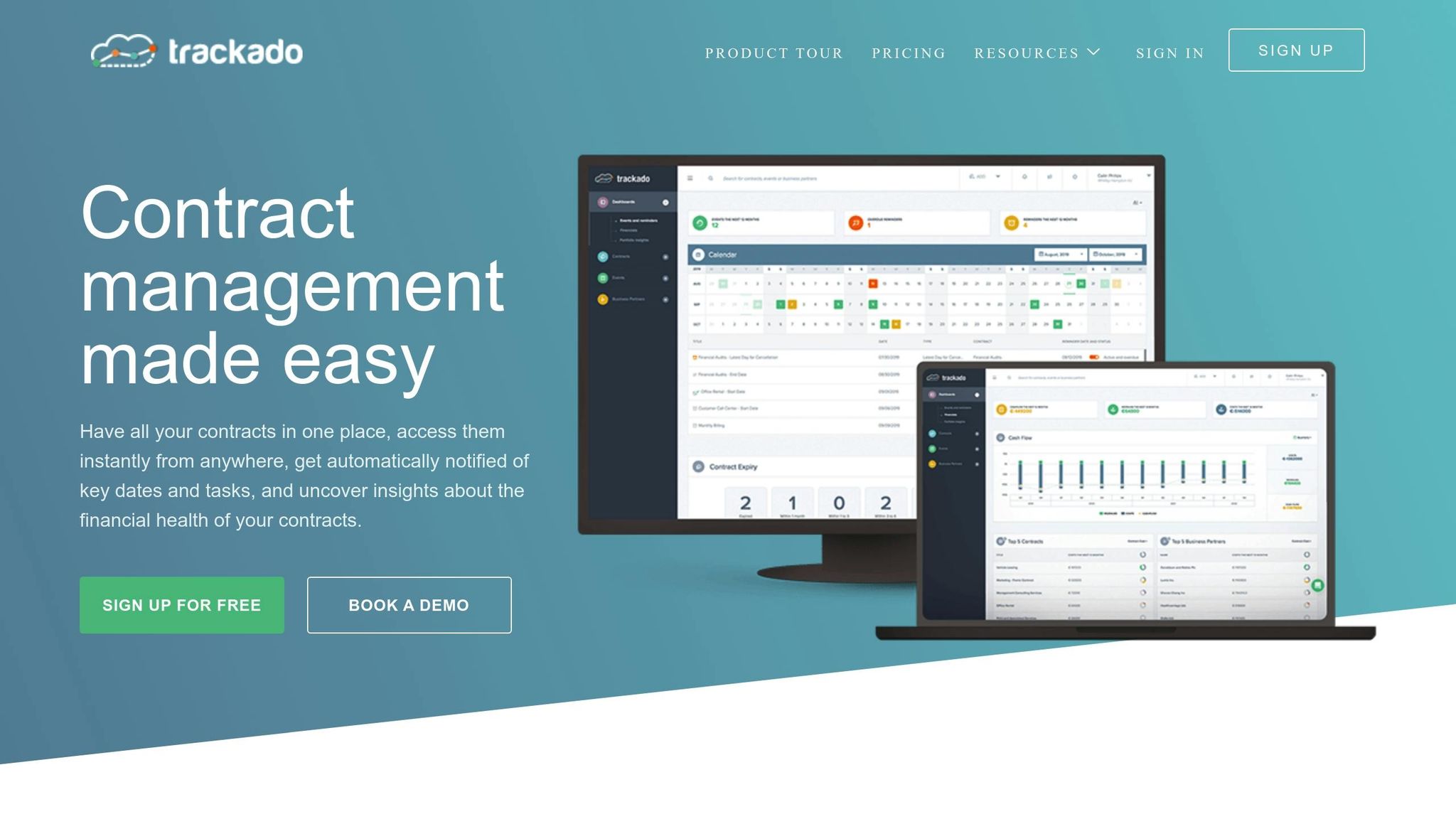
Trackado takes the advanced AI features discussed earlier and tailors them specifically for hotel contract management. Managing franchise agreements, vendor deals, and service contracts can be overwhelming for hotels, whether it’s a boutique property or a sprawling chain. Trackado simplifies this process with AI-driven contract management tools designed to meet the unique needs of the hospitality industry.
Trackado Features for Hotels
With AI-powered data extraction, Trackado removes the hassle of manual data entry. It can pull key details like payment schedules, termination terms, renewal dates, and liability limits directly from uploaded contracts. This includes unstructured data from sources like scanned PDFs or even handwritten notes, which make up a significant portion (80–90%) of digital data in the hospitality sector. All you need to do is upload a contract, and the system extracts and organizes the critical information into customizable fields.
To keep hotels on top of their obligations, automated deadline reminders ensure no key dates are missed. Notifications can be set for 30, 60, or 90 days in advance, with alerts sent via email or integrated platforms. This allows managers to maintain a contract renewal planner for better visibility. This feature helps hotels shift from reactive management to proactive oversight, cutting down processing time by 25–50%.
Trackado also centralizes all contracts in a secure, searchable repository. Hosted in European data centers with SSL encryption, the platform allows hotels to organize agreements by partner, category, or department. Users can filter and search instantly, ensuring quick access when needed. Task-based workflows streamline the approval process by routing contracts to the right people, while integrated e-signing eliminates the need to switch between platforms. Customizable fields and milestone tracking provide a clear view of costs, revenues, and obligations across the entire portfolio.
Trackado Pricing Plans for Different Hotel Sizes
Trackado offers pricing options designed to fit the needs of hotels of all sizes:
| Plan | Monthly Price | Users | Contracts | Custom Fields | Key Features |
|---|---|---|---|---|---|
| Free | $0 | 1 | 15 | 2 | Basic storage, automated reminders |
| Starter | $39 | 3 | 60 | 5 | Multi-user access, financial insights |
| Business | $129 | 8 | 300 | Unlimited | Workflows, advanced organization |
| Enterprise | $299 | 25 | Unlimited | Unlimited | Workflow templates, SAML, API access |
Independent hotels and smaller properties can begin with the Free or Starter plans to manage essential vendor and service contracts. For mid-sized hotels handling more complex agreements, the Business plan offers unlimited custom fields and workflow automation. Larger hotel groups managing hundreds of contracts across multiple locations will find the Enterprise plan ideal, with its unlimited capacity and advanced security features. Additional users can be added for $10 per month, and a free trial is available to test the platform before making a commitment.
These pricing plans give hotels of any size the ability to adopt AI-powered contract management, transforming manual processes into efficient, strategic oversight.
sbb-itb-49df6ae
Common Hotel Contract Problems and AI Solutions
Hotels manage a wide range of complex agreements – vendor contracts, franchise deals, service agreements – and traditional methods often fall short. Relying on manual data entry across scattered spreadsheets or paper logs creates tedious workflows and increases the risk of errors. These inefficiencies drain staff resources and can lead to costly mistakes.
Reducing Errors in Vendor Contracts
AI simplifies and improves the accuracy of vendor contract management by automating repetitive tasks. It compares new contracts against pre-approved templates, identifying non-standard language or missing clauses before they cause issues. Interestingly, during beta testing of AI contract tools, some errors initially attributed to AI were later found to be human mistakes from earlier manual reviews.
"The AI could potentially be more accurate than an employee when parsing documents." – Austin Segal, CEO, Singlepane
Using Optical Character Recognition (OCR), AI can convert scanned or image-based legacy contracts into searchable, editable text. This makes it possible to analyze older agreements that were previously locked in read-only formats. By catching rate discrepancies and billing errors early, AI helps prevent these issues from affecting a hotel’s revenue. This proactive approach naturally supports AI’s role in maintaining regulatory compliance.
Meeting Hospitality Regulations
AI doesn’t just streamline deadlines – it continuously audits contracts to ensure compliance with ever-changing hospitality regulations. Non-compliance can lead to steep penalties, such as fines for failing to meet PCI standards for credit card data, which range from $5,000 to $500,000. AI tools monitor contracts for compliance with key regulations, including PCI standards and ESG (Environmental, Social, and Governance) metrics. Automated systems flag contracts for updates when laws change, saving time and reducing the risk of oversight.
AI also evaluates partners against sustainability benchmarks like ISO 14064 and GHG Protocol, integrating ESG considerations into contract reviews. This automated auditing process ensures contracts remain up-to-date with legal and ethical standards without requiring exhaustive manual checks.
Protecting Contract Data Security
Paper-based systems and scattered files pose serious risks to sensitive data. AI platforms address these vulnerabilities by replacing outdated methods with secure, encrypted systems featuring strict access controls. For instance, Trackado hosts contracts in secure European data centers using SSL encryption, ensuring only authorized personnel can access specific agreements.
Centralizing all vendor and event contracts into a single digital repository eliminates manual filing errors and provides controlled access. Features like digital signatures and encrypted storage ensure compliance with PCI and GDPR standards, while maintaining detailed audit trails for every contract action. By consolidating contracts into a secure, AI-driven system, hotels not only enhance data security but also improve overall efficiency. This ties back to the broader benefits of AI-powered contract management.
The Future of AI in Hotel Contract Management
AI is reshaping hotel contract management, moving it from simple document storage to a system of proactive intelligence. Modern platforms go beyond archiving and reminders – they now offer insights that can shape strategy. For example, they can suggest ideal negotiation positions, flag high-risk contracts before expiration, and even predict potential issues like supplier SLA failures or unfavorable renewal terms by analyzing historical data. Contracts are no longer static documents; they’ve become dynamic tools for decision-making.
These AI-driven systems are delivering tangible results: 50% faster contract execution times and a 30% improvement in rate compliance across hotel chains. This efficiency isn’t just about saving time – it’s about creating seamless links between contracts and other critical business areas.
"The evolution of hotel contract management is no longer about managing documents – it’s about managing intelligence." – Joseph Friedmann, ReadyBid
Looking ahead, contract management will increasingly integrate with broader business systems like CRM, invoicing, and property management platforms. Imagine being able to ask, “What risks are in our top 20 vendor contracts?” and receiving detailed, clause-specific answers instantly. This kind of capability eliminates repetitive tasks like data entry, allowing staff to dedicate more time to enhancing guest experiences and refining business strategies.
Trackado is a prime example of this shift. Its AI tools handle clause extraction and classification, automate workflows, and ensure compliance – all while offering secure European hosting. These features centralize contract management, streamline monitoring, and provide real-time financial insights. Adopting AI-powered solutions isn’t just about improving operations; it’s about staying competitive in an industry where tight margins and increased regulatory pressures make every advantage count.
FAQs
How does AI enhance accuracy in managing hotel contracts?
AI brings a new level of precision to hotel contract management by automating tasks like data extraction and reducing the likelihood of human error. For instance, AI-driven tools can swiftly scan contracts, pull out essential details, and maintain consistency across records. This eliminates many of the mistakes that often occur with manual data entry.
Beyond just extracting information, AI also validates contract details by comparing them against standardized templates. Any discrepancies are flagged early, allowing issues to be addressed before they escalate. This not only ensures accuracy but also helps hotels stay compliant with their contractual obligations.
By simplifying these processes, AI gives hotel managers access to reliable, current contract data. The result? Time saved and fewer expensive mistakes to worry about.
What are the main advantages of using automated tools to track deadlines in hotel contracts?
Automated deadline tracking can make a big difference for hotels by boosting efficiency and cutting down on risks. When systems automatically keep tabs on important dates – like contract renewals, compliance deadlines, or other commitments – hotels can sidestep expensive penalties, avoid service interruptions, and seize opportunities they might have otherwise missed. Plus, by taking these administrative tasks off employees’ plates, staff can spend more time focusing on guest experiences and bigger-picture goals.
Another big plus is the reduction in manual errors. Automation ensures deadlines are met consistently, with proactive reminders and alerts helping hotel management stay on top of their obligations. This not only lowers operational risks but also gives hotels better control over their contracts. The result? Stronger relationships with vendors, smoother compliance processes, and smarter use of resources – all crucial for staying competitive in a fast-moving industry.
How is AI improving risk management and compliance in hotel contracts?
AI is transforming how hotels handle risk management and compliance in their contracts by delivering data-driven insights that pinpoint potential risks and ensure regulations are followed. Using advanced risk scoring, AI can assess agreements for liabilities, helping legal teams focus on high-risk contracts and lowering the likelihood of disputes or breaches.
AI tools also keep an eye on contractual obligations in real-time, flagging any non-compliance issues. This ensures hotels stay in line with both external regulations and internal policies. On top of that, AI can automatically update contract templates to include the latest legal standards, reducing the risk of outdated or non-compliant language slipping through.
By processing large amounts of data and streamlining compliance tasks, AI makes contract management easier, cuts down on legal risks, and boosts operational efficiency for hotels.