
Renewable energy contracts, like Power Purchase Agreements (PPAs), come with long-term financial risks that can significantly affect profitability. Key challenges include weather variability, market price fluctuations, and policy changes. Poor forecasting can lead to losses of tens of millions of dollars over a 15-year contract. Here’s what you need to know:
- Resource Variability: Energy production depends on unpredictable factors like wind and sunlight. Tools like P50 and P90 forecasts help estimate production levels.
- Market Price Volatility: Energy prices can drop during peak renewable production, reducing revenue. Price cannibalization and fluctuating wholesale prices add to the uncertainty.
- Policy Risks: Changes in government policies or delays in regulatory processes can disrupt revenue models and lead to stranded assets.
To manage these risks, developers use tools like Monte Carlo simulations, financial metrics (e.g., NPV, IRR), and scenario analysis. Strategies such as hybrid PPAs, portfolio diversification, and insurance products like Solar Revenue Puts help mitigate challenges.
Platforms like Trackado simplify contract management by centralizing data, automating compliance tracking, and offering real-time financial insights, including accounting for Power Purchase Agreements, ensuring long-term stability for renewable energy projects.
Main Financial Risks in Renewable Energy Contracts
Three Primary Financial Risks in Renewable Energy Contracts
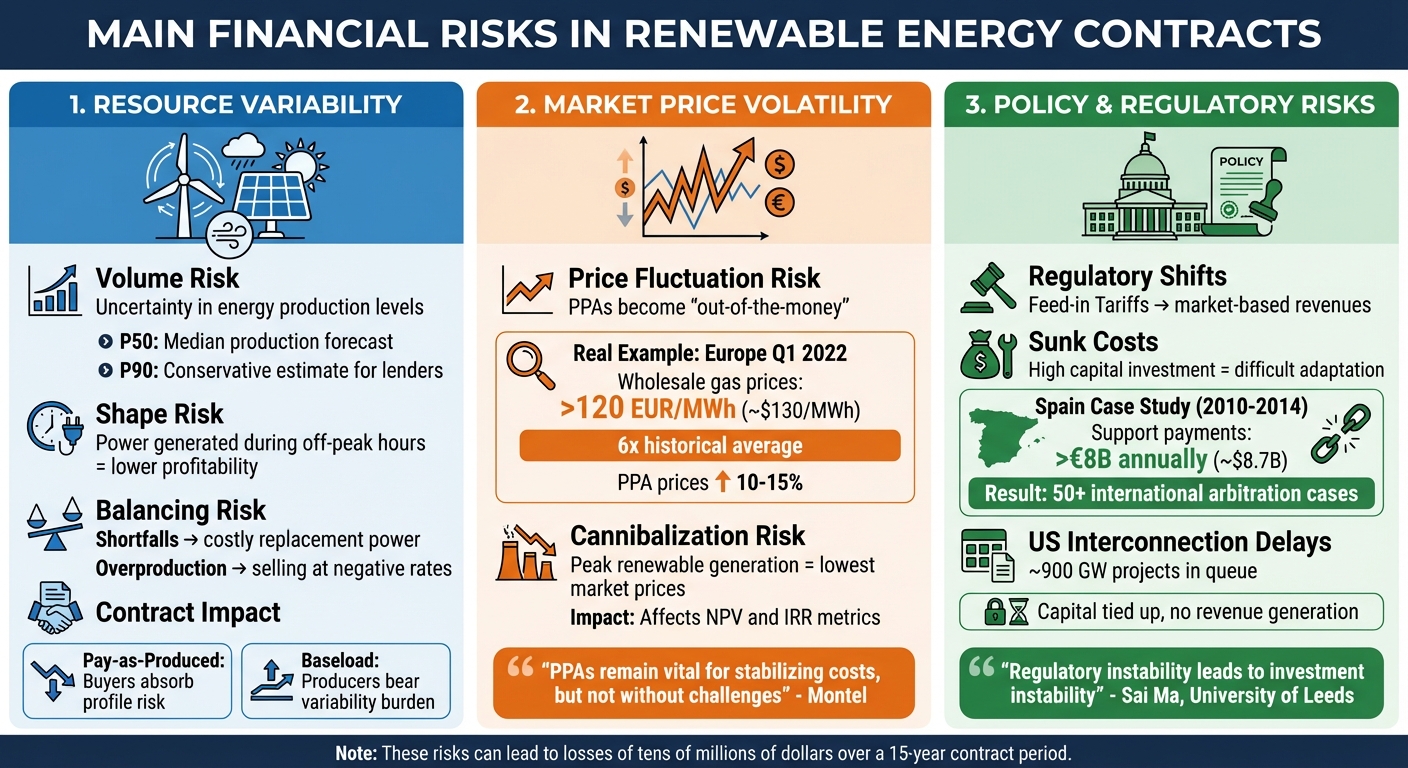
Following our introduction to renewable energy risk challenges, let’s dive into the key financial risks that can threaten the viability of long-term contracts. Renewable energy projects face three primary financial risks that can disrupt operations and profitability. Recognizing these risks is critical to safeguarding investments and ensuring steady cash flows throughout the contract’s duration.
Resource Variability
One major challenge is volume risk, which refers to the uncertainty surrounding energy production levels. For instance, wind farms may not achieve expected wind speeds, and solar plants may underperform due to extended cloud cover. To evaluate this uncertainty, financial institutions rely on P50 and P90 values. P50 represents the median production forecast, while P90 (or sometimes P99) is a more conservative estimate used by lenders to assess repayment risks and determine whether a project is financially viable.
Another factor is shape risk (also known as profile risk). Even if a project meets annual energy production targets, generating power during off-peak hours can lower profitability since market capture rates are reduced. Adding to the complexity is balancing risk, where shortfalls in production may force the purchase of costly replacement power. Conversely, overproduction during periods of low market prices could mean selling surplus energy at negative rates.
The allocation of these risks depends on the contract structure. For example:
- In "Pay-as-Produced" (PAP) contracts, buyers usually absorb profile risk.
- In "Baseload" or "Pay-as-Consumed" contracts, producers bear the burden of variability, often needing to procure energy from the market to fulfill fixed delivery commitments.
Market Price Volatility
The unpredictability of energy prices presents another significant financial risk. When prices fluctuate sharply, power purchase agreements (PPAs) can become "out-of-the-money." This means the agreed-upon price in the contract exceeds current market rates, potentially destabilizing the buyer’s financial position or even leading to bankruptcy.
For example, during the first quarter of 2022, average monthly wholesale gas prices in Europe soared past 120 EUR per megawatt-hour (around $130 per megawatt-hour) – a staggering six times the historical average. This extreme volatility pushed PPA prices up by an estimated 10% to 15% during the same period. Compounding the issue is cannibalization risk, where renewable energy generation peaks coincide with the lowest market prices, directly impacting revenue streams.
"PPAs remain a vital tool in stabilising energy costs amidst market volatility, but they are not without their challenges." – Montel
These price fluctuations can significantly affect financial metrics like Net Present Value (NPV) and Internal Rate of Return (IRR). In some cases, these metrics may reveal that future cash flows, once discounted, fall short of covering the initial investment.
Policy and Regulatory Risks
Changes in government policies can introduce some of the most unpredictable financial risks. Regulatory shifts can transform a project’s revenue model, such as moving from guaranteed income streams (like Feed-in Tariffs) to market-based revenues. This exposes investors to greater price and volume risks. The problem is compounded by the high "sunk costs" associated with renewable projects – once capital is invested, adapting to new regulations becomes nearly impossible, potentially leading to stranded assets or reduced profitability.
For instance, between 2010 and 2014, Spain faced significant backlash after altering its renewable energy policies. The government reduced support payments, which had ballooned to over €8 billion (about $8.7 billion) annually. These changes sparked more than 50 international arbitration cases, with investors arguing that Spain failed to provide a stable legal framework.
"Regulatory instability can lead to investment instability and ultimately result in regulatory failure to achieve the essential goals of renewable energy policies." – Sai Ma, Sustainability Research Institute, University of Leeds
Even in countries with supportive policies, delays in regulatory processes can create financial risks. In the United States, for example, there are approximately 900 GW of renewable energy projects stuck in interconnection queues awaiting evaluation. These delays tie up capital, prevent revenue generation, and risk losing financing if grid connections are not secured.
Addressing these risks requires robust forecasting and mitigation strategies to ensure renewable energy projects remain financially sound and operationally resilient.
sbb-itb-49df6ae
Methods for Forecasting Financial Risks
After identifying potential risks, the next step is determining how they might impact finances. Renewable energy developers and lenders use various analytical tools to predict how uncertainties – like energy production, pricing fluctuations, and regulatory shifts – might influence a project’s financial performance. These methods guide decisions about investments and contract structures to reduce potential losses.
Probabilistic Modeling for Yield and Pricing
Probabilistic modeling applies statistical techniques to handle uncertainties in energy production and market pricing. Instead of relying on a single prediction, this approach creates a range of potential outcomes by analyzing historical data and variations in factors such as solar irradiance, wind speeds, and equipment performance.
Monte Carlo simulations are a popular tool in this space. They run thousands of scenarios by tweaking multiple uncertain variables at once – like solar output, cost overruns, or interest rate shifts. The results often include key figures like P50 (median production estimates) and P90 (more conservative estimates), which are essential for assessing risk.
"Uncertainty in PV energy estimates is ‘one of the most critical areas of lack of understanding’ according to independent engineers, financiers, PV model developers, and other industry stakeholders." – Matthew Prilliman et al., National Renewable Energy Laboratory
For projects with a "merchant tail" – where energy is sold at spot market prices after the expiration of a Power Purchase Agreement (PPA) – stochastic modeling and forward price curves are used to forecast revenues in volatile markets. This is especially important for projects that extend beyond the initial 10 to 15 years covered by a PPA.
Studies show that stochastic optimization often outperforms traditional deterministic methods in managing the technical and financial complexities of renewable energy systems. These probabilistic tools provide a bridge between technical forecasts and financial insights.
Financial Metrics for Risk Assessment
Financial metrics like Net Present Value (NPV), Internal Rate of Return (IRR), and Debt Service Coverage Ratio (DSCR) help gauge a project’s financial health and viability.
- NPV: This metric discounts future cash flows to their present value. A positive NPV indicates that a project is expected to generate returns above the required rate, while a negative NPV suggests financial infeasibility.
- IRR: This measures the expected rate of return. For solar projects, the minimum acceptable IRR (or hurdle rate) typically ranges from 8% to 12%. Falling below this threshold can make it hard to attract equity investors.
- DSCR: This ratio assesses whether a project can cover its debt payments with cash flow. Lenders usually require a DSCR between 1.2x and 1.5x, meaning the project must generate $1.20 to $1.50 in cash flow for every dollar of debt service. Ratios below 1.2x could trigger lender covenants or force excess cash to be redirected toward debt repayment.
| Metric | Purpose | Key Risk Indicator |
|---|---|---|
| Net Present Value (NPV) | Evaluates if returns exceed the required investment threshold | Negative NPV signals financial unviability |
| Internal Rate of Return (IRR) | Compares expected returns across projects | Must surpass the hurdle rate (8-12% for solar) |
| Debt Service Coverage Ratio (DSCR) | Checks if cash flow covers debt payments | Ratios under 1.2x may prompt lender actions |
These metrics should be recalculated periodically to reflect shifts in market conditions, inflation, and regulations. Breaking down capital expenditures into direct costs (like solar panels) and indirect costs (such as contingency reserves) can further refine these assessments. Together, these financial tools complement scenario analysis, which we’ll dive into next.
Scenario Analysis for Risk Mitigation
Scenario analysis explores best-case, worst-case, and most likely outcomes, helping identify key risk factors. Unlike probabilistic modeling, which generates thousands of random scenarios, this method focuses on a few targeted cases based on specific event combinations.
Sensitivity analysis often complements scenario analysis. It examines how changes in a single variable – like a 10% rise in operating costs or a 5% drop in solar output – affect financial outcomes. This approach highlights the factors that have the greatest impact on profitability, allowing developers to prioritize their risk management efforts.
In July 2025, Energy Brainpool and Montel conducted a valuation study for German wind assets to estimate fair-value PPA pricing for 2026–2030. Using real-world market data and price scenarios, they calculated a fair value of EUR 58.54/MWh (roughly $63.50/MWh). This analysis helped developers and financiers strike a balance between long-term market exposure and predictable returns.
"Scenario analysis, which considers best-case, worst-case, and most likely scenarios, is another useful tool for understanding how different situations may affect project outcomes." – Montel Energy
Advanced tools like the System Advisor Model (SAM) from the National Renewable Energy Laboratory (NREL) make these analyses easier. SAM supports parametric studies, Monte Carlo simulations, and weather variability assessments (like P50/P90 studies). Over 35,000 professionals, including developers and policymakers, have used SAM to evaluate financial and technical options for renewable projects.
To get the most from scenario analysis, financial models should be updated regularly to align with current market trends and regulatory updates.
Strategies to Reduce Financial Risks
Accurate risk forecasts are just the starting point. Renewable energy developers and buyers rely on a mix of strategies to tackle financial uncertainty head-on. By rethinking contract structures, diversifying portfolios, and leveraging insurance tools, they can better handle market fluctuations, production challenges, and regulatory changes. Let’s break down how these strategies work.
Optimizing Contract Structures
Traditional Power Purchase Agreements (PPAs) often lock parties into rigid, long-term terms that don’t always adapt well to shifting markets. Newer, more flexible contract structures are gaining ground, offering a more balanced approach to risk-sharing.
- Upside Sharing: This approach allows both buyers and generators to split the benefits of higher wholesale prices while sharing the burden of price drops. Buyers get some protection from price spikes, and generators reduce their losses during downturns.
- Hybrid PPAs: Pairing renewable energy assets with storage solutions, like batteries, stabilizes energy output and boosts revenue during peak demand. For instance, excess solar energy generated during the day can be stored and sold during higher-priced evening hours.
- Shorter-Term Contracts: Instead of the standard 10- to 15-year agreements, contracts lasting 3, 5, or 7 years are gaining traction. These shorter commitments lower long-term risks and make renewable energy more accessible for smaller companies. Aggregation, which groups multiple small buyers together, further spreads credit risks while offering the benefits of large-scale generation.
Portfolio Diversification
Focusing too heavily on weather-dependent assets can create vulnerabilities. Diversifying across technologies, locations, and contract types can smooth out unpredictable variations in production.
- Technology Mix: Combining wind and solar assets in a portfolio helps balance generation. Wind typically performs better at night and during winter, while solar peaks during the day and summer. This natural complement reduces the mismatch between energy production and demand, known as "shape risk".
- Geographic Spread: Spreading projects across different areas minimizes the impact of localized weather events and grid curtailments. It also curbs "price cannibalization", where oversupply from a single technology floods the market and drives prices down.
- Institutional Investment Appeal: Large, diversified portfolios attract investors like pension funds, which prefer stable cash flows even if they come with lower returns. This can lower the overall cost of electricity. Contracts-for-Difference (CfDs), a widely used tool for managing risk in such portfolios, have already been implemented in over half of the global offshore wind supply.
Insurance and Guarantees
Even the best contracts can’t account for every unexpected event. Insurance and guarantees act as essential safety nets, protecting against resource shortages and operational hiccups.
- Solar Revenue Puts: These guarantee up to 95% of expected solar production, shielding project owners from weather-related or equipment issues that reduce output.
- Volume Firming Agreements (VFAs): Co-created by Microsoft and REsurety, VFAs help stabilize revenues in "pay-as-produced" contracts by covering both volume and profile risks.
- Proxy Revenue Swaps: These swaps allow projects to trade variable revenue for a fixed payment, reducing financial uncertainty without requiring physical delivery guarantees.
- Availability Guarantees: Contractors ensure equipment operates during high-price periods, preventing revenue losses caused by downtime or maintenance delays.
Getting the right coverage starts with early collaboration with risk advisors. Darren Popham, Chief Client Officer at Marsh, emphasizes:
"Engaging risk and insurance advisors early in the project lifecycle is critical to successful risk identification and mitigation".
How Trackado Supports Risk Management in Renewable Energy Contracts
Managing risk effectively in renewable energy contracts requires more than just robust forecasting methods – it demands a reliable system to handle complex agreements. With contracts often spanning 10 to 25 years and involving millions of dollars, staying on top of obligations, deadlines, and financial risks is absolutely essential. Trackado’s contract management platform simplifies this process, eliminating the need for clunky spreadsheets or missed alerts.
Centralized Contract Management
Renewable energy contracts, such as Power Purchase Agreements (PPAs), often include intricate risk-allocation clauses. These might involve price floors, upside shares, force majeure provisions, or availability guarantees. Trackado uses AI-powered data extraction to centralize these critical clauses, ensuring they’re easy to track and enforce. Additionally, its milestone tracking feature helps organizations meet crucial deadlines for permits, interconnection, and procurement. This reduces the chance of overlooking ambiguous contract terms, which can lead to expensive disputes.
For instance, in 2020, up to 5 gigawatts of U.S. solar projects failed due to missed construction deadlines. This highlights how development risk can derail even the most well-funded projects. Trackado’s tools mitigate such risks by keeping all key contract details in one accessible place.
Financial Insights for Risk Forecasting
The renewable energy market is anything but static, with prices and conditions shifting constantly. Trackado provides real-time financial insights by tracking costs, revenues, and payment schedules. This allows managers to quickly adapt to market volatility. For example, the platform can help identify merchant risk, which occurs when wholesale prices fall below PPA rates, or basis risk, where nodal prices fail to align with retail prices. By centralizing this data, organizations can conduct scenario analyses, adjust hedging strategies, and renegotiate contracts as needed.
Recent market trends, such as wholesale electricity prices in Europe climbing above $200/MWh, underscore the importance of these tools. Trackado’s dashboard makes it easier for organizations to evaluate contract performance against market conditions, enabling smarter, faster decisions.
Automation and Compliance Monitoring
Beyond financial clarity, keeping contracts compliant is crucial for avoiding penalties. Missing a payment deadline or failing to meet performance requirements can lead to termination risk, which often carries hefty consequences. Trackado minimizes these risks with automated reminders and task-based workflows, ensuring that payment deadlines are met and performance obligations are fulfilled.
The platform also addresses volumetric risk by tracking whether electricity production aligns with contract terms and confirming the receipt of the correct number of Renewable Energy Credits (RECs). This level of automation is especially helpful for organizations new to renewable energy procurement. While tech giants have long been involved, universities, breweries, and smaller commercial entities are increasingly entering the space. Trackado provides these newcomers with the oversight they need to avoid costly errors, supporting the financial stability required for managing renewable energy contracts over the long term.
Conclusion: Best Practices for Forecasting and Managing Risks
Effectively forecasting and managing financial risks in renewable energy contracts is critical for ensuring the long-term success of these projects. With contracts often lasting 10 to 25 years and involving substantial financial commitments, organizations need to adopt a combination of detailed scenario analysis and well-crafted contractual agreements. As Gavin Ahern from Coho Climate explains, "Selecting the right energy project for your desired strategy is the best way to reduce your risk". This process includes conducting thorough due diligence on development risks, negotiating price floors (commonly set at $0 to protect against negative market prices), and using hub-settled agreements to minimize volatility [4,32]. These measures are especially important as the renewable energy market continues to evolve.
The market itself is expanding beyond its traditional participants, such as tech giants, to now include universities, smaller companies, and nonprofits. According to Rachit Kansal from Rocky Mountain Institute, "The market has been broadening significantly… with many having never completed a PPA transaction before". This shift highlights the growing need for organizations to prioritize risk education and strengthen their financial modeling capabilities. Regularly updating financial models, performing sensitivity analyses, and aligning project choices with specific organizational goals – whether it’s minimizing short-term volatility or maximizing long-term savings – are essential steps [4,19].
Hybrid PPAs, which integrate renewable energy projects with storage solutions, are another strategy gaining traction for managing shape and basis risks [14,32]. For instance, in 2020, Wells Fargo entered into a structured retail agreement with Shell Energy, securing 150,000 MWh of renewable energy annually with fixed power prices for 7 to 12 years. This approach significantly reduced the company’s exposure to market fluctuations. Such examples demonstrate how carefully designed contracts can effectively distribute risk and safeguard organizations from unfavorable scenarios.
Tools like Trackado further simplify risk management by centralizing contract data, automating compliance tracking, and providing real-time financial insights. Its AI-powered extraction capabilities capture key provisions – such as price floors, availability guarantees, and force majeure clauses – while automated reminders ensure critical deadlines are met. For organizations new to renewable energy procurement, having this level of oversight can be a game-changer, helping maintain financial stability over the lifetime of these long-term agreements and avoiding the challenges of manual tracking systems.
FAQs
How do I choose between P50 and P90 for a PPA?
When deciding between P50 and P90, it all comes down to how much risk you’re comfortable taking. P50 represents a 50% chance that the estimated energy yield will be met or exceeded. It’s great for those who lean toward more optimistic projections. On the other hand, P90 gives a 90% probability, offering a more cautious estimate that prioritizes reliability – perfect for ensuring steadier cash flow forecasts. The choice ultimately depends on how much financial risk your project or organization is ready to handle.
What is price cannibalization, and how can I hedge it?
Price cannibalization happens when the surge in renewable energy production – such as solar and wind – drives electricity prices down during peak generation times. This drop occurs because these energy sources have very low marginal costs, which can put pressure on investment returns. To counter this, consider strategies like using financial tools (futures or options), diversifying your energy portfolio, or locking in long-term power purchase agreements (PPAs) with fixed prices. These approaches can help stabilize revenues and tackle the risks of market volatility.
When does contract software like Trackado reduce financial risk most?
Contract management software, such as Trackado, helps minimize financial risks by offering real-time monitoring, automated reminders for obligations and renewals, and centralized contract management. These tools ensure you stay on top of deadlines, maintain compliance, and avoid costly financial mistakes, giving you greater control over your contracts.