
Managing vendor regulatory risks is about ensuring your third-party vendors comply with laws and industry standards. Non-compliance can lead to penalties, legal issues, and reputational damage. For U.S. businesses, especially in regulated industries like healthcare and finance, this is a must.
Here’s what you need to know:
- Key Risks: Data breaches, operational disruptions, and reputational harm.
- Regulations to Watch: GLBA, HIPAA, PCI-DSS, SOX, and CCPA.
- Steps to Manage Risks:
- Create a vendor inventory and classify vendors by risk level.
- Conduct due diligence using risk assessments and compliance checks.
- Include safeguards in contracts (e.g., audit rights, breach notification clauses).
- Monitor vendors regularly, especially high-risk ones.
Tools like Trackado help simplify vendor management through automation, ensuring compliance tracking, contract management, and risk assessments are efficient and accurate.
Why it matters: Over 60% of U.S. data breaches involve vendors, with costs averaging $4.76 million per breach. Proactive management reduces risks, protects your business, and keeps you compliant.
Main Regulatory Risks in Vendor Relationships
Collaborating with vendors can expand your business capabilities, but it also brings regulatory challenges. Here’s a breakdown of the key risks that U.S. companies must manage when working with third-party vendors.
Data Privacy and Cybersecurity Risks
When vendors handle sensitive data, the stakes are high. Data breaches and privacy violations are some of the most pressing concerns. U.S. laws like the Gramm-Leach-Bliley Act (GLBA), Health Insurance Portability and Accountability Act (HIPAA), and Payment Card Industry Data Security Standard (PCI-DSS) mandate strict security measures for handling regulated information.
A 2024 ISACA survey revealed that over 60% of organizations had experienced a third-party data breach in the past two years. Many of these breaches were tied to weak vendor risk management practices. The financial toll is staggering – IBM’s 2023 Cost of a Data Breach Report found that breaches involving third-party vendors cost U.S. companies an average of $4.76 million.
For example, if a healthcare vendor fails to secure patient data under HIPAA, both the vendor and the contracting company could face hefty fines and legal repercussions. To minimize risks, it’s essential to ensure that all vendors – and their subcontractors – follow the same stringent security protocols.
Operational and Financial Risks
Vendor non-compliance can ripple through your operations, causing disruptions like service outages, supply chain delays, or even losing access to critical systems. These interruptions can be particularly damaging if they stem from a vendor’s failure to meet regulatory standards.
The financial fallout is just as concerning. Companies often face costs related to legal fees, regulatory penalties, and remediation efforts. Reflecting this reality, nearly 80% of organizations have increased the frequency of their vendor risk assessments since 2020.
Operational headaches can intensify when a key vendor’s compliance issues force them to pause or significantly alter their services. In such cases, businesses are left scrambling to find replacements while juggling additional risks and costs.
Reputational Risks
A vendor’s regulatory missteps can tarnish your company’s reputation, even if you weren’t directly responsible. Negative publicity from vendor failures can erode customer trust and strain existing partnerships.
When a vendor’s non-compliance becomes public knowledge, the media often highlights the fallout rather than the nuances of the vendor relationship. This can lead to reduced customer confidence, damaged brand credibility, and increased scrutiny of your own compliance practices.
To better understand these risks, here’s a quick overview:
| Risk Type | Description | Example Regulations | Potential Impact |
|---|---|---|---|
| Data Privacy & Cybersecurity | Risks tied to managing sensitive data and preventing breaches | GLBA, HIPAA, PCI-DSS | Data breaches, fines, and legal consequences |
| Operational & Financial | Risks from vendor non-compliance disrupting business operations | SOX, FFIEC, Dodd-Frank | Service delays, financial losses, and penalties |
| Reputational | Risks of losing customer trust and facing negative publicity | FTC Act, State AG enforcement actions | Brand damage and reduced customer confidence |
Ultimately, a single vendor compliance failure can trigger a cascade of problems – financial, operational, and reputational. To manage these risks effectively, it’s critical to treat vendor compliance as an extension of your own regulatory responsibilities.
How to Conduct Vendor Regulatory Risk Assessment
Managing vendor regulatory risk requires a structured approach that spans from identifying vendors to ongoing monitoring. This process helps pinpoint high-risk vendors, ensuring resources are allocated where they’re needed most. The goal? To align risk management efforts with your operational priorities.
Vendor Inventory and Classification
Building a detailed inventory of your vendors is the first step in managing regulatory risk effectively. Start by listing all vendors and classifying them based on their risk level. Consider factors like the type of service they provide, the level of access they have to sensitive data, and their integration with your systems. For instance, a vendor handling customer payment data or personally identifiable information (PII) would be considered high-risk, while a vendor supplying office supplies would likely fall into the low-risk category.
Many organizations adopt a tiered classification system, evaluating vendors on criteria such as data sensitivity, the importance of their services to operations, compliance history, financial health, and technical security measures. This categorization determines how much due diligence is needed, how often vendors should be reassessed, and what contractual safeguards are necessary.
Here’s an example of how vendors might be classified:
| Risk Tier | Criteria | Assessment Frequency |
|---|---|---|
| High-Risk | Access to sensitive data and critical services | Semi-annually or annually |
| Moderate-Risk | Limited data access, non-critical services | Annually |
| Low-Risk | No sensitive data access, minimal impact | Every 18–24 months |
Due Diligence and Initial Risk Assessment
Once vendors are classified, the next step is to evaluate their compliance and risk posture. This involves conducting due diligence using standardized questionnaires. These tools assess multiple areas, including legal compliance (e.g., certifications like SOC 2, ISO 27001, or HIPAA), financial stability (via credit checks and financial reviews), and technical security practices.
To streamline this process, many organizations use a weighted risk scoring system. For example, you might assign 40% of the score to security practices, 25% to operational reliability, 20% to compliance, and 15% to financial health. The resulting score provides an overall risk rating that’s easy to document for future reference or dispute resolution.
Contract Safeguards and Monitoring
The final piece of the puzzle is embedding protective measures in vendor contracts and setting up robust monitoring systems. Key contractual clauses to include are:
- Audit Rights: Allowing you to review the vendor’s security practices, compliance measures, and data handling protocols.
- Data Protection Requirements: Mandating that vendors adhere to specific security standards, like encryption or compliance with regulations such as GDPR or CCPA.
- Breach Notification Clauses: Requiring vendors to promptly report any security incidents.
Other important provisions might cover certification requirements, indemnification, and clear protocols for handling data at the end of the contract.
For ongoing monitoring, reassess vendors based on their risk tier. High-risk vendors should be reviewed semi-annually or annually, moderate-risk vendors annually, and low-risk vendors every 18–24 months. Additionally, certain events – like a vendor experiencing a security breach, undergoing a major structural change, or gaining expanded access to your systems – should trigger an immediate reassessment.
If non-compliance is detected, follow predefined escalation procedures with clear timelines for remediation. For example, if a vendor fails to implement required encryption for data at rest, you might categorize this as a high-severity issue, requiring resolution within 30 days and outlining specific consequences for missed deadlines.
Tools like Trackado can simplify this process by centralizing contract management, automating compliance reminders, and tracking key dates. With features like AI-powered data extraction and customizable fields, these platforms make it easier to organize due diligence records and keep up with monitoring requirements.
Tools and Technologies for Vendor Risk Management
When managing a growing number of vendor relationships, relying on manual processes quickly becomes unmanageable. Technology-driven solutions step in to simplify this complexity, turning it into an automated system that minimizes human error. In fact, more than 60% of organizations have adopted automation for at least part of their vendor risk assessment processes using specialized platforms.
This move toward automation isn’t just about making life easier – it’s a necessity in a regulatory environment where missing compliance deadlines can lead to hefty fines and damage to your reputation. Modern platforms leverage AI to enhance risk detection and response, allowing businesses to manage extensive vendor portfolios without being buried in paperwork. This automation also streamlines contract management, making it more efficient and reliable.
Role of Contract Management Platforms
Contract management platforms act as the backbone of vendor regulatory risk management, addressing common challenges like scattered documents, missed deadlines, and inconsistent compliance tracking. By centralizing all contracts in a single electronic repository, businesses eliminate the chaos of searching through emails, shared drives, and filing cabinets. This centralization ensures that compliance clauses, obligations, and critical dates are easily accessible, simplifying audits and ongoing monitoring.
Automated reminders are another game-changer. These systems notify stakeholders about key milestones, renewal dates, and compliance deadlines, reducing manual effort and minimizing the risk of human error. Real-time dashboards and robust reporting tools further enhance oversight, enabling organizations to quickly spot non-compliance, generate audit-ready reports, and demonstrate due diligence to regulators. With 70% of surveyed companies now using automated workflows for continuous monitoring, this approach has become the norm in the industry.
Trackado Features for Vendor Management
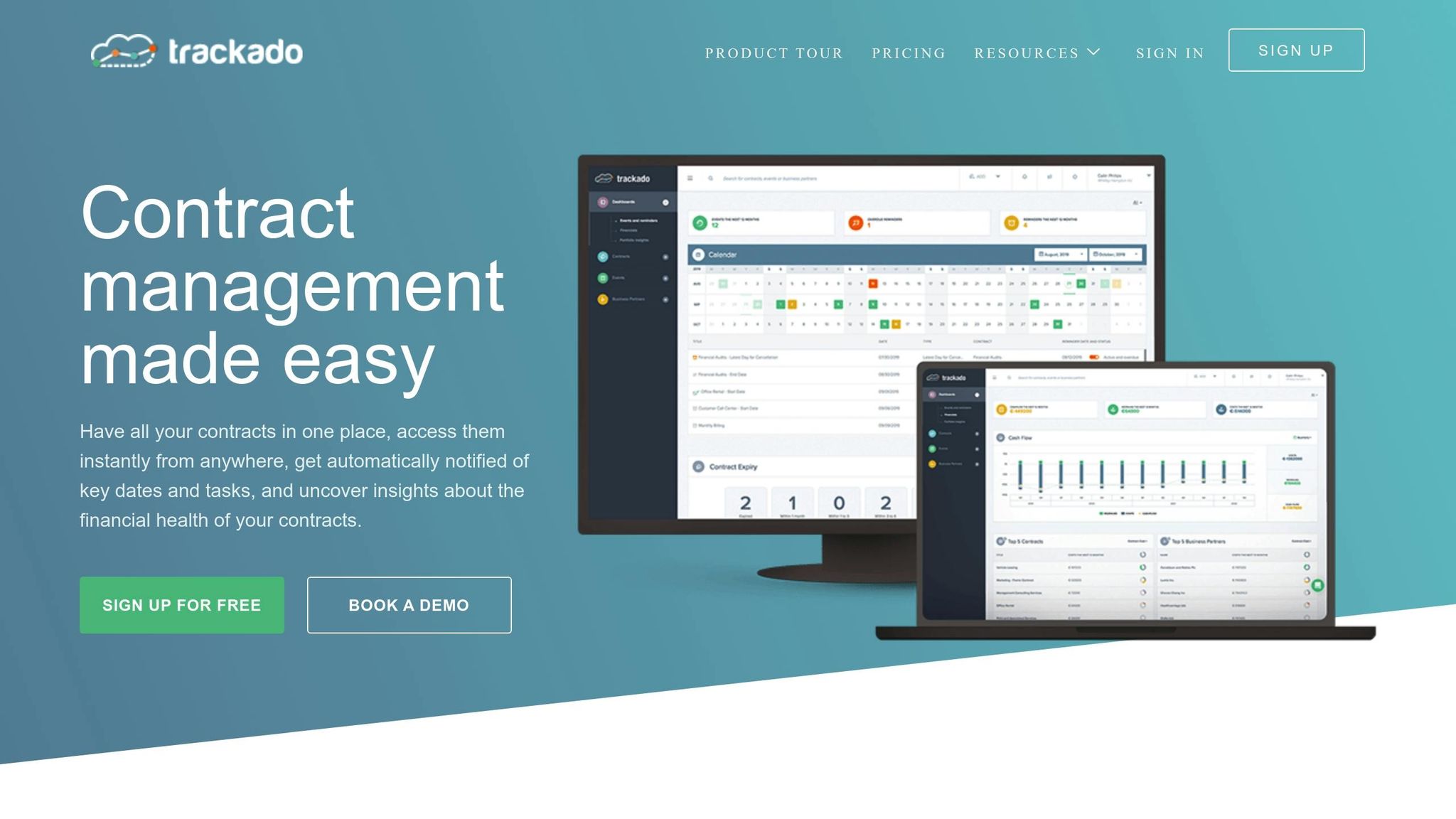
Trackado exemplifies how contract management platforms can use automation and security-focused designs to tackle regulatory risks effectively. With AI-powered data extraction, Trackado automatically identifies and pulls essential contract terms, compliance clauses, and financial details from uploaded documents. This speeds up vendor onboarding, ensures data accuracy, and supports real-time compliance tracking.
The platform’s customizable fields and milestone tracking allow businesses to adapt compliance monitoring to their specific needs. For instance, a healthcare provider can configure fields to track Business Associate Agreement (BAA) renewals, HIPAA certifications, and security assessments. Meanwhile, a financial services company might focus on SOX compliance documentation, audit reports, and regulatory attestations.
Task-based workflows ensure that required reviews are completed on time and clarify accountability. For example, if a high-risk vendor contract needs legal review before renewal, the system automatically routes it to the appropriate stakeholders and tracks its progress, preventing delays caused by forgotten emails or misplaced documents.
Trackado’s security measures are designed to meet strict regulatory requirements. Hosted in secure European data centers with SSL encryption, the platform complies with enterprise-grade standards as well as U.S. regulations like HIPAA and GLBA. Sensitive vendor and contract data are protected through encrypted storage and secure hosting, with detailed access logs available for audits.
Integrated e-signature capabilities simplify the contract execution process while ensuring proper compliance documentation. By managing the entire lifecycle of vendor contracts – from negotiation and approval to execution – within one platform, Trackado prevents version control issues and guarantees that all finalized agreements meet regulatory standards.
Additionally, Trackado’s financial transparency tools provide clear insights into costs, revenues, and critical dates. This feature is particularly valuable for budget planning and regulatory reviews. For small and medium-sized businesses, Trackado offers a cost-effective, user-friendly solution that delivers enterprise-grade vendor risk management without breaking the bank.
sbb-itb-49df6ae
Best Practices for Vendor Regulatory Risk Management
Building on the methods and tools previously discussed, these best practices can take your vendor regulatory risk program to the next level. Managing vendor regulatory risk effectively calls for a structured approach that incorporates regular updates on regulations, thoughtful vendor segmentation, and technology-driven monitoring. When executed well, these practices help maintain a compliant and resilient vendor network across your supply chain.
Align Policies with U.S. Regulatory Standards
To stay compliant, it’s essential to keep your risk management policies aligned with current U.S. regulations like GLBA, HIPAA, SOX, and CCPA. Regularly review these policies – whether quarterly or annually – to address new legislative changes and refine internal guidelines that support your due diligence efforts. Rely on regulatory update services and consult legal experts to ensure you’re ahead of the curve when it comes to compliance.
Segment Vendors by Regulatory Risk
Vendors don’t all carry the same level of regulatory risk, so it’s important to tailor oversight based on their risk profiles. Effective segmentation should factor in elements like the sensitivity of the data they handle, their access to critical systems, potential financial implications, and regulatory exposure. For instance, a healthcare provider might divide vendors into three tiers:
- Tier 1: Vendors with access to patient data; require annual audits and monthly monitoring.
- Tier 2: Vendors with system access but no patient data; require semi-annual reviews.
- Tier 3: Vendors with no system access; evaluated only at contract renewal.
Tracking key metrics – such as compliance breach counts, audit completion rates, risk scores by tier, remediation timelines, and contract renewal compliance – can help ensure your segmentation strategy is working effectively. Once your segmentation is in place, leveraging technology becomes essential for monitoring and managing these tiers efficiently.
Use Technology for Monitoring and Automation
As your vendor portfolio grows, relying on manual processes can lead to errors and inefficiencies. Automating monitoring tasks not only reduces these risks but also ensures compliance. Technology platforms centralize contract management, automate deadline tracking, and streamline other critical functions.
Take Trackado, for example. This platform addresses vendor management challenges with features like customizable fields and milestone tracking, allowing organizations to tailor compliance monitoring to meet specific regulatory needs. Whether it’s tracking SOX compliance documentation, audit reports, or regulatory attestations, the platform’s AI-powered data extraction simplifies the process. It identifies key contract terms and compliance clauses from uploaded documents, speeding up vendor onboarding while maintaining accuracy. For organizations managing large vendor portfolios, such tools provide the scalability and consistency needed to uphold compliance without overburdening internal teams.
Conclusion
Managing vendor regulatory risks is a critical strategy for safeguarding your business from financial setbacks, operational hiccups, and reputational harm. With more than 60% of U.S. data breaches involving third-party vendors and regulatory penalties often reaching millions per incident, the risks for businesses are immense.
As discussed earlier, successful vendor risk management relies on proactive evaluation and consistent monitoring. Companies with well-developed vendor risk programs experience 30% fewer compliance violations and recover from incidents 50% faster. These figures underscore why top-performing organizations are shifting from reactive compliance approaches to more comprehensive risk management systems.
Technology plays a key role in this transformation. Manual processes simply can’t keep up with the increasing complexity of vendor relationships and regulatory requirements. Automated risk management tools can cut vendor assessment times by as much as 50%, while ensuring evaluations are both accurate and consistent. This efficiency directly connects to the solutions offered by modern platforms.
Take Trackado, for example. This contract management platform uses automation and centralization to tackle vendor risk challenges effectively. Features like customizable fields and milestone tracking help ensure that no regulatory requirement is overlooked, turning vendor risk management into a strategic advantage.
While regulations will continue to evolve, businesses with strong practices in place are better equipped to adapt and succeed. Start by building a detailed vendor inventory, apply risk-based segmentation, and use technology to automate monitoring processes. These steps, as outlined earlier in discussions on vendor classification and due diligence, lay the groundwork for a resilient vendor management strategy that drives both compliance and growth.
FAQs
How can businesses verify that their vendors comply with important regulations like HIPAA and PCI-DSS?
To keep vendors aligned with important regulations like HIPAA and PCI-DSS, businesses need a well-organized approach to managing vendor risks. Start by performing detailed due diligence during the onboarding process. This means reviewing things like certifications, compliance reports, and security policies to ensure vendors meet the necessary standards. Make it a habit to request updated documentation regularly to confirm that vendors continue to comply with these regulations.
It’s also important to include clear compliance expectations in your contracts. Define these terms explicitly and incorporate periodic audits or assessments to keep an eye on vendor practices. Tools like Trackado can simplify this process by helping you track contract obligations, set reminders for compliance reviews, and centralize vendor documentation. This way, you can maintain better visibility and control over your vendor relationships.
How can I effectively monitor high-risk vendors to minimize data breaches and operational disruptions?
To keep an eye on high-risk vendors effectively, the first step is to put a strong vendor risk assessment framework in place. This means regularly reviewing vendors based on key factors like their data security measures, compliance with relevant regulations, and overall financial health. Leveraging tools or platforms that centralize vendor information and automate the risk monitoring process can save time and make oversight more efficient.
It’s also important to set up real-time alerts for critical issues, such as missed deadlines or potential security gaps. Periodic audits are another essential piece of the puzzle, helping ensure vendors stick to the agreed-upon standards. Lastly, maintaining open and clear communication with vendors is crucial. This helps address any problems quickly and fosters a sense of transparency in the partnership.
How does automating vendor risk management with tools like Trackado enhance compliance and reduce errors?
Automating vendor risk management with tools like Trackado makes compliance easier by organizing all contract-related information in one secure, centralized platform. This approach removes the hassle of manual tracking and reduces the chances of missing important deadlines or overlooking key details.
Trackado offers features such as automated reminders, milestone tracking, and task-based workflows to help you stay on top of obligations and contract renewals. By cutting down on manual processes, automation not only saves time but also minimizes the risk of human error, ensuring smoother operations and improved compliance with regulations.