
Missed renewals, compliance issues, and unfulfilled obligations can cost small and medium-sized businesses (SMBs) thousands of dollars annually. In fact, contract disputes cost U.S. businesses about $50,000 each, with SMBs losing up to 9% of contract value every year. Real-time monitoring offers a practical way to avoid these risks by automating contract oversight, sending timely alerts, and tracking obligations effectively.
Key Takeaways:
- Missed Renewals: Overlooking deadlines can lead to costly auto-renewals or service interruptions, eroding up to 40% of a contract’s value.
- Compliance Risks: Non-compliance with laws like GDPR or CCPA can result in fines ranging from $2,500 to $14,502 per violation.
- Unfulfilled Obligations: Failing to meet contract terms can damage partnerships and lead to disputes.
Tools like Trackado simplify contract management by offering features like automated email reminders, AI-powered metadata extraction, and GDPR-compliant security. Trackado’s pricing starts with a free plan and scales to meet growing business needs, making it accessible for SMBs to stay on top of their contracts and avoid financial pitfalls.
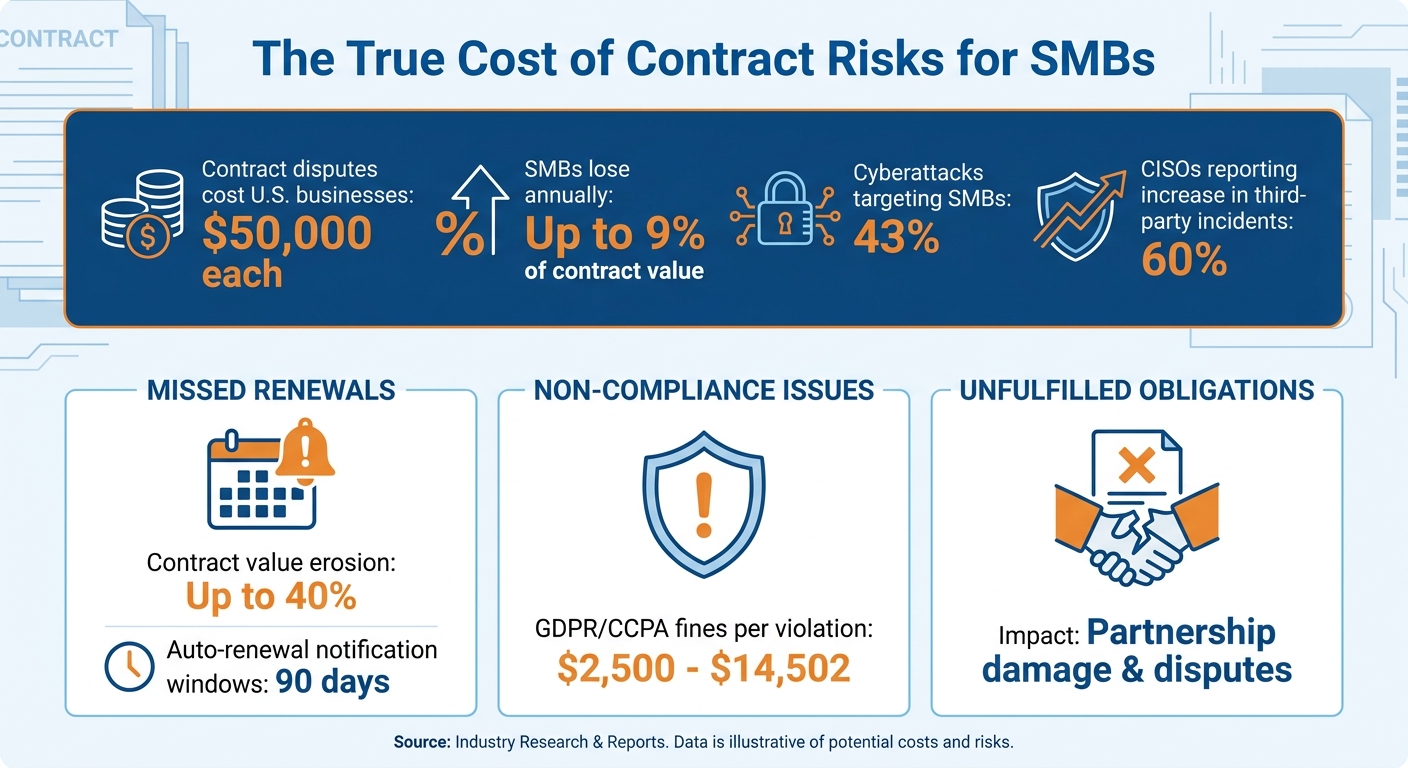
Contract Risk Statistics and Costs for SMBs
Common Contract Risks for SMBs
Small and medium-sized businesses (SMBs) often face three major contract challenges: missed renewals, non-compliance, and unfulfilled obligations. With limited resources, these risks can snowball into costly problems. Let’s break down why each issue matters and how real-time monitoring can help avoid them.
Missed Renewals
Overlooking renewal deadlines can cost businesses dearly. Without a dedicated team to manage contract timelines, SMBs often realize a contract has expired only when it’s too late. This can lead to service interruptions and a loss of leverage in negotiations. Vendors, aware of the tight timeline, can dictate terms that may not favor the SMB. In fact, research shows that poor renewal management can erode up to 40% of a contract’s value.
Auto-renewal clauses are another trap. Missing the notification window – often as long as 90 days – can lock businesses into agreements that no longer align with their needs. Beyond the financial strain, missed renewals can disrupt operational planning and limit flexibility.
Non-Compliance Issues
Falling short on compliance can lead to fines and reputational damage. Compliance isn’t just about adhering to laws; it also involves meeting the specific terms laid out in contracts. This can range from maintaining data protection standards to hitting service level targets. Without proper tracking systems, SMBs are more likely to overlook these requirements, exposing themselves to legal and financial risks.
Unfulfilled Obligations
Unmet contractual obligations can harm critical partnerships. Contracts outline key terms like payment schedules, delivery deadlines, performance metrics, and reporting requirements. When businesses fail to meet these expectations, it can lead to misunderstandings that strain relationships. Over time, these lapses may escalate into disputes, especially if the contract language is unclear or responsibilities are poorly defined.
sbb-itb-49df6ae
How Real-Time Monitoring Reduces Contract Risks
Real-time monitoring takes the guesswork out of contract oversight by automating processes, reducing human error, and minimizing risks. These risks – like missed renewals, compliance lapses, or unfulfilled obligations – can be overwhelming without an automated solution. Instead of relying on spreadsheets or calendar reminders that are easy to miss, automated systems provide consistent oversight and allow businesses to scale their monitoring efforts without adding more staff. This is especially important when you consider that 43% of cyberattacks target small and medium-sized businesses (SMBs) and 60% of CISOs report an increase in third-party incidents. These systems are designed to streamline key tasks like tracking renewals, ensuring compliance, and managing obligations.
Managing Renewals Ahead of Time
One of the standout benefits of real-time monitoring is automated alerts for contract renewals. These notifications ensure SMBs stay ahead of deadlines, avoiding the chaos of unexpected expirations. This kind of proactive system keeps contracts current and prevents disruptions.
Maintaining Compliance with Continuous Oversight
Beyond renewals, continuous monitoring plays a critical role in maintaining compliance. It helps businesses catch small compliance issues early, ensuring that third parties meet standards like GDPR, HIPAA, and PCI-DSS. As Panorays explains:
Continuous monitoring involves security audits, compliance reviews, and using monitoring tools to track third-party behavior for suspicious anomalies.
Additionally, these systems generate audit trails that document compliance efforts. This is increasingly vital, as cyber insurers now require verified proof of effective controls during compliance reviews.
Tracking and Meeting Obligations
A unified platform simplifies the tracking of payment schedules, deadlines, and performance metrics, while also enabling vendor risk tiering. By consolidating these tasks, businesses eliminate the blind spots caused by fragmented tracking systems. Furthermore, holding vendors accountable through clear contractual clauses – like breach notification timelines or audit rights – empowers SMBs to address potential issues early, rather than uncovering them later during disputes.
Using Trackado for Real-Time Contract Monitoring
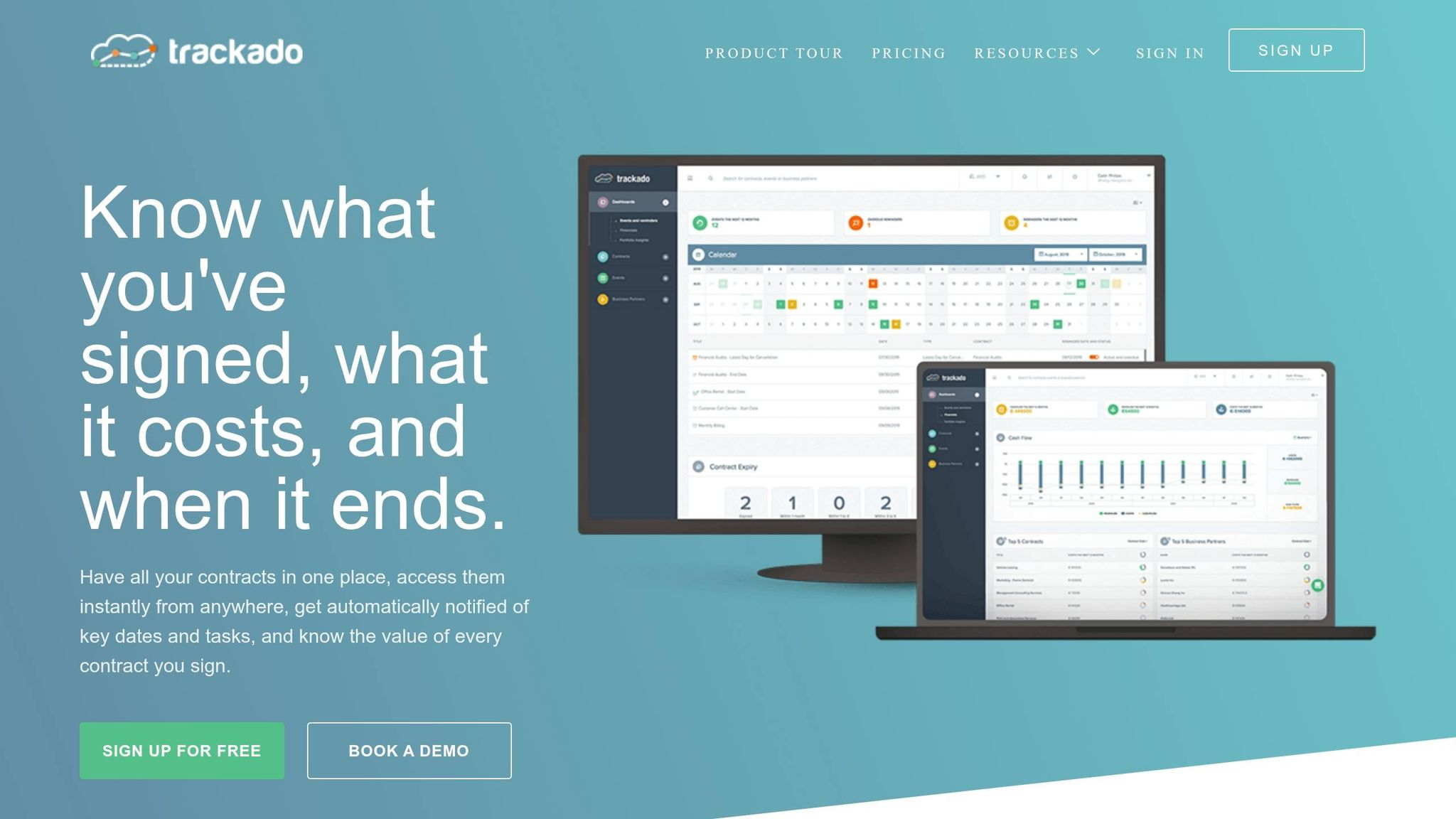
Trackado simplifies contract management for SMBs, offering a centralized, cloud-based platform that eliminates the need for spreadsheets and manual tracking. Designed for businesses without legal teams or complex enterprise systems, it provides a single, secure location to store contracts electronically. With instant access through any web browser, Trackado ensures clear and consistent oversight of all contract data.
Features Built for SMB Efficiency
Trackado takes the hassle out of contract management by automating tedious tracking tasks. Features like automated email reminders keep teams informed about critical dates, contract milestones, and renewal deadlines, helping avoid costly auto-renewals or service interruptions. The platform’s centralized billing feature enables businesses to monitor both supplier expenses and customer revenue in one place.
A standout feature, the "email-in" capability, allows users to upload contracts directly to the system by CCing a unique Trackado email address during the sales or signing process. Daisy Miller, Project Coordinator at Zapmap, shares her experience:
"The ability to work with our contracts in the repository has made contract admin so much easier! The email-in feature is also something we use extensively… the contract is then uploaded directly to our repository."
Additional features include AI-assisted metadata extraction for faster data entry, customizable fields for organizing contracts, and audit trails to simplify compliance checks. With GDPR-compliant data processing, EU-based hosting, and end-to-end encryption, Trackado ensures sensitive business data is handled securely.
Trackado’s well-rounded feature set not only reduces contract risks but also ensures a smooth and quick adoption process.
Simple Adoption with Fast Results
Unlike complex enterprise tools that demand months of setup, Trackado is ready to use almost immediately. Its cloud-based design eliminates installation requirements, and teams can sign up for free and start managing contracts without extensive training. This self-serve approach lets SMBs tackle renewal and compliance challenges right away. Peter Skeen, Head of Legal, Procurement and Company Secretarial at Good Energy, praises the ease of use:
"We like that Trackado is simple to use and that we could fairly easily tailor it without costly development time. I would recommend it for any business looking for its first contract management system."
Trackado delivers noticeable results quickly, as Yiannis Karavassilis, COO at CloudKid, explains:
"The moment we knew we had made the right choice with Trackado was when we received email notifications that gave us a heads-up when something was ending or renewing. This really helped us to keep on top of things and avoid sticky situations with partners we didn’t want to continue to work with."
Pricing Plans for SMBs
Trackado’s pricing model is designed to grow with your business. It starts with a 30-day free trial, no credit card required, and offers scalable options to fit various needs:
| Plan | Monthly Price | Users | Contracts | Custom Fields | Key Features |
|---|---|---|---|---|---|
| Free | $0 | 1 | 15 | 2 | Basic contract storage and tracking |
| Starter | $39 | 3 | 60 | 5 | Expanded capacity for small teams |
| Business | $129 | 8 | 300 | Unlimited | Workflows and advanced customization |
| Enterprise | $299 | 25 | Unlimited | Unlimited | Workflow templates, SAML, API access |
The Free plan is perfect for businesses just starting out, while the Starter and Business plans provide additional capacity as contract volumes grow. For larger needs, the Enterprise plan offers unlimited contracts and users, with additional users available for $10 per month each.
Wrapping It Up
For small and mid-sized businesses, missing renewals, falling out of compliance, or neglecting obligations can do more than just disrupt daily operations – they can chip away at financial health and customer trust.
Real-time monitoring steps in to automate oversight, sending continuous alerts that help prevent small oversights from turning into expensive problems.
Cloud-based tools make this level of monitoring easier than ever. Take Trackado, for example – a centralized platform that removes blind spots and streamlines contract tracking. With features like automated reminders for deadlines, AI-powered metadata extraction, and GDPR-compliant security, it tackles contract risks head-on without the need for heavy training or IT involvement.
FAQs
What should I monitor in a contract in real time?
Keeping an eye on key dates and obligations is crucial to sidestepping risks like missed renewals, non-compliance, or overlooked commitments. Pay special attention to renewal dates, expiration dates, and milestone deadlines to ensure nothing slips through the cracks. Staying on top of compliance requirements and obligations is also essential to avoid potential breaches. Tools such as automated reminders and centralized tracking systems can make this process much easier, helping you manage these critical details efficiently and ahead of time.
How far ahead should renewal alerts be sent?
Renewal alerts are best sent at three key intervals: 90 days, 30 days, and 7 days before a contract expires. This timeline gives enough room for reviewing the terms, making decisions, and taking necessary actions, reducing the risk of missed renewals or unexpected interruptions.
How does real-time monitoring help with audits and compliance proof?
Real-time monitoring allows organizations to keep a constant eye on their obligations, deadlines, and regulatory requirements. By doing so, it ensures that accurate and up-to-date documentation is always at hand, making it much easier to demonstrate compliance when audits occur.