
Missed contract deadlines are expensive. Businesses lose 9.2% of annual revenue due to poor contract management, with global losses reaching $2 trillion each year. Manual systems like spreadsheets fail to track deadlines effectively, leading to financial penalties, compliance issues, and missed opportunities.
Here’s how automation solves these problems: Following a contract automation checklist can help you get started.
- Prevents missed renewals: Automated alerts (90, 60, 30 days, etc.) ensure no deadlines are overlooked, avoiding costly auto-renewals or penalties.
- Saves time: Automation reduces manual effort, freeing up teams to focus on higher-impact tasks.
- Improves compliance: Tracks regulatory requirements, flags hidden clauses, and minimizes legal risks.
- Speeds up workflows: Automates contract approvals and routing for faster cycles.
- Provides real-time insights: Centralized dashboards and AI-powered tools turn deadlines into opportunities for better decisions.
Key stat: Companies using automation improve contract renewal efficiency by 40% in three months. Tools like Trackado simplify contract tracking, starting at just $39/month. Stop risking revenue – automate your contract management today.
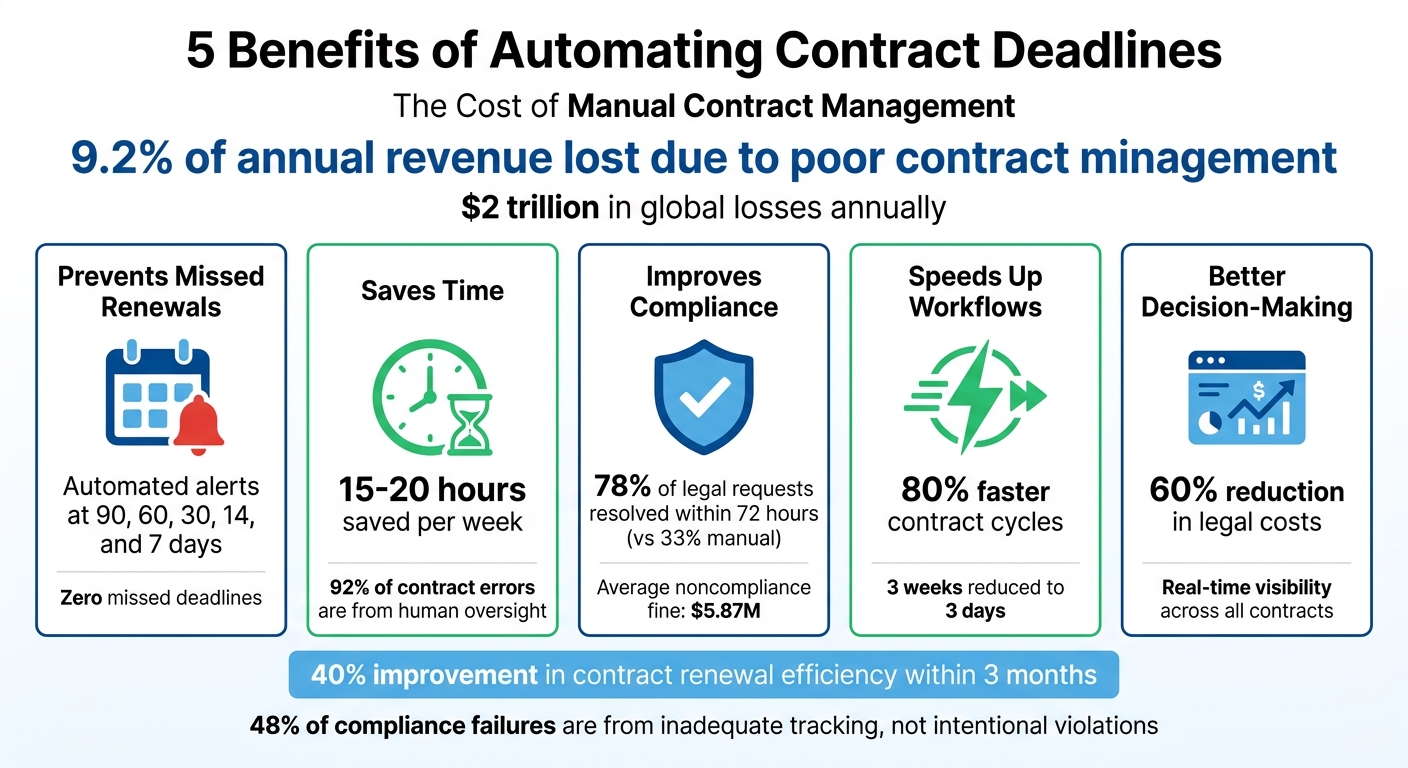
5 Benefits of Automating Contract Deadlines: Key Statistics and Outcomes
1. Prevents Missed Renewals and Avoids Financial Penalties
Automatic Deadline Tracking
Relying on manual tracking often leads to missed notice periods. Take this example: a contract renewing on December 31 might require a 90-day cancellation notice, making October 2 the critical deadline. Miss that date, and you could face automatic renewals with price hikes of 5–10%.
Automation simplifies this process by calculating deadlines using a straightforward formula:
Notice Deadline = Renewal Date – Termination Notice Days.
It also sends reminders at intervals like 90, 60, 30, 14, and 7 days before the deadline. These alerts ensure your team has ample time to review terms and take action.
"The moment we knew we had made the right choice with Trackado was when we received email notifications that gave us a heads-up when something was ending or renewing. This really helped us to keep on top of things and avoid sticky situations with partners we didn’t want to continue to work with." – Yiannis Karavassilis, COO, CloudKid
By avoiding missed deadlines, automation not only prevents unwanted renewals but also shields your organization from financial and legal pitfalls.
Compliance and Risk Management
Accurate deadline tracking is just the start – automated systems also minimize risks by spotting hidden clauses and ensuring compliance. Missing deadlines can lead to costly consequences. For instance, HIPAA violations tied to expired Business Associate Agreements can range from $100 per day to as much as $1.5 million annually per category.
Automation tools go beyond basic tracking by scanning contracts for hidden clauses, such as auto-renewal traps or price escalation terms. These tools make it easier to renegotiate contracts before deadlines, often saving companies 15–30% compared to last-minute efforts.
Solutions like Trackado use AI to extract critical dates and terms from contracts automatically. This ensures nothing slips through the cracks, even as your contract portfolio expands.
sbb-itb-49df6ae
2. Reduces Manual Work and Frees Up Team Resources
Automation doesn’t just prevent missed renewals – it completely changes how teams handle their day-to-day tasks.
Cutting Down on Manual Work
Tracking contracts manually takes up a lot of time that could be spent on more impactful projects. For teams managing hundreds of contracts, this can mean losing 15–20 hours per week – almost half the workload of a full-time employee. Imagine what could be accomplished if that time were redirected to more strategic efforts.
Plus, manual processes are often riddled with common contract management mistakes. A staggering 92% of contract management errors stem from human oversight. And it’s not just about contracts – 18% of accountants admit to making financial errors daily. Relying on manual methods can also lead to version control problems and outdated data, creating even more headaches.
Streamlining Workflows
Automation simplifies how teams meet contract deadlines and manage obligations. For example, AI-powered OCR (optical character recognition) can extract critical details like dates, payment terms, and obligations from PDFs in seconds – what previously required days of manual effort. Automated systems also speed up legal request handling; 78% of legal requests are resolved within 72 hours using automation, compared to just 33% with manual workflows.
These tools free up resources for higher-value tasks. Procurement teams can shift their focus from administrative tracking to strategic sourcing and fostering vendor relationships. Legal teams spend less time answering routine questions and more time acting as strategic advisors across departments. Meanwhile, sales and commercial teams gain the ability to independently access key details, like notice periods, without waiting on others.
Platforms like Trackado take efficiency to the next level by using AI to extract contract metadata automatically. This eliminates the need for manual reviews and gives teams instant access to the information they need. Combined with automated deadline tracking, these tools help drive better performance across the board.
3. Improves Compliance and Reduces Legal Risk
Compliance and Risk Management
Poor contract management can be a costly mistake – organizations lose about 9% of their annual revenue due to inefficiencies in this area. Noncompliance is even more expensive. In 2022, the average fine for a single noncompliance event was $5.87 million, and when you factor in business disruption, lost productivity, and reputational harm, the total cost can skyrocket to around $14 million.
Automation offers a way to stay ahead of these risks. By continuously monitoring contract terms throughout their lifecycle, automated systems eliminate the need for manual tracking via memory or outdated spreadsheets. These tools are designed to track regulatory requirements and identify clauses that don’t align with current legal standards. This proactive approach includes automated alerts, which help ensure compliance and reduce exposure to legal risks.
Automatic Deadline Tracking
Missed deadlines can lead to serious legal consequences, but automated systems take the uncertainty out of the equation. They send tiered alerts well in advance of key dates, giving teams sufficient time to renegotiate terms, terminate unfavorable agreements, or address other critical issues.
The difference automation makes is clear. Companies using automated tools can respond to legal requests within 72 hours in 78% of cases, compared to only 33% for those relying on manual processes. Tools like Trackado offer features such as automatic deadline reminders and milestone tracking, ensuring that important dates like notice periods and renewal deadlines are never missed. Using a contract renewal planner can further streamline this process by providing a clear schedule of upcoming dates.
Data Transparency and Insights
Beyond just meeting deadlines, automation centralizes contract data, providing real-time insights into compliance. A secure digital contract repository acts as a single source of truth, solving a common problem: 71% of companies admit they can’t locate at least 10% of their signed contracts. Scattered documents across emails and shared drives make it nearly impossible to stay audit-ready or verify compliance on demand.
Without a centralized system, contracts end up scattered across inboxes and shared drives, making it nearly impossible to stay audit-ready or act on renewals before it’s too late.
AI-powered tools simplify this process by transforming unstructured PDFs into searchable, structured data in minutes. Companies that embrace digitization and encourage its adoption see tangible results, including a 75% reduction in accounting errors. This not only saves time but also minimizes risks, making compliance more manageable and efficient.
4. Speeds Up Contract Cycles and Approval Workflows
Workflow Efficiency
Slow contract cycles can drain resources and delay revenue. Companies using automated contract management systems report an average of 80% faster cycle times – from initial bid to signed agreement. In about 40% of organizations, there’s confusion over who handles the contract workflow. Automation clears up this ambiguity by using pre-configured rules to automatically route contracts. For example, contracts exceeding $50,000 can be sent directly to the VP of Finance, while smaller agreements follow a different approval path. This smart routing prevents contracts from sitting idle in inboxes while teams figure out the next steps, saving time and reducing bottlenecks.
Reduction in Manual Effort
Relying on manual processes for contract routing often leads to unnecessary delays. Automated workflows, enhanced with integrated e-signatures and smart intake forms, can shrink approval cycles from weeks to just days – cutting a typical three-week process down to three days. Smart intake forms gather all critical details upfront, ensuring every contract is immediately placed into a trackable pipeline instead of being buried in endless email chains. On top of that, AI-assisted metadata extraction can automatically surface key dates, obligations, and payment terms from uploaded contracts, reducing the manual review burden before contracts reach a human reviewer.
Data Transparency and Insights
With streamlined workflows in place, centralized dashboards provide a clear, real-time view of contract statuses. These dashboards eliminate the need for constant manual updates by showing exactly where each contract is in the approval process. Teams across Sales, Legal, Procurement, and Finance can access the same information simultaneously, reducing communication gaps. Tools like Trackado enhance this with approval workflows and milestone tracking to keep everyone on the same page. Automated notifications via Slack or email prompt approvers to act quickly, helping project managers spot bottlenecks and make informed decisions based on real-time data.
5. Supports Better Decision-Making with Real-Time Visibility
Data Transparency and Insights
Automated tracking tools give teams instant access to crucial data, turning what were once overlooked dates into opportunities for strategic decision-making. Real-time dashboards take contract deadlines beyond administrative tasks, transforming them into what experts call "revenue moments." These are key points where businesses can decide whether to renew, renegotiate, or terminate agreements, unlocking untapped potential.
This level of visibility also helps uncover contract leakage – the difference between a contract’s expected value and what’s actually realized. Leakage often happens due to missed billing for extra services, unintended discounts, or unnoticed pricing adjustments. With real-time insights, organizations can address these gaps, ensuring they maximize the value of every agreement.
Automatic Deadline Tracking
Automated systems offer a clear view of expiring contracts, helping teams prioritize high-value renewals and renegotiations well before deadlines. For example, annual price escalation clauses – typically ranging from 3–5% – can automatically kick in unless flagged in advance. Tools like Trackado make this process even easier by using clause extraction and classification to convert unstructured contract text into searchable metadata. This allows teams to perform full-text searches and generate detailed reports across their entire contract portfolio.
Using filters for partner, category, department, or custom fields, teams can quickly evaluate financial commitments, lease obligations, and future cash flows. This granular visibility not only simplifies renewal decisions but also supports more accurate budgeting and forecasting.
Compliance and Risk Management
Real-time visibility shifts risk management from being reactive to proactive. Automated systems instantly flag non-compliance issues and contractual anomalies, addressing a significant concern – 48% of compliance failures are caused by inadequate tracking, not intentional violations.
Automated audit trails further enhance compliance by documenting who was notified of a milestone and what actions were taken. This level of accountability is invaluable during regulatory investigations. By standardizing and automating contract management processes, organizations can reduce legal and negotiation costs by as much as 60% by identifying and addressing issues early.
Conclusion
Automating contract deadlines safeguards your revenue while allowing your team to focus on higher-priority tasks. Consider this: poor contract management costs businesses an average of 9% of their annual revenue, and human errors are responsible for 92% of contract-related mistakes. Companies that stick to manual systems are 3.2 times more likely to encounter service disruptions tied to contracts.
Spreadsheets might feel familiar, but they offer a false sense of control. By switching to automated tracking, you replace static lists with dynamic tools like automatic alerts and audit trails. For instance, organizations using fully automated systems can respond to legal requests within 72 hours in 78% of cases, compared to just 33% with manual methods.
For small and mid-sized businesses, automation doesn’t have to mean complexity or high costs. Tools like Trackado provide a user-friendly option for centralized contract storage, deadline reminders, and real-time updates. Starting at $39/month – with a free tier for managing up to 15 contracts – it’s designed to deliver results without requiring lengthy setups or steep learning curves.
Getting started is simpler than you might think. Most teams can be up and running within four weeks. Set up multi-stage alerts – 90, 60, 30, and 7 days before key deadlines – to ensure ample time for approvals or negotiations. Escalation rules can also be put in place, so if a primary contact misses an alert, a manager is automatically notified.
This proactive approach not only saves time but also tackles the inefficiencies that come with manual processes. The risks of inaction – missed renewals, contract management risks, compliance issues, and lost revenue – can add up fast. The solution is clear: automated tracking transforms deadlines into opportunities for smarter, more strategic decisions.
FAQs
How do I choose the right reminder intervals for renewals?
To stay on top of your contracts, align your reminder intervals with the notice periods outlined in the agreements – usually 30 to 60 days before renewal dates. This timing gives you enough room to review the terms, negotiate changes, or cancel if necessary. By automating these reminders, you can dodge unexpected auto-renewals, cut unnecessary costs, and minimize compliance risks. Adjust the timing for each contract based on its specific terms to ensure smoother management throughout its lifecycle.
What contract data should I track beyond renewal dates?
Tracking more than just renewal dates is crucial when managing contracts. Pay attention to terms, obligations, renewal and notice periods, pricing escalation clauses, and compliance requirements. Keeping an eye on these details can help you minimize risks, stay compliant, and improve the chances of successful renewals.
How can I roll out automated deadline tracking without disrupting my team?
To make automated deadline tracking work effectively, you need a system that ensures accountability, sends timely reminders, and flags potential issues before deadlines are missed. Begin by identifying and extracting deadlines, then turn them into actionable tasks with clearly assigned owners. Tools like Trackado, a structured contract management platform, can centralize all your contracts, automate reminders, and handle obligations efficiently. This approach minimizes manual work while maintaining accountability and compliance without causing unnecessary interruptions.