
When a vendor sends you a contract, the dispute resolution clause is easy to skip. It feels hypothetical – you’re not planning to fight anyone. But the terms buried in that clause determine how much time and money you’ll spend if something does go wrong. Here’s what to check before you sign.
Here’s the plain-English version:
- Does the scope cover all relevant disputes? Look for "arising out of or relating to" language – narrower wording like "arising under" can leave payment, SLA, or data-related claims outside the clause.
- Is there a carve-out for urgent situations? Check that either party can still seek emergency court relief (e.g. for IP or confidentiality breaches) without going through the full dispute process first.
- Is there a clear escalation path? A well-drafted clause requires written notice, then manager-level talks, then executive escalation before formal proceedings begin. If it jumps straight to arbitration, that’s a red flag.
- Are timelines specified? Look for firm deadlines – typically 15-30 business days for negotiation, 30 days for mediation. Vague language like "reasonable time" can be exploited.
- Does work continue during a dispute? The clause should require both parties to keep performing undisputed obligations while the process runs. If it doesn’t, a vendor could pause delivery the moment a dispute is raised.
- Are mediation and arbitration terms clearly defined? Check for named provider (AAA, JAMS, ICC), number of arbitrators, seat, language, and whether the award is binding.
- Who pays? Look for how filing fees, neutral fees, and legal costs are allocated. "Each party pays its own" is standard – watch out for one-sided fee-shifting clauses.
Takeaway: if your vendor clause does not tell people what gets covered, who acts next, where the fight goes, and who pays, you may end up arguing about the process before you even reach the problem itself.
| Clause area | What I’d look for |
|---|---|
| Scope | “Arising out of or relating to” language, plus survival after termination |
| Urgent court relief | Clear carve-out for TROs and injunctions |
| Escalation | Written notice, named contacts, settlement authority, deadlines |
| Mediation | Required or optional, start method, mediator selection, 50/50 fee split |
| Arbitration | Rules, seat, language, arbitrator count, final-and-binding wording |
| Court terms | Governing law, jurisdiction, venue, enforcement court |
| Costs | Filing fees, neutral fees, attorneys’ fees, prevailing-party rule |
If I were reviewing a vendor agreement, I’d use this as a fast screening list before the contract goes out for signature.
Note: This post is for informational purposes only and does not constitute legal advice. Contract dispute clauses vary significantly by jurisdiction, contract type, and specific business circumstances. Always consult a qualified legal professional before drafting or signing contracts with dispute resolution provisions.
Checklist Item 1: Does the Clause Cover All Relevant Disputes?
Start by making sure the clause covers the disputes you’re most likely to face.
Include Broad Contract-Related Disputes
Use "arising out of or relating to this Agreement" instead of "arising under." The second phrase is narrower, and courts may read it in a way that leaves out related tort or statutory claims.
It also helps to name the main dispute categories outright. That usually includes formation, validity, interpretation, performance, breach, termination, enforceability, SLA failures, payment disputes, and data security incidents.
Post-termination claims are easy to miss, and that can cause a mess later. If there’s no survival provision, the clause may stop applying once the contract ends. That can leave disputes over data return, transition help, or final invoices without an agreed forum. State that the dispute-resolution clause survives termination and expiration. That keeps those later disputes inside the same process.
Add Clear Carve-Outs for Urgent Court Action
A broad scope clause also needs a clear carve-out. The clause should say that each party keeps the right to seek preliminary injunctive relief or a temporary restraining order in a court of competent jurisdiction, without first going through the usual dispute tiers.
This carve-out fits urgent harm, like IP theft or confidentiality breaches. For more routine issues, such as SLA, payment, and change-order disputes, use the standard contract process. For urgent IP and confidentiality claims, use the court carve-out.
Next, set the escalation path so covered disputes move through the contract in order.
sbb-itb-49df6ae
Checklist Item 2: Is There a Clear Escalation Path?
After you define the dispute scope, spell out the exact steps both sides must take before anyone files in arbitration or court. The clause should set a clear path: written notice, negotiation, then mediation before either side starts formal proceedings.
Require Written Notice and Named Decision-Makers
Start with written notice sent through a verifiable method to the contract’s notice address. That notice should be a required first step before either party can file.
Then move the issue up the chain in two levels. At Level 1, the dispute goes to project or account managers. At Level 2, it moves to senior executives who have settlement authority. For smaller companies, Level 2 should name the owner or founder.
Set Firm Deadlines for Negotiation and Mediation
Use firm timelines so the process doesn’t drag on. Set 15 to 30 business days for negotiation. If the dispute isn’t resolved, require mediation within 30 days. Use business days, not calendar days, and toll limitation periods during the escalation process so good-faith negotiations don’t cause a claim to expire.
Also state that both parties must keep performing their undisputed obligations while the process is underway, so undisputed work and payments continue during the dispute.
Checklist Item 3: Are Mediation and Arbitration Terms Well-Defined?
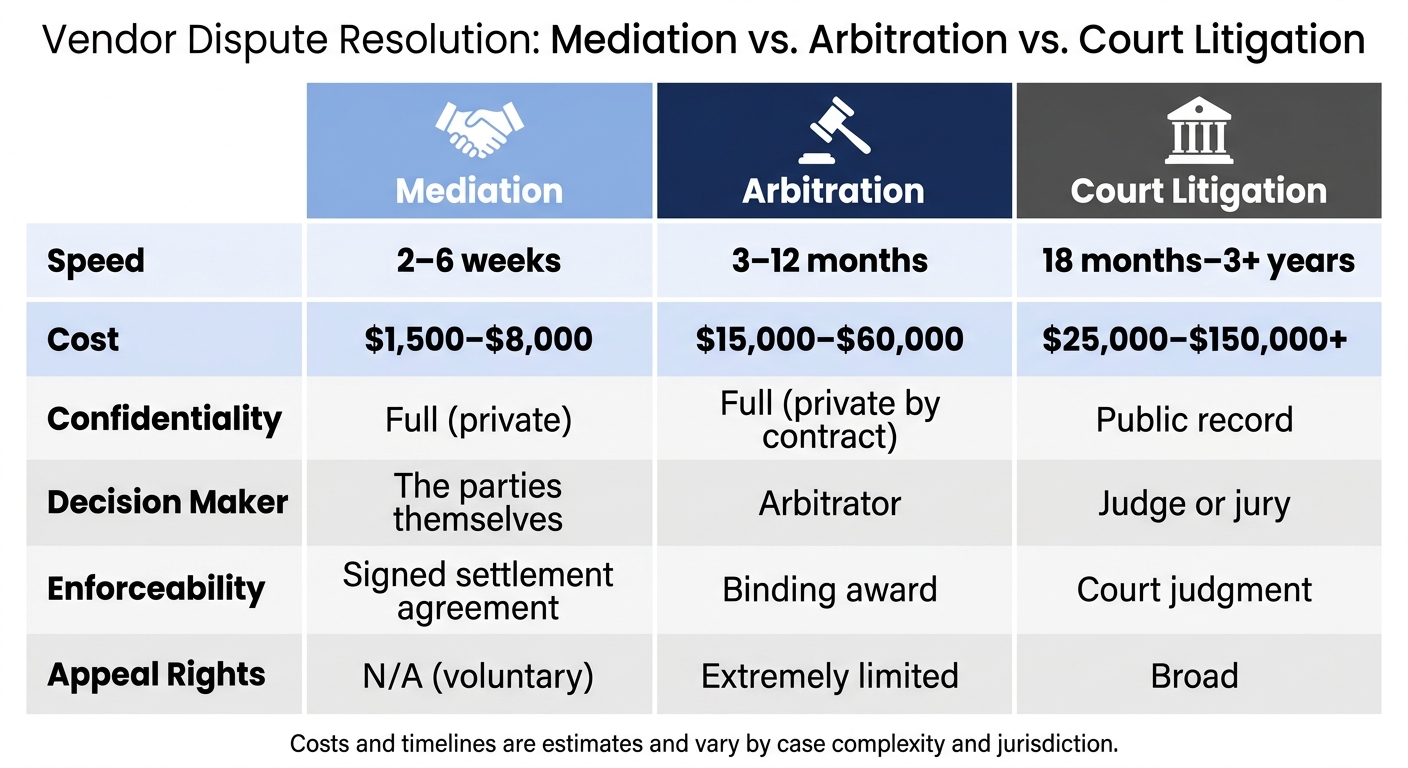
Mediation vs. Arbitration vs. Court Litigation: Cost, Speed & Key Differences
Spell out the mediation and arbitration steps that the escalation path will trigger.
State Whether Mediation Is Mandatory, How It Starts, and Who Pays
Say plainly whether mediation must happen before arbitration or litigation. Then explain how it begins. That usually means a written request sent to the other party and a named administrator, such as AAA or JAMS.
The clause should also explain how the mediator is chosen. A common setup is simple: the parties try to pick the mediator together first. If they can’t agree within 15 days, a neutral authority appoints one.
Fee splitting matters too, so put it in writing. In many contracts, mediation fees are split 50/50. You should also state that all mediation communications are confidential and inadmissible in any later proceeding.
Lock Down the Arbitration Rules, Seat, and Enforceability
If mediation doesn’t work, the next step is arbitration. This part of the clause should name the administering institution, the rules, the number of arbitrators, the seat, and the language.
The seat isn’t just a formality. It determines the procedural law and which court has supervisory jurisdiction.
Include "final and binding" language and state that "judgment on the award may be entered in any court having jurisdiction". That line does a lot of work. For vendor contracts that cross state lines or involve international suppliers, it can matter even more because the New York Convention allows arbitration awards to be enforced in more than 170 signatory countries.
Next, separate governing law, venue, and cost allocation from the dispute process.
Comparison Table: Mediation vs. Arbitration vs. Court
Use this table to compare the three paths at a glance.
| Feature | Mediation | Arbitration | Court Litigation |
|---|---|---|---|
| Speed | 2–6 weeks | 3–12 months | 18 months–3+ years |
| Cost | $1,500–$8,000 | $15,000–$60,000 | $25,000–$150,000+ |
| Confidentiality | Full (private) | Full (private by contract) | Public record |
| Decision Maker | The parties themselves | Arbitrator | Judge or jury |
| Enforceability | Signed settlement agreement | Binding award | Court judgment |
| Appeal Rights | N/A (voluntary) | Extremely limited | Broad |
Then align the forum terms with governing law and venue.
Checklist Item 4: Are Governing Law, Venue, and Costs Clearly Separated?
After the arbitration section, spell out the court rules that still apply.
Choose Governing Law, Court Jurisdiction, and Venue Separately
Governing law, jurisdiction, and venue are not the same thing, so they need separate clauses.
Governing law sets the contract’s substantive rules. Jurisdiction tells you which court system can hear the case. Venue says where that court case will be heard. That split matters because courts can still step in for injunctive relief or to enforce an award.
Be specific. Name the court that can handle injunctive relief or enforcement, and make the court jurisdiction and venue exclusive to cut off forum shopping.
Decide How Fees, Expenses, and Finality Are Handled
Next, decide who pays the procedural costs.
This is one of those spots where vendor contracts often go quiet, and that silence can create risk. Your clause should cover filing fees, neutral compensation, and attorneys’ fees.
You should also say whether the prevailing party can recover reasonable fees and costs, or whether each side pays its own.
Track Clause Dates, Owners, and Renewal Risks in One Place
Then make sure these terms stay current when the contract renews.
Old forum or governing law terms can roll over by default and create avoidable risk. Use Trackado to track renewal dates, clause owners, and review deadlines, so old forum or law terms don’t renew automatically.
Conclusion: The Minimum Dispute Resolution Clause Checklist
When reviewing a vendor’s dispute resolution clause, you’re not looking for perfection. You’re looking for gaps. A clause that leaves out scope, escalation timelines, mediation terms, or cost allocation puts you at a disadvantage before a dispute even starts. Use this as your pre-signature checklist: scope, escalation path, mediation and arbitration terms, governing law and venue, and cost allocation. If any of these are missing or vague, flag them before you sign, not after.
Review these terms at each renewal so the clause stays current – Trackado helps track renewal dates and key clause details so nothing rolls over by default.
FAQs
When should a dispute clause survive termination?
A dispute resolution clause should expressly survive termination. That way, both parties still have to use the agreed process to handle claims tied to the contract’s performance, validity, breach, or termination.
This matters because disputes often show up after a contract ends. Think final payment issues, handoff duties, or other transition-related obligations. Without survival language, one party may try to sidestep the agreed dispute process simply because the contract is no longer in effect.
How do I choose between mediation, arbitration, and court?
Choose the path that fits your business goals, your relationship with the other party, and the terms in the contract.
Start with negotiation. It helps protect the relationship and keeps costs under control. If that doesn’t work, move to mediation for a voluntary settlement.
Choose court if you want a more accessible process and the option to appeal, especially for lower-value contracts. Choose arbitration if privacy matters, if the dispute needs technical expertise, or if you may need international enforcement under the New York Convention.
What fee rule should a vendor contract use?
Vendor contracts usually use a few standard ways to divide dispute-related costs. In many cases, the parties split mediation or neutral fees equally. Another common setup is that each side pays its own legal costs. Some agreements also use a loser-pays model.
Some contracts go a step further. They shift fees based on relative success or bad faith, and they may add reasonableness standards or recovery caps to keep expenses in check.