
Power Purchase Agreements (PPAs) are long-term contracts that support renewable energy projects, offering stable energy prices and reducing market volatility. However, they come with risks that can impact costs, compliance, and project success. This includes navigating the complexities of accounting for Power Purchase Agreements. Here’s a quick breakdown of the five key risks and how to manage them:
- Volumetric Risk: Energy generation may not match forecasts due to weather, equipment issues, or grid curtailment. Solutions include performance guarantees, Volume Firming Agreements (VFAs), and real-time monitoring.
- Shape Risk: Mismatched energy production and demand patterns can lead to higher costs. Mitigation strategies include energy storage, diversified energy sources, and contract structures like baseload PPAs.
- Regulatory and Policy Risk: Changing regulations can disrupt projects or alter financial outcomes. Use change-in-law clauses, off-ramp provisions, and supply chain audits to stay compliant.
- Counterparty and Credit Risk: Financial instability of buyers or developers can derail projects. Perform due diligence, secure financial guarantees, and include step-in rights in contracts.
- Market and Price Risk: Price fluctuations can make PPAs uncompetitive. Manage this with price collars, shorter contract durations, and financial modeling.
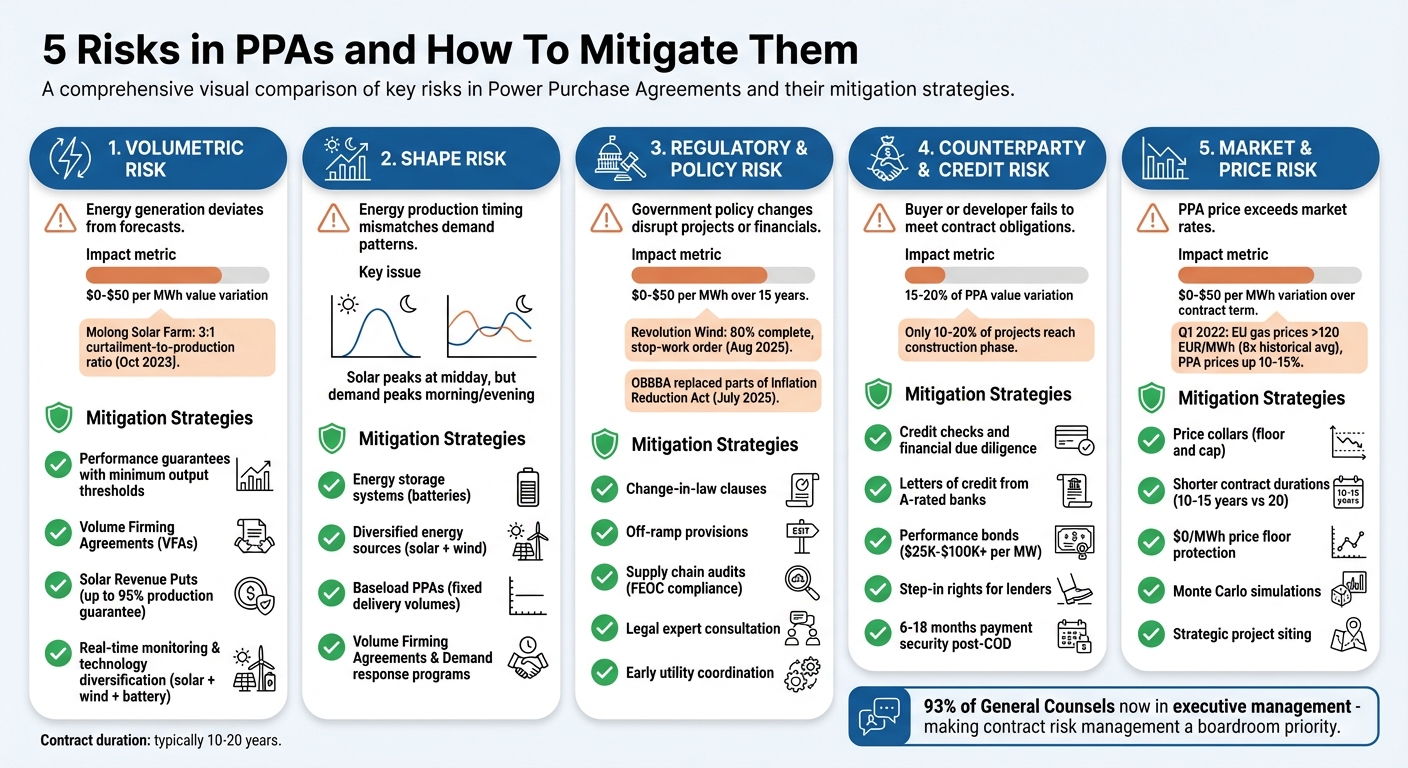
5 Key Risks in Power Purchase Agreements and Mitigation Strategies
1. Volumetric Risk
Volumetric risk is one of the most pressing challenges in Power Purchase Agreements (PPAs) because it directly impacts both costs and compliance efforts.
This type of risk arises when actual electricity generation deviates from forecasts, potentially forcing buyers to purchase replacement power at fluctuating grid rates. Studies suggest that these variations can influence a PPA’s value by anywhere from $0 to $50 per megawatt-hour. For companies relying on PPAs to reach sustainability goals, underperformance could also mean falling short on Renewable Energy Credits (RECs), increasing the risk of regulatory noncompliance.
What Drives Volumetric Risk?
Several factors contribute to volumetric risk:
- Weather variability: Prolonged periods without adequate wind or sunshine significantly reduce energy generation.
- Equipment issues: Malfunctions or unexpected downtime can lower output.
- Grid curtailment: When grid operators limit energy output to maintain system stability, it directly impacts production.
A striking example occurred in October 2023 at Australia’s Molong Solar Farm, where severe curtailment led to more energy being curtailed than generated. The production-to-curtailment ratio was an alarming 3:1.
Addressing these challenges is essential to minimize the financial and operational impact of volumetric risk.
Strategies to Minimize Volumetric Risk
Reducing volumetric risk requires a mix of contractual safeguards, technological solutions, and strategic planning:
- Performance guarantees: Negotiate agreements that ensure developers meet minimum capacity or output thresholds.
- Volume Firming Agreements (VFAs): These agreements help manage volume risks in pay-as-produced contracts.
- Solar Revenue Puts: For solar projects, this insurance-like mechanism guarantees up to 95% of forecasted production, offering added reliability.
- Real-time monitoring: Include provisions for continuous monitoring to quickly identify and address performance issues.
- Technology diversification: Combining solar, wind, and battery storage across different locations can smooth out production and reduce vulnerability to localized weather disruptions.
- Curtailment clauses: Clearly define how curtailment – whether physical or financial – affects performance guarantees and payment obligations.
sbb-itb-49df6ae
2. Shape Risk
Shape risk happens when the timing of renewable energy production doesn’t align with the times energy is actually needed. This mismatch often leads to the need for additional power purchases from the wholesale market during periods of underproduction. For instance, solar plants generate their peak output at midday, but many facilities require more energy during early morning or late afternoon hours. Similarly, wind farms tend to produce the most energy at night, while facilities like data centers often experience their highest demand during the day. When renewable energy falls short, supplemental energy must be purchased – often at higher spot market rates.
"Shape risk arises when the energy output pattern of a facility doesn’t match the consumer’s demand profile." – Kenia Silvério, Synertics
Why Intermittent Renewable Energy Leads to Shape Risk
Renewable energy sources, like wind and solar, are inherently variable because they depend on weather conditions. This variability means the "shape" of energy production rarely matches the consistent and predictable energy needs of industrial operations. For example, electricity demand from data centers has more than doubled since 2014 and now accounts for about 4.4% of global energy consumption. This growing demand highlights the challenge of synchronizing renewable energy generation with actual consumption patterns. Without proper management, this mismatch can lead to inefficiencies and higher costs.
Managing Shape Risk
To address shape risk effectively, several strategies can be employed:
- Energy storage systems: Batteries can store excess energy produced during peak renewable generation periods and release it when demand is high.
- Diversified energy sources: Combining solar and wind projects can create a more balanced energy production profile, reducing variability.
Contract structures also play a critical role in managing shape risk:
- Pay-as-produced PPAs: These agreements place the shape risk on the buyer, who benefits from lower base rates.
- Baseload PPAs: Here, the generator takes on the shape risk, committing to deliver fixed energy volumes regardless of production variability, usually at a higher price.
- Hedging tools: Volume Firming Agreements and proxy revenue swaps can help buyers mitigate the financial impact of mismatched energy profiles.
Operational flexibility is another important tool. By adopting demand response programs and leveraging real-time monitoring platforms, facilities can adjust their energy consumption patterns to better align with renewable energy availability. These tools also enable early identification of mismatches, helping to minimize disruptions and costs.
3. Regulatory and Policy Risk
Regulatory and policy changes can significantly impact Power Purchase Agreements (PPAs), often introducing new challenges beyond the usual operational uncertainties. Shifts in government policies directly affect the financial stability of PPAs. For instance, in July 2025, the One Big Beautiful Bill Act (OBBBA) replaced parts of the Inflation Reduction Act, tightening eligibility for clean electricity credits and introducing strict Foreign Entity of Concern (FEOC) compliance rules. Under these changes, projects using components from restricted countries risk losing valuable tax incentives. Such policy updates can sway a PPA’s value by as much as $0 to $50 per megawatt hour over a 15-year period.
The U.S. regulatory framework further complicates matters, as it divides authority between federal and state levels. The Federal Energy Regulatory Commission (FERC) oversees wholesale rates and interstate transmission, while state Public Utility Commissions (PUCs) manage retail rates and generation siting. This division creates multiple layers of approvals, and if a state commission denies cost pass-through to ratepayers, the entire PPA could face early termination. To safeguard against these risks, contracts must include strong provisions to protect PPA value.
How Policy Changes Affect PPAs
Policy changes don’t just threaten future projects – they can disrupt ongoing ones too. For example, in August 2025, the Revolution Wind project was hit with a national security stop-work order from the Bureau of Ocean Energy Management (BOEM), even though it was nearly 80% complete. Similarly, the Empire Wind 1 project in New York had to restructure its contract in May 2025 due to federal stop-work orders and inflation-related challenges. These incidents caused delays and increased costs, highlighting how unpredictable policy shifts can derail even advanced projects.
Tax credit structures are particularly vulnerable to policy changes. By late 2025, the renewable energy credit transfer market had stabilized at around 90¢ per dollar of credit, but this stability hinges on consistent federal policies. Stricter domestic content requirements and FEOC restrictions under OBBBA forced developers to perform detailed supply chain audits to maintain eligibility for tax incentives. Without compliance, projects risk losing access to these critical financial benefits. On top of federal rules, state-level policies like Renewable Portfolio Standards (RPS) add another layer of uncertainty, as these mandates can change with new administrations or shifting budget priorities.
How to Protect Against Policy Risk
To manage the volatility caused by policy changes, proactive contractual measures are essential. One of the most effective tools is the inclusion of change-in-law clauses. These clauses outline how a contract should adapt when regulations shift. As noted by Stoel Rives LLP:
"The seller will often agree to spend up to a negotiated amount of money… to maintain the value and use of environmental attributes after a change in law. Once that financial cap is reached, the seller is under no further obligation".
This approach limits financial exposure for both parties while maintaining flexibility.
Another useful strategy is incorporating off-ramp provisions. These allow for contract termination if critical regulatory milestones aren’t achieved. For example, if a Public Utility Commission denies approval or interconnection costs exceed agreed limits, an off-ramp provides a clean exit. A practical example of this is the Nellis Air Force Base PV project in Nevada, completed in December 2007. The project used a FAR Part 41 utility service contract to secure a PPA price of 2.2¢/kWh while selling renewable energy credits (RECs) to Nevada Power to meet state RPS solar requirements. This structure helped shield the project from changing environmental incentives.
To further reduce exposure, consult legal experts specializing in energy to ensure contract language aligns with current regional regulations. Regular supply chain audits can also help maintain FEOC compliance, and early coordination with utilities can clarify interconnection requirements and potential tariff adjustments. While policy risks can never be fully eliminated, these strategies can help you navigate the ever-changing regulatory landscape with more confidence.
4. Counterparty and Credit Risk
Counterparty and credit risk, much like volumetric and shape risks, require careful evaluation and proactive measures. This type of risk arises when a buyer or developer fails to meet the terms of a contract. For instance, buyers might default on payments, or developers could face challenges completing or operating a project. According to LevelTen Energy, about 15–20% of a PPA’s value variation stems from six key risk factors, including stricter credit and counterparty terms. This risk becomes especially critical in the 12–36 months leading up to the Commercial Operation Date (COD). A developer’s financial collapse during this period could leave buyers scrambling for alternative supply solutions or even force them to abandon the agreement altogether. After regulatory hurdles, credit and counterparty stability stand out as major concerns in PPAs.
For buyers, ensuring that developers have the financial capacity to complete construction and operate the project over a 10- to 15-year term is essential. Similarly, developers must verify that buyers can reliably pay for electricity. Historical economic downturns have shown how declining credit ratings can make PPAs unbankable. Even with signed contracts, such situations can halt financing, delay construction, and trigger costly renegotiations.
How to Assess Credit Risks
Assessing credit risks starts with a deep dive into financial stability. Formal credit checks should examine ratings, debt-to-equity ratios, and overall financial health. A credit rating downgrade can undermine a PPA’s bankability, cutting off critical financing. Developers should also be evaluated based on their project track record and whether they plan to operate the asset long-term or sell it.
Bankability analysis is another critical step. This process determines whether a buyer’s credit strength is sufficient for the developer to secure non-recourse debt. Rachit Kansal, Senior Associate at Rocky Mountain Institute, highlights an important distinction in the market:
"The early adopters, the large companies that moved into this market have become sophisticated in understanding their risk and understanding their own constraints and appetites. However, the market has been broadening significantly… with many having never completed a PPA transaction before".
This broadening market introduces new players who may lack the financial expertise of seasoned participants. To mitigate this, thorough due diligence is key. Reviewing financial statements, analyzing ownership structures, and comparing the financial backing of larger, well-capitalized firms against smaller entities can provide valuable insights.
How to Reduce Counterparty Risk
Once risks are identified, mitigation strategies come into play. Financial instruments and contractual safeguards are essential tools for reducing counterparty risk. Credit support instruments – such as letters of credit from A-rated banks, parent company guarantees, or performance bonds – offer a strong initial layer of protection. Additionally, financial security deposits can help cover potential shortfalls. These deposits often range from $25,000 to over $100,000 per megawatt during pre-construction, with post-COD security covering 6 to 18 months of expected PPA payments. This is particularly important given that only 10–20% of renewable energy projects that begin development make it to the construction phase.
Contractual provisions can also play a significant role. For example, step-in rights enable lenders or suppliers to take over project operations if a buyer defaults or faces insolvency, ensuring the project continues. Assignment rights should be carefully structured to prevent transferring the PPA to third parties unless they meet or exceed the original counterparty’s creditworthiness.
Market-based termination clauses are another useful safeguard. These clauses require the breaching party to compensate for the difference between the agreed PPA price and current market rates if obligations aren’t met. As Norton Rose Fulbright points out:
"the attractiveness and bankability of long-term Corporate PPA agreements depend significantly on the creditworthiness of the corporate buyer".
To further reduce risks, work with specialist energy lawyers. They can refine contract language around defaults and insolvency and set up real-time monitoring systems for both generation and financial data. Modern AI in PPA management can further streamline this oversight by automating data analysis and risk detection. This combination of legal and financial oversight ensures that all parties are protected and obligations are met.
5. Market and Price Risk
Market and price risk comes into play when the price set in a Power Purchase Agreement (PPA) exceeds the current market rate. Events like external shocks and price swings can significantly impact profitability. Take the first quarter of 2022, for instance – average wholesale gas prices in Europe soared past 120 EUR/MWh, which was six times higher than the historical average. As a result, PPA prices in some markets climbed by 10–15%.
Price volatility isn’t just driven by geopolitical events like the Russian invasion of Ukraine. It also stems from fluctuating fossil fuel costs and weather-related impacts on renewable energy sources like hydropower and wind. Another challenge is basis risk, which occurs when there’s a disconnect between the market price at the project’s delivery point and the buyer’s settlement location. If these prices don’t align, buyers could face unexpected costs. Additionally, as renewable energy becomes more widespread, price cannibalization can happen. This occurs when an oversupply of cheap power during peak production – like midday for solar – drives market prices into negative territory, reducing the overall value of PPAs. These factors highlight how unpredictable market conditions can shape the economics of such contracts.
Understanding Price Volatility in PPAs
Several factors contribute to PPA price fluctuations. Most Virtual PPAs (VPPAs) operate as "contracts for differences", meaning the buyer and seller settle based on the difference between a fixed strike price and a variable market price. If market prices dip below the PPA rate, buyers end up paying more than they would on the open market.
LevelTen Energy reports that non-price risks – such as generation patterns and settlement locations – can lead to PPA value differences of anywhere from $0 to $50 per megawatt hour. Over a 15-year contract, these variations could amount to tens of millions of dollars. On top of that, inaccurate forward curves or flawed future price forecasts can increase the risk of overpaying for long-term agreements.
How to Manage Price Risk
Once price volatility is understood, the next step is to take action to minimize exposure. A combination of contractual tools and strategic planning can help reduce price risk. For instance, price collars – setting both a minimum floor and a maximum cap – can stabilize contract prices. Akamai Technologies demonstrated this approach in 2019 by securing a price floor for a 7 MW wind project in Texas, providing a reliable hedge against market dips.
A $0/MWh price floor is particularly useful when market prices go negative, offering buyers a safety net. Another key strategy is project siting – choosing projects that are located in the same market as a company’s physical operations can act as a natural hedge against local energy price increases. Microsoft has also taken an innovative approach by working with REsurety to create the Volume Firming Agreement (VFA), an insurance-style product designed to shield PPA buyers from financial risks tied to weather-driven fluctuations in energy volume and generation patterns.
Before committing to a PPA, financial modeling is critical. Monte Carlo simulations can help assess the likelihood of a contract becoming uncompetitive under different wholesale market scenarios. Another way to manage risk is by opting for shorter contract durations. Many corporate buyers now prefer agreements lasting 10, 12, or 15 years instead of the traditional 20-year terms, reducing long-term exposure. Including price reopener clauses – allowing for adjustments if market conditions shift drastically – adds another layer of protection. These strategies, when combined, help address the unpredictable nature of market and price risks in PPAs.
Using Contract Management Tools to Reduce PPA Risks
Managing contracts effectively is a key approach to reducing the risks associated with Power Purchase Agreements (PPAs). These agreements often stretch over 10 to 20 years and come with intricate obligations. Without a centralized system to monitor critical milestones, financial securities, and compliance requirements, companies can easily miss deadlines, leading to liquidated damages, termination rights, or hefty regulatory penalties. A robust contract management platform offers the visibility needed to address these challenges proactively.
A well-organized system for storing and tracking contracts can further mitigate these risks.
Organizing Contract Storage and Monitoring
Centralizing contract storage simplifies document organization and prevents outdated versions from causing confusion. By housing all PPA documents, amendments, and related communications in one searchable location, teams across legal, financial, and operational departments can access accurate, up-to-date information. This is especially important for Virtual PPAs, which operate as contracts-for-differences and require ongoing monitoring of the relationship between fixed PPA rates and fluctuating market prices.
Platforms like Trackado streamline this process by organizing contracts by partner, category, or department. They provide full visibility into costs and revenues, while AI-powered data extraction automatically captures essential information, reducing manual errors. Role-based permissions ensure that sensitive financial data remains secure, while giving relevant team members access to performance metrics – directly addressing credit and compliance risks.
Real-time dashboards further enhance oversight, tracking the transition from test energy rates to contract rates as projects are commissioned. This ensures accurate billing from the start. Considering that 15% to 20% of a PPA’s value variation stems from six key risk factors unrelated to the base price, having immediate access to performance data allows buyers to adjust their energy procurement strategies before financial losses mount.
In addition to centralized storage, automated reminders and compliance tracking are essential for avoiding costly delays.
Setting Up Automated Reminders and Compliance Tracking
Missing a Commercial Operation Date (COD) can result in daily penalties or even give the offtaker grounds to terminate the agreement. Automated milestone tracking helps prevent these issues by sending alerts for critical tasks like securing financing, ordering equipment, obtaining permits, and completing interconnection studies. Trackado’s automated reminders and milestone tracking ensure teams stay on top of deadlines, including the final delay period after which a buyer can terminate the agreement.
Trackado also offers customizable workflows and task-based approvals, simplifying transitions between financial securities and maintaining a digital audit trail of all negotiations and amendments. For example, pre-construction security – often $25,000 or more per megawatt – must be returned or dissolved once post-commercial operation security takes effect, typically covering 6 to 18 months of anticipated payments.
Monitoring credit risk is equally critical. If a counterparty’s credit rating falls below investment grade, the project may become "unbankable", potentially halting mid-construction. Automated alerts for credit downgrades give teams the opportunity to renegotiate terms or secure additional guarantees before problems escalate. With 93% of General Counsels now participating in executive management, identifying and managing contract risks has become a top priority in boardrooms. Integrated tools that combine compliance tracking with financial oversight enable legal teams to showcase their value while easing the workload on in-house counsel during regulatory shifts.
Conclusion
Power Purchase Agreements (PPAs) come with a host of risks that can span the 10–20 years of their duration. Challenges like production shortfalls – whether from volumetric or shape risks – can leave buyers scrambling to cover gaps with costly replacement power or balancing charges when energy generation doesn’t align with demand. Regulatory changes can also flip seemingly favorable agreements into financial liabilities, while credit issues with counterparties might derail projects entirely. And let’s not forget market volatility, which can expose buyers to unpredictable price fluctuations.
Here’s a sobering statistic: only 10–20% of renewable energy projects that start development actually make it to the construction phase. This low success rate highlights just how crucial it is to identify contract risks and design contracts with care. Identifying risks early allows for better cash flow protection, fairer contract terms, and more consistent long-term benefits. To manage these risks effectively, a mix of strategies is key – think due diligence, specialized insurance, smart contract features like price collars and change-in-law clauses, and diversifying portfolios across different technologies and locations.
At the heart of all this is proactive contract management, which ties these risk mitigation strategies together. Tools like Trackado’s centralized system can help avoid costly oversights, such as missed deadlines that trigger penalties. With 93% of General Counsels now holding executive positions, robust compliance tracking has become a cornerstone of successful PPAs. By combining meticulous planning, strategic execution, and advanced tools like Trackado, stakeholders can secure dependable and cost-efficient renewable energy for years to come.
FAQs
What are Volume Firming Agreements, and how do they help manage volumetric risk in PPAs?
Volume Firming Agreements (VFAs) aren’t explicitly outlined in the material provided, but they generally play a role in renewable energy Power Purchase Agreements (PPAs) to manage volumetric risk – the gap between expected and actual energy production. This risk is a frequent challenge in renewable energy projects, as factors like weather fluctuations can significantly impact energy output.
Although VFAs themselves aren’t deeply detailed here, there are several common strategies to tackle volumetric risk, including hedging contracts, diversifying energy portfolios, and adopting flexible contract terms. These approaches aim to stabilize financial results by minimizing the effects of unpredictable energy generation. To delve deeper into VFAs, consulting additional resources or seeking expert advice would be beneficial.
How do change-in-law clauses help address regulatory and policy risks in PPAs?
Change-in-law clauses play a crucial role in managing regulatory and policy risks within Power Purchase Agreements (PPAs). These clauses define how shifts in laws, regulations, or policies – like new taxes, tariffs, or compliance rules – are addressed. By outlining adjustments to obligations, renegotiation terms, or even termination rights, they help protect agreements from becoming unexpectedly costly due to unforeseen legal changes.
Given that PPAs often span several years, these clauses establish a structured process for handling changes. This includes setting notice periods, detailing documentation requirements, and defining steps for resolving disputes. Such provisions help safeguard cash flow, minimize uncertainty, and allow both parties to adjust fairly to new circumstances.
Leveraging a contract management tool like Trackado can make this process even smoother. These tools can track critical dates, monitor clause language, and provide alerts about policy changes, ensuring you stay proactive and compliant with the terms of your agreement.
How can buyers reduce market and price risks in long-term Power Purchase Agreements (PPAs)?
Buyers looking to handle market and price risks effectively can consider financially-settled PPAs, often referred to as virtual PPAs. These agreements operate like contracts-for-differences, enabling buyers to secure a fixed price and shield themselves from unpredictable changes in spot market prices.
Another option is structuring off-site PPAs with price collars or hedging provisions. These tools limit exposure to sudden price surges, offering more stability and predictability. By adopting these approaches, buyers can better manage their energy costs over time.