
A vendor incident can cost you twice: once during the outage, and again when the contract renews by default. If incident records are not tied to notice dates, cure periods, SLA credit deadlines, and breach reporting rules, you can miss non-renewal windows, lose service credits, and struggle to prove compliance.
Here’s the short version:
- Track every vendor incident against the contract
- Review incident history 60 to 90 days before the notice deadline
- Use patterns, not memory, to decide whether to renew, renegotiate, or exit
- Keep proof for SLA claims, breach notices, and audit reviews
- Act before auto-renewal locks you into another term
A few facts make the risk clear:
- 84% of auto-renewing B2B contracts in one benchmark used a 30-day non-renewal notice period
- Many contracts still require 30, 60, or 90 days’ written notice
- GDPR breach reporting can trigger a 72-hour deadline
- Many vendor agreements shorten breach notice timing to 24–48 hours
- SLA credit claims often must be filed within 30 days or by the next billing cycle
If I boil the article down to one point, it’s this: incident history should be part of the contract decision, not stuck in an email thread. A clean log with dates, impact, clause references, and claim deadlines gives you support for renewal talks, termination rights, credit recovery, and audit records.
The practical fix is simple: keep one incident record per vendor contract, include business impact in U.S. dollar terms, and run a dated review using a contract renewal planner before the notice window closes.
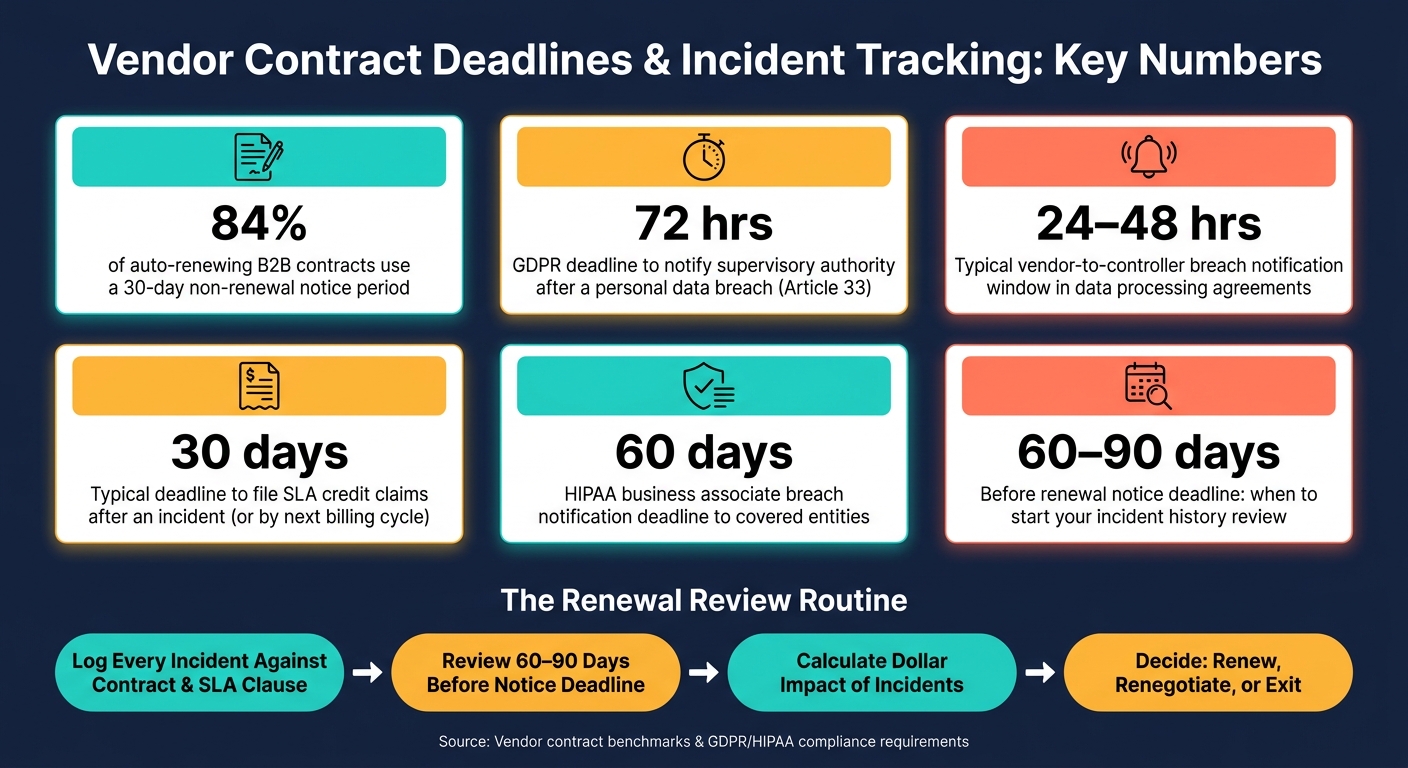
Vendor Contract Deadlines & Incident Tracking: Key Numbers
The problem: weak incident tracking hurts renewal and compliance decisions
When incident records aren’t tied to contract dates, teams lose leverage at renewal time, miss claim deadlines, and end up with thin audit trails. Memory isn’t enough to support a contract decision. Without a clear record, renewal calls turn into guesswork.
Unresolved incidents can slip past auto-renewal windows
If your team reviews incident history too late, the non-renewal window can close before anyone acts. Then the contract renews by default.
A lot of contracts also give the vendor a cure period after written notice of breach before termination rights begin. If no one sends that written escalation before the deadline, you may lose the record needed to back up termination for cause.
Service credits are often missed
Most SLA-based contracts include service credits. But knowing an outage happened isn’t enough. In most cases, the contract requires a formal claim within a short window – often 30 days after the incident or by the end of the next billing month – and that claim usually needs details such as incident IDs, timestamps, and affected services.
Service credits are much easier to recover when the incident log includes:
- Timestamps
- Incident IDs
- Affected services
- The claim deadline
For SMBs, percentage-based credits are usually the simplest path. Impact-based credits often demand much more proof.
Missed credits aren’t just an ops issue. They’re a contract cost.
Incomplete records create audit and compliance gaps
Missing incident dates and response logs can turn into a compliance failure, not just a renewal headache. Under GDPR Article 33, controllers have 72 hours from awareness of a personal data breach to notify the supervisory authority. Most data processing agreements shorten that timeline, often requiring vendors to notify the controller within 24–48 hours so the controller can still meet the legal deadline.
Under some agreements, particularly those involving US healthcare data, vendors must notify the controller within 60 days of discovering a breach, and many contracts use shorter timelines in practice.. If your incident log doesn’t show when you first learned of the breach and what the vendor said, you can’t prove compliance – even if your team moved fast. That’s the painful part. A gap in the record doesn’t just look sloppy. It can become the finding.
That same evidence helps with contract decisions too. It gives your team something solid to use when deciding whether to renew, renegotiate, or terminate.
sbb-itb-49df6ae
How incident history should drive renewal choices and contract actions
Use incident history to guide the renewal decision. The key is timing. You need to map each event to the contract’s notice deadline, cure rights, and renewal date before those windows close.
Match incident timelines to notice periods and cure rights
The incident log matters only when you line it up with the contract clock.
If a contract renews on 07/20/2026 and needs 60 days’ notice, the non-renewal deadline is 05/21/2026. A breach notice sent on 02/12/2026 starts the cure period. If the vendor does not cure by 03/13/2026, you have grounds to pursue termination for cause.
Send notice in the exact way the contract requires, and keep proof of delivery.
Use incident patterns to decide: renew, renegotiate, or terminate
Once the deadlines are clear, look at the pattern. Was it one bad event, or does the log show a trend?
A single major incident may still support renewal if the vendor moves fast and fixes the root cause. But repeated smaller failures usually point in a different direction: renegotiation, shorter terms, or non-renewal.
Use incident patterns as direct inputs to the vendor performance review:
| Incident Pattern | Vendor Response | Action |
|---|---|---|
| One major incident, strong remediation | Transparent, fast, documented | Renew with tighter SLAs and reporting |
| Recurring minor incidents, weak root-cause analysis | Slow, shallow | Negotiate a shorter term or non-renew |
| Repeated SLA failures near credit threshold | Mixed | Renegotiate credits, add chronic SLA failure clause |
| Unresolved breach past cure period | Unresponsive | Terminate |
Some contracts define chronic SLA failure in plain terms – for example, three or more Priority 1 outages in any rolling 90-day period. If your incident log shows that pattern, you have both a contract-based and practical reason to act.
Bring incident costs into renewal negotiations
If the pattern is expensive, put a dollar amount on it before renewal talks start.
Measure incident cost in lost revenue, staff time, remediation, and customer impact. A documented figure makes renewal requests harder to brush aside. When your ask is tied to records instead of frustration, you have a solid basis to push for higher service credit caps, automatic credits tied to metric thresholds, or lower annual fees.
The solution: build a simple incident-to-contract review process
Use one owner, or a small cross-functional team, to run the incident log and renewal review. The key is simple: tie every incident to its contract and review both on a fixed schedule.
Keep one incident record tied to each vendor contract
The main issue is that incident details end up scattered across emails, tickets, and invoices. By the time renewal comes around, people forget what happened. One central record for each contract solves a lot of that mess.
At a minimum, each incident record should include:
- Incident date and time
- Severity level
- Affected service
- Business impact in dollar terms
- The exact SLA clause involved
- Any breach notice requirement
- Credits claimed and credits applied
- A named internal owner
It also helps to add a short summary of what happened and what evidence was collected.
Be careful with severity. In many cases, it drives the credit amount.
Run a review 60 to 90 days before the non-renewal notice deadline
Start the review before the notice deadline. Not when the renewal date is already close.
Look at the last 12 to 24 months of incidents, all open remediation items, and a reconciliation of service credits claimed versus credits actually applied to invoices. If you manage more than one location, note whether the issue was isolated or showed up across sites. That distinction matters. A pattern across multiple locations gives you a much stronger case in a renewal discussion than a one-time issue at one site.
Use a contract management platform to connect incidents with dates and obligations
A spreadsheet can work early on. But once contract dates, notice periods, and remediation tasks start piling up, it gets shaky. The problem usually isn’t poor intent. It’s that nobody gets an alert when a notice window opens, and the auto-renewal slips through before anyone reviews the incident history.
Trackado puts contracts, renewal dates, notice periods, incident fields, reminders, and approvals in one place. That means the review happens on time, with renewal tasks, incident evidence, and approval steps all in the same workflow.
Conclusion: turn incident history into better renewals and defensible compliance
Vendor incidents can shape renewal, audit, and compliance decisions long after the outage is over. In most cases, the difference comes down to one thing: whether the incident was documented and tied to the right contract terms before the notice deadline passed.
That’s why this review needs to happen before the notice window closes. The routine is simple. Log each incident against the contract and SLA clause that applies. Then review that record 60 to 90 days before the renewal notice deadline and bring that evidence into the renewal conversation. Use documented impact, not frustration, to support renewal terms and remedies.
That same record also helps with compliance and audit defense. If an auditor or regulator asks how your team handled a third-party incident, a structured log tied to the contract – showing when it happened, which obligations applied, and what steps were taken – is much easier to defend than a scattered email thread. Traceability turns incident response into a defensible audit trail, and the same log can support both audit defense and contract leverage.
Use that record in vendor reviews too, not just during renewal. Performance reviews can help you spot repeat failures before renewal is on the table. If a vendor shows a worsening pattern, that should be flagged before the auto-renewal date.
The goal is simple: one incident record for each vendor contract, a fixed review schedule, and a clear decision at renewal – renew as-is, renegotiate, or move on. Teams that keep contracts, dates, and incident records tied together stop losing credits and missing renewal windows. When incidents are linked to contract dates, renewals become decisions – not surprises.
FAQs
What counts as a vendor incident?
A vendor incident is any event where a supplier fails to meet contract terms or regulatory requirements and causes problems for your business.
That can include SLA failures, missed delivery deadlines, data security breaches, or failure to follow legal or contract-specific requirements. You should document these incidents carefully. That record can support renewal decisions, service credit claims, or early termination.
Who should own incident-to-contract tracking?
Assign incident-to-contract tracking to a specific person, not a department. That makes accountability clear and avoids the usual “someone owns it” problem.
For each contract, name:
- a primary owner
- a backup owner
Those people should handle the full contract lifecycle. That includes performance, compliance duties, and incident history. With one clear owner in place, incident reports stay linked to renewal dates and supplier reviews instead of getting lost in the shuffle.
What evidence should we keep for audits and SLA claims?
Keep one central record for deliverables, deadlines, performance milestones, SLA reports, breach notices, and monitoring audit trails.
For each obligation, store the original clause reference, assigned owner, current status, amendment history, payment records, and documented compliance checks.