Tracking renewable energy contracts is crucial for verifying savings, meeting obligations, and ensuring equipment works as promised. Without proper oversight, you risk financial losses and missed sustainability goals. Here’s what you need to know:
- Key Metrics: Focus on energy production (Capacity Utilization Rate, Plant Availability, Performance Ratio), financial performance (utility savings, O&M cost reductions), and sustainability tracking (Renewable Energy Certificates).
- Monitoring Setup: Centralize contract data, automate alerts for deadlines, and use tools like Trackado to streamline management.
- Best Practices: Schedule regular performance reviews, collaborate with stakeholders, and leverage analytics to optimize outcomes.
The bottom line: Consistent tracking ensures you get the savings and benefits outlined in your contracts while maintaining clarity and control over long-term projects.
Key Metrics and KPIs for Renewable Energy Contracts
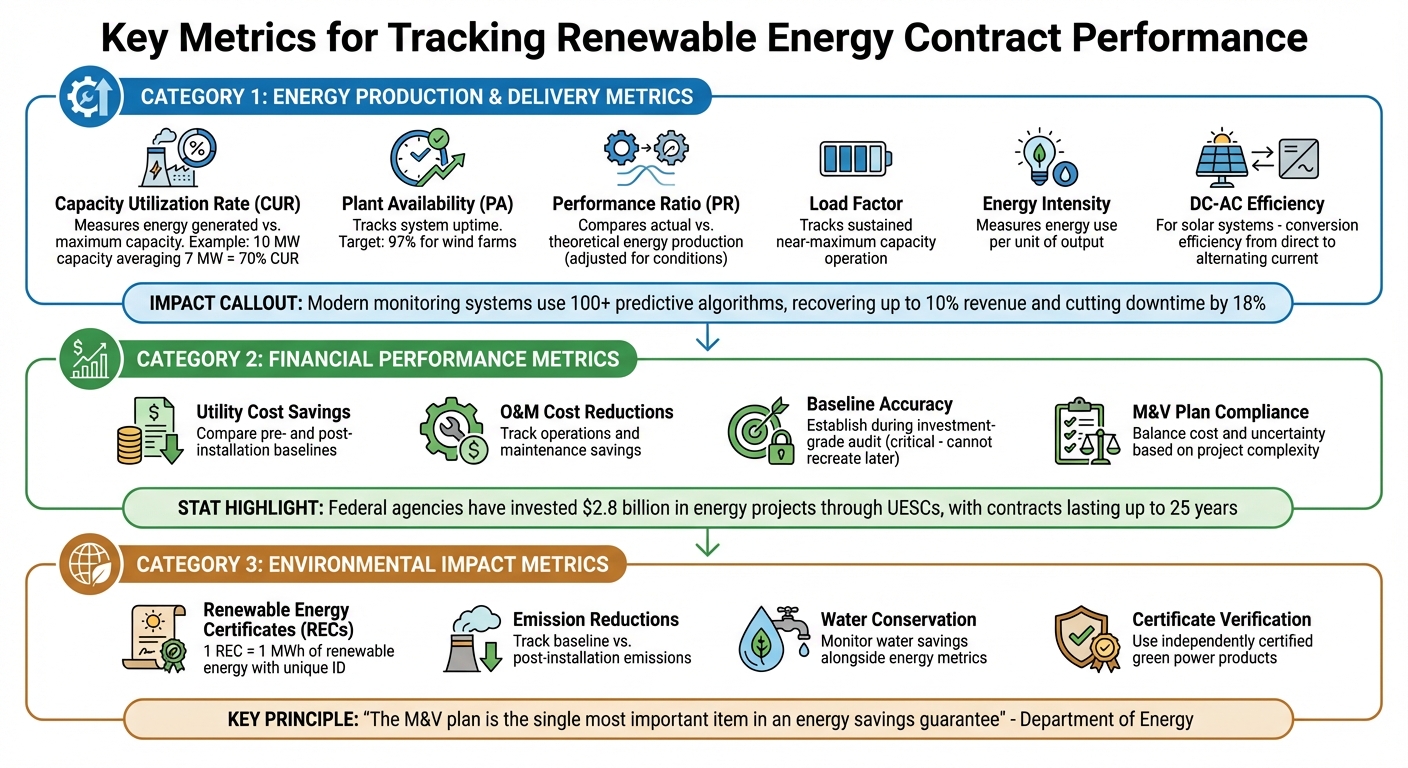
Key Metrics for Tracking Renewable Energy Contract Performance
Metrics bring clarity and accountability to renewable energy contracts. Without clear KPIs, it’s hard to verify whether your provider is meeting its commitments or delivering the expected results. These metrics fall into three main areas: energy production, financial performance, and environmental impact. Let’s break them down further.
Energy Production and Delivery Metrics
Capacity Utilization Rate (CUR) gauges how much energy your system generates compared to its maximum capacity. A higher CUR reflects better performance. For instance, if a solar installation with a 10 MW capacity averages 7 MW, its CUR is 70%, signaling potential inefficiencies.
Plant Availability (PA) measures uptime, with wind farms often aiming for 97% availability. Falling below this threshold can mean lost revenue for every idle hour.
Performance Ratio (PR) helps you compare actual versus theoretical energy production, adjusted for external conditions. This metric is especially useful when evaluating facilities of varying sizes and locations.
Other metrics include Load Factor, which tracks sustained near-maximum capacity, and Energy Intensity, which measures energy use per unit of output . For solar systems, DC-AC Efficiency is critical, as it reflects how well the system converts direct current into alternating current.
Modern monitoring systems now integrate over 100 predictive and operational algorithms, bridging the gap between data tracking and optimization. These systems have enabled operators to recover up to 10% of revenue and cut downtime by 18%. Automated alerts for energy overuse or equipment issues can help prevent unnecessary losses.
Financial Performance Metrics
Once energy output is quantified, it’s essential to ensure the financial outcomes align with expectations.
Financial KPIs confirm whether your renewable energy project is delivering savings. Comparing pre- and post-installation baselines is crucial for this analysis. According to the Department of Energy:
The M&V plan is the single most important item in an energy savings ‘guarantee’.
Key areas to track include utility cost savings and operations and maintenance (O&M) cost reductions. In many performance-based contracts, these savings directly fund the project over time, making accuracy non-negotiable.
While annual financial reviews are standard, more frequent evaluations can help fine-tune operations and avoid year-end surprises. Federal agencies, for example, have invested roughly $2.8 billion in energy, water efficiency, and renewable energy projects through Utility Energy Service Contracts (UESCs), with performance periods often lasting up to 25 years.
Establishing baselines during the investment-grade audit is critical because recreating them after installation is nearly impossible. Your M&V plan should clearly specify which utility rates will be used to calculate savings, reducing the risk of disputes. As the Department of Energy advises:
M&V should balance cost and uncertainty. More complex ECMs usually merit more M&V.
Environmental Impact Metrics
To ensure sustainability goals are met, environmental metrics are just as important as financial and operational ones.
Renewable Energy Certificates (RECs) are the standard for tracking renewable electricity ownership. Each REC represents the environmental benefits of one megawatt-hour (MWh) of renewable energy delivered to the grid . Tracking systems assign unique IDs to each MWh to prevent double counting and ensure only one entity claims the environmental benefit.
These systems also confirm regulatory compliance and support green power verification. As the EPA explains:
Tracking systems assign a unique identification number to each REC to ensure that only one REC is issued for each MWh of generation reported, to avoid ownership disputes and minimize double issuance.
Beyond RECs, comparing baseline energy and water usage to post-installation data can quantify savings and reduced emissions. Water conservation is increasingly monitored alongside energy savings to evaluate overall sustainability. Automated, certificate-based tracking provides precise details for each MWh, making it easier to verify claims. Buyers of renewable electricity should opt for suppliers offering independently certified green power products to ensure reliability and avoid double counting.
sbb-itb-49df6ae
How to Set Up a Monitoring System for Renewable Energy Contracts
Creating an effective monitoring system involves organizing your data, automating repetitive tasks, and selecting tools that fit your specific needs. These steps work hand-in-hand with the energy, financial, and performance metrics discussed earlier. The aim? To simplify workflows, avoid missed deadlines, and gain a clear understanding of contract performance – all without overwhelming your team. Here’s how to centralize your data, set up automated alerts, and use tools like Trackado to manage contracts efficiently.
Centralizing Contract Data
The first step is to gather all your renewable energy agreements in one place. This includes Power Purchase Agreements (PPAs), leases (residential or commercial), and Operations and Maintenance (O&M) agreements. Complement these with Measurement and Verification (M&V) plans, post-installation reports, and performance reviews. Centralizing this data ensures you can track performance effectively while maintaining easy access to critical documents.
Using standardized contract templates and O&M guidelines can help improve consistency and clarity across your projects. For procurement, consider creating a Request for Proposal (RFP) checklist to capture essential details like scope, deliverables, requirements, and submission dates. Tools like ENERGY STAR Portfolio Manager can further streamline tracking of onsite renewable electricity generation and consumption, keeping everything in one centralized location. When drafting O&M agreements, clearly outline equipment operational states and failure modes to enhance communication between stakeholders. Once your data is centralized, automating alerts becomes the next logical step to avoid missing deadlines.
Automating Alerts and Notifications
Automating reminders for key dates – such as contract expirations, milestones, and renewals – can help your team stay on top of compliance and avoid revenue losses. Set up lead-time alerts to notify your team at intervals like 30, 60, or 90 days before a contract’s renewal or termination date. This gives you ample time to renegotiate terms or prepare the necessary documentation.
For added efficiency, configure alerts to notify multiple recipients, such as procurement and legal teams. For performance-based contracts, link alerts to M&V milestones to ensure planned savings are tracked. Research shows that effective contract management software can boost annual profits by as much as 9%. A centralized dashboard can provide a clear snapshot of all upcoming milestones, eliminating the need to rely on scattered calendar entries. Dedicated software tools can integrate these features seamlessly, making the process even smoother.
Using Trackado for Contract Management
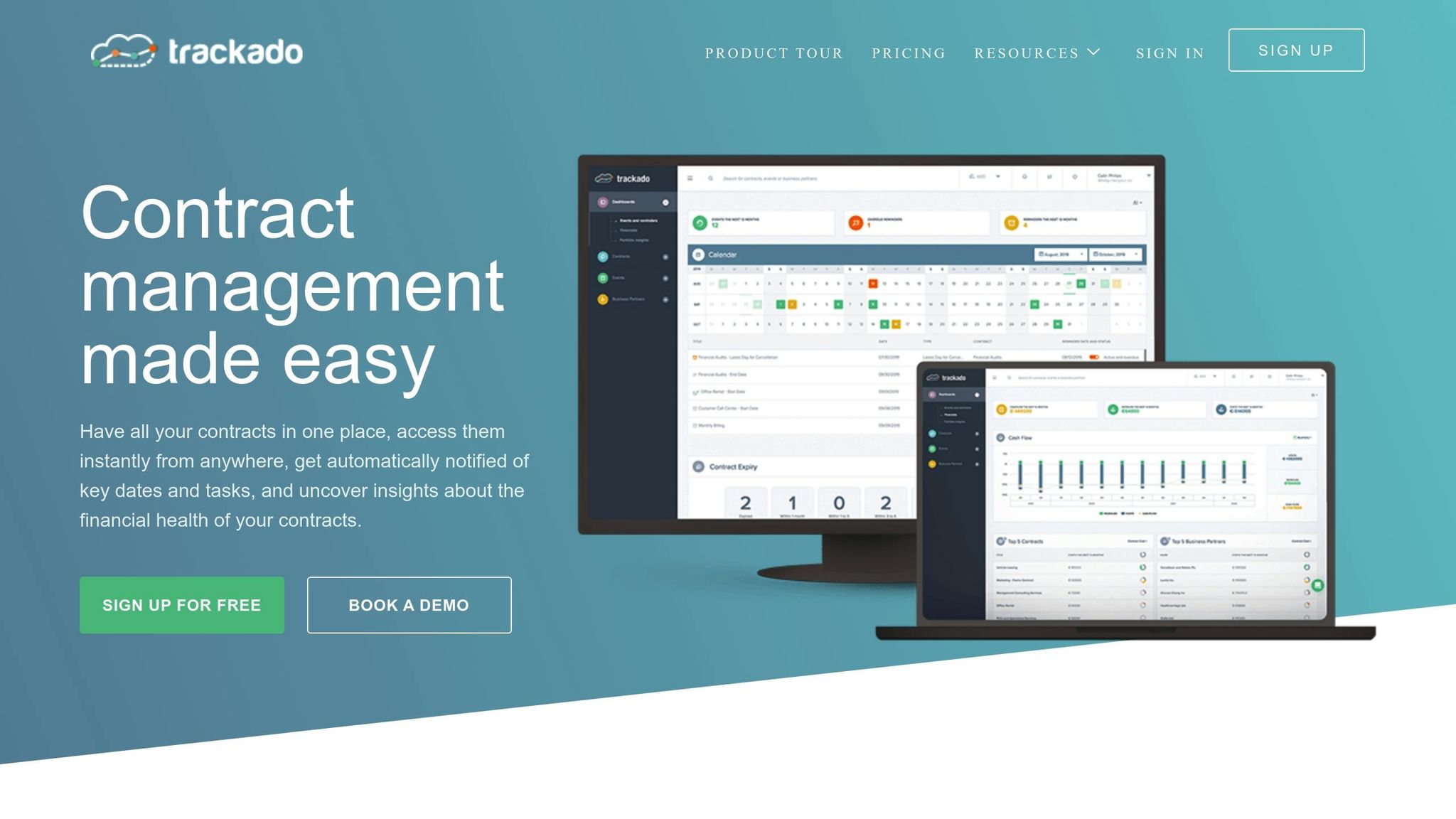
Trackado is a powerful tool for managing renewable energy contracts, offering centralized storage, automated alerts, and financial insights – all in one easy-to-use platform. Its AI-driven data extraction feature pulls key details like dates, payment terms, and milestones directly from uploaded contracts, cutting down on manual data entry and reducing the risk of missed obligations, such as RFP deadlines or performance reviews.
With Trackado, you can organize contracts by partner, category, or department, making it simple to oversee multiple PPAs or O&M agreements across different facilities. It also offers financial insights, giving you a clear view of costs, revenues, and contract value over time. This makes it easier to assess whether your projects are delivering the expected savings. Trackado aligns with key performance indicators by providing real-time data on energy production, cost savings, and environmental impact.
Additional features include task-based approval workflows to streamline internal processes and integrated e-signing to speed up contract execution. Trackado is hosted in secure European data centers with SSL encryption, meeting high security standards. Pricing starts at $39/month for the Starter plan (3 users, 60 contracts) and goes up to $299/month for the Enterprise plan (25 users, unlimited contracts), with extra users available for $10/month. A free trial is available, allowing you to test the platform before committing.
Best Practices for Monitoring Contract Performance
Regular Performance Reviews
From the very beginning of negotiations, it’s crucial to schedule regular performance reviews. Start by defining baseline conditions – like equipment inventory, occupancy levels, and energy consumption – and establish a clear Measurement and Verification (M&V) plan. Before officially accepting a project, conduct inspections and spot checks to verify that all equipment is installed correctly and can deliver the promised savings.
Annual reviews are a must to ensure systems are well-maintained and operating as expected. However, more frequent checks can help fine-tune operations based on feedback and avoid any unpleasant surprises at the end of the year. The level of M&V should align with the project’s complexity and the potential savings involved. For example, a combined heat and power plant demands more rigorous M&V than a straightforward lighting retrofit.
To keep things running smoothly, designate a primary contact to maintain documentation continuity. Also, assign a government witness to join providers during verification activities. Establish procedures to quickly review the energy service company’s annual M&V reports, ensuring they meet the requirements of the task order. These reviews should also identify changes, like demolished buildings or removed equipment, which might require immediate contract buy-outs for the affected measures. Regular reviews like these foster collaboration and keep all stakeholders on the same page.
Collaborating with Stakeholders
Once structured reviews are in place, open communication with all stakeholders – providers, legal teams, and finance departments – is key to resolving issues early and maintaining performance. A well-defined M&V plan, which includes agreed-upon baselines and savings calculations, helps everyone stay aligned.
Work with utility partners to create a Performance Assurance Plan that outlines clear protocols and assigns specific responsibilities for maintaining equipment performance throughout the contract’s duration. These contracts, such as Utility Energy Service Contracts (UESCs), can last up to 25 years, making ongoing collaboration essential. Agreeing on the M&V approach with the energy provider before the investment-grade audit begins ensures that baseline data is captured accurately. Keep communication open to swiftly address any contract changes, like adjustments for decommissioned equipment or demolished buildings, so the contract always reflects the site’s current state.
Using Analytics to Improve Performance
Performance reviews and stakeholder collaboration set the stage for analytics to take contract monitoring to the next level. Automated tools like Energy Management Information Systems (EMIS) and Monitoring-Based Commissioning (MBCx) platforms can analyze performance data and optimize energy assets. These tools replace error-prone manual spreadsheet management, consolidating energy meter data and billing information to improve decision-making.
Dive into key metrics such as ex-post KPIs like Specific Yield, paired with ex-ante inspection data, to predict performance trends and address potential safety concerns. Industry standards recommend maintaining a balance of 80% preventive maintenance to 20% corrective maintenance to keep systems running efficiently. Dashboards that integrate metrics like Energy Attribute Certificate (EAC) balances, certificate status, and energy usage across business areas provide a clear view of progress toward sustainability goals. When analyzing short-term performance (e.g., over two weeks or a month), always use temperature-adjusted formulas to ensure the data is accurate. These practices not only improve current contract performance but also pave the way for better deals in the future.
Conclusion
Effective tracking plays a key role in reducing risks, ensuring financial accuracy, and maximizing long-term project value. By allocating risks properly and closely monitoring savings guarantees, you can minimize uncertainty and maintain control over your operations. Regular oversight also helps identify maintenance or operational issues early, safeguarding performance and boosting investor confidence.
"Measurement and verification (M&V) activities help agencies confirm that legally and contractually required savings guarantees are met in federal energy savings performance contracts (ESPCs)".
This verification process spans several phases – from project development to the performance period – and requires a careful balance between monitoring costs and project complexity.
Automated systems have taken efficiency to the next level. According to the EPA, tracking systems that provide automated, detailed MWh data significantly reduce manual errors and consolidate contract information in one place. This not only cuts down on manual labor but also ensures a unified, reliable source of information for managing your contract portfolio.
Trackado builds on these benefits by centralizing renewable energy contracts in a single platform. It automates deadline tracking, extracts critical data, and organizes performance metrics for easy access. With AI-powered data extraction and customizable fields, you can track energy production, financial performance, and environmental impact KPIs in one streamlined system. Automated reminders help you stay on top of scheduled M&V reports and stakeholder reviews, while secure European hosting ensures your contract data remains protected. From consolidating contracts to delivering real-time alerts, Trackado simplifies the entire process, making it easier to manage your portfolio and achieve the outcomes outlined in this guide.
FAQs
What metrics should I use to measure the performance of a renewable energy contract?
To gauge how well a renewable energy contract is performing, it’s essential to focus on metrics that highlight energy production, efficiency, and financial returns. Start by comparing the actual energy savings and renewable energy output (in megawatt-hours) to the baseline estimates. This helps confirm whether the system is meeting expectations. Keeping an eye on system availability and uptime is equally important, as these indicate how reliably the system operates.
You’ll also want to assess maintenance costs and ensure the contract is meeting all its obligations. Check how accurate the initial savings estimates were, and track renewable energy certificates (RECs) to confirm the energy’s renewable source. By applying standardized measurement and verification (M&V) practices, you can maintain consistency, improve accountability, and fine-tune future projects.
How do automated alerts improve the management of renewable energy contracts?
Automated alerts are essential for staying on top of renewable energy contracts. These alerts provide timely reminders for critical deadlines, events, and performance metrics, helping you keep track of obligations like contract renewals, maintenance schedules, and milestone reviews. By doing so, they reduce the chances of missing important tasks, which could lead to penalties or compliance issues.
Additionally, automated alerts notify stakeholders about potential problems or performance deviations. This creates opportunities for quick decisions and corrective actions, ensuring smoother contract management. With these alerts in place, operations remain on track, and performance is consistently monitored – key factors for effectively handling renewable energy contracts.
Why is regular collaboration with stakeholders critical for renewable energy projects?
Keeping the lines of communication open with stakeholders is key to ensuring renewable energy projects stay on track and deliver on their promises. Regular check-ins and reviews allow teams to catch potential problems early, confirm performance metrics, and tweak strategies to improve efficiency and cost savings.
This kind of proactive engagement promotes transparency and accountability, strengthening partnerships and empowering stakeholders to make well-informed decisions. In the end, it’s a critical step toward meeting both energy goals and financial targets while keeping projects on a successful trajectory.