
Manufacturers lose 8.6% of annual spend and up to 9% of revenue due to poor contract management. Outdated systems like spreadsheets and email chains create compliance risks, leading to missed deadlines, regulatory fines, and financial losses. With 50% of manufacturing firms failing within five years, these risks are too costly to ignore.
Key compliance challenges include:
- Supplier issues: Missed deadlines, quality failures, and expired certifications.
- Regulatory gaps: Unmet safety or ESG requirements causing fines and disruptions.
- Financial risks: Missed payments, unnoticed auto-renewals, and pricing errors.
- Outdated tools: Manual processes that obscure obligations and slow responses.
Solutions:
- Use contract management software to centralize data, automate contract tracking, and integrate with key systems.
- Conduct regular audits to catch errors and ensure compliance.
- Leverage AI tools for contract risk prediction to analyze legacy contracts and flag risks.
Modern tools can reduce risks, improve efficiency, and protect revenue, making them essential for manufacturers.
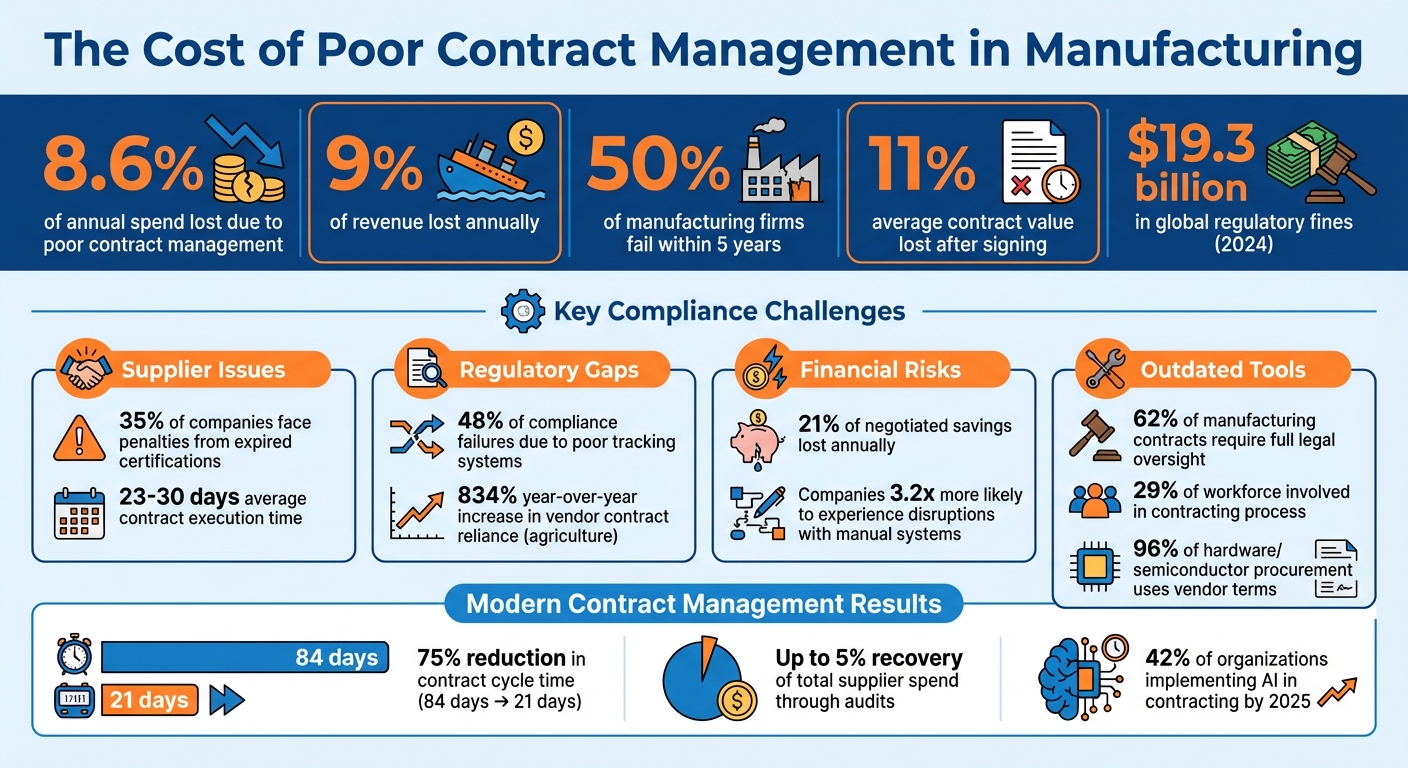
Manufacturing Contract Compliance Risks: Key Statistics and Financial Impact
Common Compliance Risks in Manufacturing Contracts
Manufacturing contracts often come with a host of risks that can disrupt operations, strain budgets, and even lead to legal troubles. These challenges typically arise from supplier issues, regulatory lapses, financial mismanagement, quality failures, and outdated contract management practices.
Supply Chain and Supplier Performance Risks
When suppliers miss deadlines or fail to meet quality standards, the ripple effects can derail your entire production process. Breaches in Service Level Agreements (SLAs) can cause delays, especially since switching to backup suppliers isn’t always straightforward. For example, industrial contracts take an average of 23 days to execute, while agricultural agreements require about 30 days. If your primary supplier’s quality issues violate SLA terms, those same terms might prevent you from sourcing elsewhere.
Another major concern is expired certifications. Roughly 35% of companies have faced penalties because critical certifications like ISO or REACH lapsed without warning. When this happens, shipments can be held up at ports, forcing manufacturers to either halt production or turn to costly alternative shipping options.
Financial complications add yet another layer of risk. Manufacturers often lose track of volume discounts or warranty claims, leaving money on the table. Fixed-price contracts also pose a challenge when raw material costs fluctuate, leading to an estimated 8.6% annual loss in spending efficiency due to poor contract management. The problem worsens when manufacturers rely on vendor-provided contracts, which often favor the supplier. In the hardware and semiconductor industries, a staggering 96% of procurement operates on vendor terms, making it nearly impossible to monitor hidden liabilities manually.
These supplier-related issues often cascade into larger regulatory and financial risks.
Regulatory Non-Compliance
Keeping up with changing regulations across local, national, and international levels is an uphill battle. Managing contracts across a global supply chain means ensuring that every supplier meets safety and environmental standards – no small feat.
The rise of IoT and AI in manufacturing has introduced new compliance requirements that demand constant vigilance. At the same time, many companies have legacy contracts sitting in filing cabinets or buried in emails, untouched and unaligned with current Environmental, Social, and Governance (ESG) standards. These overlooked contracts can conceal regulatory violations, creating significant blind spots.
In 2024, global regulatory fines totaled $19.3 billion. Many of these penalties stemmed from manufacturers signing vendor-drafted agreements to secure supply chains, only to discover later that these contracts lacked essential compliance safeguards. For instance, in the agriculture sector, reliance on vendor contracts surged by 834% year-over-year, as companies prioritized securing supplies over negotiating better terms.
Failing to comply with regulations not only invites fines but also disrupts the entire manufacturing process.
Financial Obligation Breaches
Missed payments and pricing errors can directly violate contract terms, costing businesses an average of 11% of the contract’s total value after signing. Auto-renewals that go unnoticed can allow underperforming suppliers to continue receiving payments, further compounding losses.
Disconnected systems often mean that pricing discrepancies slip through unnoticed. Contracts signed under outdated assumptions can quietly influence current operations, leaving businesses paying prices that no longer align with market conditions or negotiated terms. Poorly managed contracts can erode as much as 9% of annual revenue.
These financial missteps inevitably affect product quality and delivery performance.
Quality and Delivery Failures
Late deliveries and subpar products violate contract terms and can trigger financial penalties. When these issues arise, outdated systems often make it difficult to determine if repairs or replacements are covered under warranty, leading to repeated, unverified payments. Without automated tracking, it becomes challenging to identify whether suppliers have breached quality standards or missed delivery deadlines.
The inability to adapt quickly exacerbates these problems. If a primary supplier fails and onboarding a new vendor takes 30 days, delays are unavoidable. This leads to production stoppages, customer dissatisfaction, and mounting penalties.
All these challenges are made worse by outdated contract management practices.
Outdated Contract Management Systems
Managing thousands of contracts through spreadsheets and email chains isn’t just inefficient – it actively increases risk. Critical information often becomes unsearchable, making it hard to track obligations or identify potential liabilities.
Legacy contracts can obscure essential clauses related to regulations, performance metrics, or liabilities. When geopolitical changes or new tariffs arise, teams may struggle to pinpoint which contracts are affected. Fragmented oversight also slows down audits and inspections, making it harder to address quality or safety issues.
Manual legal reviews further complicate matters. Around 62% of manufacturing contracts require full legal oversight, and nearly 29% of a company’s workforce gets involved in some aspect of the contracting process. This not only slows execution but also hampers a company’s ability to respond to supply chain disruptions effectively.
Recognizing these risks is the first step toward adopting modern solutions that can streamline contract management and protect manufacturing operations.
sbb-itb-49df6ae
Impact of Unmanaged Compliance Risks
When compliance risks go unchecked, the consequences can be immediate and severe – ranging from costly operational disruptions to long-term damage to a company’s reputation. Here’s how these risks can spiral into significant challenges.
Production Delays and Operational Downtime
Compliance missteps can grind operations to a halt. For example, shipments may be delayed at ports when teams fail to provide the necessary compliance documentation quickly. In fact, 62% of manufacturing contracts require legal reviews, which can further slow down production and supplier onboarding processes.
IT systems and machinery are also vulnerable. Expired managed service agreements or software licenses can disable user accounts, leaving critical IT support unavailable during outages. Similarly, neglecting warranty terms often results in repeated, unnecessary payments for repairs that could have been covered. Companies relying on manual contract management systems are 3.2 times more likely to experience contract-related service disruptions compared to those using automated tools.
Switching suppliers in emergencies becomes another hurdle. With contract execution cycles averaging 30 days in some industries, finding and onboarding backup suppliers is often too slow to mitigate disruptions. Research shows that nearly half (48%) of compliance failures are due to automated task tracking rather than deliberate violations. These delays not only impact operations but also lead to financial penalties and higher costs.
Financial Penalties and Increased Costs
Operational setbacks often translate into significant financial losses. Manufacturers, for instance, lose between 8.6% and 9.2% of their annual revenue due to inefficiencies in contract management. Worse, companies forfeit an average of 11% of a contract’s total value after signing simply because they fail to track their obligations effectively.
Regulatory fines are another harsh reality. In 2024 alone, global regulatory penalties reached $19.3 billion. For healthcare organizations, HIPAA violations can result in daily fines starting at $100, with annual penalties reaching as high as $1.5 million per category. One mid-sized manufacturer, for example, faced $47,000 in rush fees and saw a permanent 23% premium increase after letting their liability insurance lapse. Beyond fines, non-compliance can lead to blacklisting from lucrative government or corporate contracts.
Costs also rise due to missed opportunities like failing to track price adjustment clauses, rebates, or volume discounts – leading to shrinking profit margins over time. Ambiguous contract terms or missed deadlines can trigger expensive legal battles, diverting resources away from growth and innovation.
Reputational Damage and Legal Disputes
The fallout from compliance failures extends beyond finances. A company’s reputation can take a serious hit when it fails to meet regulatory standards or reporting requirements. This can result in blacklisting from future contracts, especially in government procurement. Additionally, companies that don’t align with today’s environmental, social, and governance (ESG) priorities or safety standards risk reputational setbacks in an increasingly transparent marketplace.
Slow contract processes can also tarnish a company’s image. If it takes 30 days to execute a contract while competitors act faster, customers may reconsider their loyalty. In some sectors, like agriculture, teams have even resorted to using third-party paper for procurement – a practice that surged by 834% year-over-year – just to secure supply, often at the cost of favorable terms.
Poor communication and disorganized processes exacerbate these issues. For instance, when compliance documents are unavailable, shipments may be held at ports, forcing companies to resort to expensive shipping alternatives. These delays not only strain relationships with logistics partners but also damage a company’s reputation over time. Such repeated failures can erode the trust of both partners and customers, undermining years of effort to build strong relationships.
How to Identify and Assess Compliance Risks
Understanding the effects of unmanaged compliance risks is just the beginning. Manufacturers need a structured approach to pinpoint and evaluate these risks. This involves targeted assessments, regular audits, and leveraging smart technology to uncover vulnerabilities without disrupting operations.
Conducting Contract Risk Assessments
A contract risk assessment is a systematic review that categorizes risks into financial, operational, reputational, or legal areas. The objective? Spot potential issues early – like unclear payment terms, missing regulatory clauses, or unrealistic delivery schedules – before they lead to bigger problems.
Start by mapping every phase of the contract lifecycle. Pay attention to vague language that could lead to disputes, such as undefined terms or ambiguous service level agreements (SLAs). Financial risks are another key area – contracts lacking price-escalation clauses, uncapped liabilities, or currency risk protections can result in significant losses. In fact, companies lose an average of 9% of a contract’s value annually due to misaligned terms and "leakage".
To prioritize risks, use a 1–10 risk matrix. For example, contracts with unlimited financial exposure or absent data privacy clauses should rank higher than those with minor administrative issues. Assign responsibility to specific teams: Legal for regulatory gaps, Finance for pricing issues, and Operations for delivery performance. This ensures accountability for addressing each risk area.
| Risk Category | Key Indicators to Identify | Identification Method |
|---|---|---|
| Financial | Ambiguous pricing, missing tax rules, uncapped liabilities | AI-driven financial risk scoring |
| Legal | Asymmetrical indemnity, vague force majeure triggers | Clause library comparison |
| Compliance | Missing ESG/GDPR clauses, expired compliance provisions | Automated compliance monitoring |
| Operational | Unclear delivery milestones, poor SLA metrics | Integration with ERP/SCM data |
Once risks are quantified, regular audits are essential to maintain compliance and performance standards.
Performing Regular Contract Audits
Contract audits ensure that actual business practices align with the terms of the agreement. They help uncover issues like performance gaps, cost discrepancies, and regulatory non-compliance that might go unnoticed in day-to-day operations. Companies that conduct these audits often recover up to 5% of their total supplier spend.
For high-value or high-risk contracts, consider switching from annual to quarterly audits. This allows you to catch issues like billing errors, missed SLAs, or underperforming suppliers before they escalate into larger disruptions. During these audits, compare actual billing data with contract terms, verify vendor certifications, and ensure financial transactions reflect negotiated pricing.
"Contract Compliance is Contract Performance" – Keith Rosser, Contract Manager, John Lewis Partnership
To avoid inefficiencies, clearly define the scope of each audit. Decide whether the focus will be on cost validation, clause consistency, or regulatory compliance. Include supplier interviews and documentation reviews to ensure the original intent of complex terms is being met. This step is critical, as companies lose an average of 21% of their negotiated contract cost savings each year due to gaps between negotiated and realized savings.
Technology can make this process even more efficient, especially when reviewing older contracts for hidden risks.
Using AI to Analyze Old Contracts
Legacy contracts often contain risks that manual reviews overlook. AI-powered tools, using Natural Language Processing (NLP), can analyze legal language and extract key data – like liability caps, termination rights, or auto-renewal clauses – from thousands of historical documents in a fraction of the time.
AI tools compare older contract terms to current internal standards or "playbooks", flagging deviations and missing protections. For example, they can identify weak data breach notification timelines, problematic change-of-control clauses, or auto-renewal terms that lack notice requirements. A 2025 report highlighted that 42% of organizations are now using AI in their contracting processes, underscoring its growing importance.
"AI can do in minutes what might take human teams thousands of hours (or, more likely, not complete at all)." – Susan Becker, Icertis
To streamline this process, consolidate legacy contracts into a searchable digital repository using Optical Character Recognition (OCR). Configure AI tools with specific templates and risk criteria to benchmark standard contract terms and flag exceptions. This approach not only modernizes contract management but also shifts companies from reactive to proactive risk management. For example, Hormel Foods reduced its contracting cycle from 84 days to 21 days – a 75% reduction – by automating workflows across more than 50 contract types between 2024 and 2026.
Solutions Using Contract Management Software
After identifying compliance risks through assessments and audits, the next logical step is to use technology to mitigate those risks. Contract management software replaces manual processes with automation, helping to address common compliance challenges. Here’s how these tools centralize contracts, streamline workflows, and monitor regulatory compliance effectively.
Centralizing Contracts and Automating Deadline Tracking
One of the biggest challenges in maintaining compliance is fragmentation. When contracts are scattered across spreadsheets, email inboxes, or filing cabinets, important deadlines can easily slip through the cracks.
A centralized repository solves this issue by storing all contracts in one searchable location, accessible to authorized team members. For example, Trackado’s platform uses AI-powered data extraction and OCR (optical character recognition) to pull essential details – like start and end dates, renewal terms, and payment milestones – directly from scanned documents or PDFs. This eliminates the need for manual data entry.
Automated reminders ensure stakeholders are notified well in advance of critical deadlines. Real-time dashboards offer a comprehensive view of the entire contract portfolio, while detailed audit trails automatically log every action, change, and review associated with a contract.
| Feature | Manual Management | Automated Software |
|---|---|---|
| Storage | Scattered across departments/inboxes | Centralized and easily searchable |
| Deadline Tracking | Manual, prone to errors | Automated alerts and reminders |
| Data Extraction | Labor-intensive manual review | AI-driven metadata extraction |
| Visibility | Limited, manual reporting required | Real-time visual dashboards |
| Audit Trail | Hard to reconstruct | Automatically maintained history |
Centralizing contracts is just the start. Integrating these tools into existing systems takes compliance management to the next level.
Streamlining Workflows and System Integrations
Compliance isn’t limited to the legal team – it impacts procurement, finance, operations, and more. Automated workflows, including task-based approval processes and integrated e-signatures, reduce bottlenecks. This approach minimizes the need for extensive legal involvement and eliminates delays caused by waiting for physical signatures.
Integrating contract management software with systems like ERP, SCM, and financial platforms adds another layer of efficiency. For instance, connecting contract data with these systems allows businesses to identify discrepancies between negotiated terms and actual performance. This real-time monitoring can help organizations avoid losing up to 11% of a contract’s value after it’s signed.
Hormel Foods provides a great example of these benefits. By automating workflows for over 50 contract types, the company reduced its contract cycle time by 75% – from 84 days to just 21 days. This included streamlining a complex Packers and Stockyard agreement, which previously involved seven versions and 13 addendums.
Monitoring Regulatory Compliance with AI
Keeping up with ever-changing regulatory requirements is a daunting task, especially when managing hundreds or thousands of contracts. AI simplifies this process by scanning entire contract portfolios for non-standard terms and flagging high-risk clauses. Risk scores are assigned based on severity, helping teams prioritize compliance issues that require immediate attention.
"AI can do in minutes what might take human teams thousands of hours (or, more likely, not complete at all)." – Susan Becker, Icertis
Trackado’s AI also monitors regulatory changes across jurisdictions and automatically alerts stakeholders when updates affect existing contracts. For older, paper-based agreements, OCR technology digitizes and makes them searchable, identifying key regulatory phrases, codes, or keywords. This feature is especially relevant as 42% of organizations are expected to implement AI in their contracting processes by 2025.
These tools not only address compliance risks but also close the loop on challenges identified earlier, transforming how organizations manage contracts.
Moving Toward Better Compliance in Manufacturing
Relying on spreadsheets and emails to manage contracts isn’t just outdated – it’s risky. These manual processes cost manufacturers around 8.6% of their annual spend, and on average, organizations lose 11% of each contract’s value after signing. Over time, these inefficiencies pile up, taking a toll on profitability. For an industry where 50% of firms fail within their first five years, this is a vulnerability manufacturers simply can’t afford.
To stay competitive, manufacturers need to ditch manual processes in favor of automated contract management software. Why? Industrial sales agreements already take an average of 30 days to execute, and with 62% of manufacturing contracts requiring legal involvement from start to finish, delays ripple through production schedules and supplier relationships. Modern contract management tools eliminate these bottlenecks. By integrating contract data with ERP and supply chain systems, they help manufacturers automate obligation tracking, streamline workflows, and catch pricing errors before they eat into profits.
"No entity should take on such risk [managing thousands of contracts via a spreadsheet] when there are so many solutions available to them." – IDC Report (via Icertis)
Platforms like Trackado offer a clear solution. With AI-driven features, manufacturers can turn hidden contract management risks into actionable insights. Trackado’s tools include AI-powered data extraction, automated deadline tracking, and centralized secure storage – all designed to tackle compliance issues head-on. Customizable workflows ensure high-risk contracts get the attention they need without slowing down operations. Even legacy paper contracts can be digitized with OCR technology, making them searchable by keywords or regulatory codes. Hosted in secure European data centers with SSL encryption, Trackado combines security with affordability, making it accessible for small and medium-sized manufacturers.
The message is simple: sticking to spreadsheets and manual reviews will cost manufacturers dearly in missed obligations, expired warranties, and compliance oversights. Embracing contract management software offers a way to stay ahead – providing full visibility into contracts, enabling swift responses to regulatory changes, and ensuring suppliers meet expectations. The tools are ready, the ROI is proven, and the risks of doing nothing are just too high.
FAQs
What contract data should we centralize first to reduce compliance risk?
To minimize compliance risks, focus on centralizing essential elements like key obligations, payment terms, delivery schedules, quality standards, and regulatory requirements. Keeping these aspects organized is crucial for monitoring compliance, taking timely actions, and preventing potential breaches.
How often should we audit manufacturing contracts to catch issues early?
Regular audits of manufacturing contracts are essential and should happen at least once a year – or even more often if there are regulatory updates or emerging operational risks. These audits serve as a proactive measure to catch potential problems early, maintain compliance, and minimize risks.
What can AI flag in legacy contracts that humans often miss?
AI has the ability to uncover hidden obligations and risks buried within legacy contracts. These might include implied terms, obscure clauses, or ambiguous wording – details that can easily slip past human reviewers. Overlooking these elements can lead to unexpected expenses, penalties, or even legal troubles. By leveraging AI, you can achieve a higher level of precision and significantly lower the risk of missing critical information.