
Missed deadlines in hospitality contracts can lead to financial losses, legal complications, and operational disruptions. From attrition clauses in group bookings to renewal deadlines for vendor agreements, managing multiple contracts without proper systems often results in errors. Research highlights that businesses lose up to 9.2% of their annual turnover due to poor deadline management.
Key issues include:
- Unclear contract terms: Ambiguities in clauses like attrition rates or contract renewals can lead to penalties or unwanted obligations.
- Manual tracking: Spreadsheets and emails are prone to errors, causing missed deadlines and inefficiencies.
- Accountability gaps: Multi-party agreements often lack clear roles, delaying approvals and increasing risks.
Automated tools, such as Trackado, help centralise contracts, automate reminders, and track obligations effectively. This reduces risks, improves accuracy, and saves time. Businesses can trial such systems to simplify processes and avoid costly mistakes.
Common Deadline Management Problems in Hospitality Contracts
Hospitality contracts often come with tricky deadline challenges. These challenges usually arise from poorly written clauses, outdated tracking systems, and unclear roles. It’s crucial to understand these issues before considering automated tools to simplify deadline management.
Unclear Attrition Rates and Pick-Up Date Deadlines
Poorly defined deadlines can lead to financial losses and increased legal or operational risks. Attrition clauses, which bind organizers to fill a specific percentage of their reserved room block (usually 70%-90%), are particularly troublesome. If these clauses require "nightly attrition" instead of allowing for cumulative calculations, organizers face even greater risks. Nightly attrition means meeting room commitments every single night, leaving no room for fluctuations in attendance during arrival or departure days.
For instance, falling short by 15 rooms per night over a three-night event, with a room rate of $150, could result in a hefty $6,750 penalty.
"Hotel attrition is one of the biggest financial risks in group event management. Many planners only learn about it when facing unexpected charges."
– Mika Takahashi, Prostay
Cutoff dates, typically set 30 to 90 days before an event, allow organizers to adjust room blocks without penalties. Missing these deadlines can leave organizers on the hook for the full original block, even if attendance is lower than expected. Additionally, vague resale clauses with language like "reasonable efforts" can force organizers to pay for rooms that hotels later resell unless audit rights are clearly defined. Another challenge arises when attendees book rooms through third-party platforms instead of the official block, as these bookings might not count toward the attrition threshold unless explicitly stated in the contract.
Vague Termination and Renewal Clauses
Ambiguities in termination and renewal clauses can trap businesses in unwanted agreements or lead to penalties. Contracts with unclear notice periods or automatic renewal terms often result in extended obligations for services no longer needed. This lack of clarity may also prevent businesses from renegotiating better terms. To avoid these issues, contracts should include precise language that outlines notice periods, renewal procedures, and termination conditions.
Manual Deadline Tracking Causes Errors
Using spreadsheets, email threads, and calendar reminders to manage contract deadlines is a risky approach. Studies show that poor contract management can cost businesses up to 8.6% of their revenue, with 90% of executives acknowledging the need for improved systems. Key deadlines often get lost in email inboxes, outdated contract versions circulate between departments, and there’s no centralized view of obligations.
"Managing contracts can feel like a never-ending battle, especially as your business starts to take off. The more you grow, the more contracts you have to handle, and things can get chaotic fast."
– Sangeetha S, Senior Product Marketing Manager, Signeasy
The manual process is time-consuming, with staff spending hours entering data, chasing signatures, and sending reminders – time that could be better spent on guest services. Version control issues further increase the chances of errors, while the rise in document fraud (up 20% in 2023) highlights the risks of relying on non-secure, manual systems. Additionally, failing to monitor daily room pickup reports at least 90 days before an event can result in missed opportunities to address shortfalls in time.
No Clear Responsibility in Multi-Party Agreements
Hospitality contracts often involve multiple stakeholders, which complicates accountability for tracking deadlines. Without clear roles, approvals get delayed, and critical deadlines are missed.
When contract details are spread across invoices, distributor systems, and departmental spreadsheets, maintaining a clear overview becomes nearly impossible. This is especially challenging for hotel groups managing multiple properties, where inconsistent approaches to vendor contracts are common. Misaligned expectations among contractors, architects, and suppliers can also lead to costly project delays. In fact, around one in ten businesses risk losing contracts entirely due to the lack of centralised storage. Without automated tools to assign tasks and provide visibility across teams, accountability gaps persist, leading to financial penalties, legal complications, and operational disruptions across the hospitality industry.
sbb-itb-49df6ae
How Poor Deadline Management Affects Hospitality Contracts
Poor management of deadlines can lead to financial losses, legal troubles, and operational setbacks that can jeopardize the success of hospitality businesses.
Financial Penalties and Lost Revenue
Missed deadlines often result in hefty financial penalties and lost income. In the hospitality sector, where contracts are intricate, inefficiencies can eat up as much as 40% of a contract’s total value.
For instance, failing to meet room block commitments – usually 80–90% of reserved rooms – forces hotel groups to pay for unused inventory. Similarly, not hitting minimum food and beverage spending targets means covering the shortfall out of pocket. Missing payment deadlines can lead to default interest charges, disrupting cash flow, while failure to release unused rooms on time results in escalating cancellation fees as event dates draw closer.
Construction and renovation projects are another area of concern. Missing milestones can incur daily fines that range from thousands to millions of dollars. Delays in renewing contracts can cause businesses to lose long-standing favorable rates or even essential vendor services. On top of this, failing to meet regulatory deadlines – whether for food safety, GDPR compliance, or licensing – can result in severe penalties from authorities.
These financial burdens are often accompanied by legal and compliance risks, creating further complications for businesses.
Legal and Compliance Risks
Missing a contractual deadline can legally qualify as a breach of contract. While many cases result in claims for damages, some breaches – especially those tied to deadlines deemed "of the essence" – can lead to full contract termination.
"In the majority of cases, missed deadlines or late payments will only entitle you to seek compensation via a damages claim… But there are instances where contracts also provide for agreements to be terminated or where termination is permissible under common law rules because the breach is deemed sufficiently serious."
– Michael Frape, Commercial Dispute Resolution Lawyer, Ashtons Legal
A major risk arises when businesses attempt to terminate contracts over missed deadlines without solid legal grounds. As Ashtons Legal cautions, wrongly asserting a termination right can backfire, leaving the business liable for breach of contract and facing compensation claims.
Regulatory compliance is another minefield. Missing deadlines for permits or licenses can result in losing the legal ability to operate, forfeiting industry certifications, or facing substantial fines. For businesses involved in government contracts, failing to meet reporting deadlines could lead to blacklisting from future opportunities.
These legal and financial challenges often spiral into operational inefficiencies.
Operational Problems
In an industry where multiple contracts – covering procurement, sales, and legal obligations – run simultaneously, a single missed deadline can throw the entire system into disarray. Such inefficiencies can extend contract processing times by over 30%, reducing value by 8.6%.
Communication breakdowns further exacerbate these issues. Multi-party agreements often involve various departments and external partners. If one team neglects to update the schedule, critical obligations can be overlooked. Alarmingly, 57% of legal teams still use manual tools like spreadsheets or email reminders to track deadlines, and 90% of business users struggle to understand contract terms.
Operational disruptions can also stem from expired maintenance contracts or lapsed vendor agreements, leading to equipment failures or service interruptions. These issues not only compromise customer satisfaction but also strain relationships with partners and guests. Instead of focusing on strategic initiatives, teams are often stuck dealing with last-minute crises, limiting their ability to make proactive decisions.
These challenges highlight the need for automated systems to effectively manage critical deadlines and reduce risks across the board.
Solutions for Deadline Management Challenges
Addressing the challenges of mismanaged deadlines starts with improving contract oversight. Shifting from manual, disjointed systems to centralized and automated platforms can significantly cut risks and boost efficiency in hospitality operations.
Centralizing Contract Management
Keeping all contracts in a single, secure repository eliminates the confusion of scattered data. A centralized system provides instant, remote access to contract information for teams managing multiple properties. With advanced search and filtering tools, staff can quickly locate key milestones across departments or partners. Plus, a clear audit trail ensures every agreement is accounted for, reducing the chances of conflicting information or missed obligations.
Cloud-based platforms play a vital role here, offering role-based access controls to safeguard sensitive deadlines. This centralization also sets the stage for seamless integration with automated tracking tools.
Using Automation for Tracking and Reminders
Once contracts are centralized, automation takes deadline management to the next level. Automated systems capture key dates with precision, eliminating human error. For instance, AI-powered extraction can pull critical dates – like renewals, expirations, and notice periods – straight from unstructured PDF contracts, saving hours of manual effort. Alerts set for intervals such as 60, 30, and 14 days ensure deadlines are never overlooked. Considering that poor contract tracking can cost organisations around 9% of their annual revenue, automation becomes not just a convenience but a financial necessity.
Modern tools even integrate with platforms like Slack, delivering real-time alerts directly where teams are already active, rather than relying solely on email notifications.
Streamlining Workflows with Customizable Features
Centralization and automation are just part of the solution. Efficient workflows are essential for keeping everything on track. Custom approval chains and conditional routing ensure contracts move swiftly to the right people, avoiding bottlenecks. Clear review sequences and automatic escalations help prevent delays, especially if a key contact is unavailable. These workflows can be adjusted based on factors like contract value, vendor type, or department, ensuring high-priority agreements get the attention they require.
For example, Trackado offers task-based approval workflows and customizable fields, enabling teams to tailor processes to their specific needs. Integrated e-signature tools speed up the process further, while performance metrics – like renewal success rates and time saved – help teams fine-tune their approach. Together, these workflow enhancements complement centralization and automation, creating a robust system for managing deadlines effectively.
Benefits of Using Trackado for Hospitality Contract Management
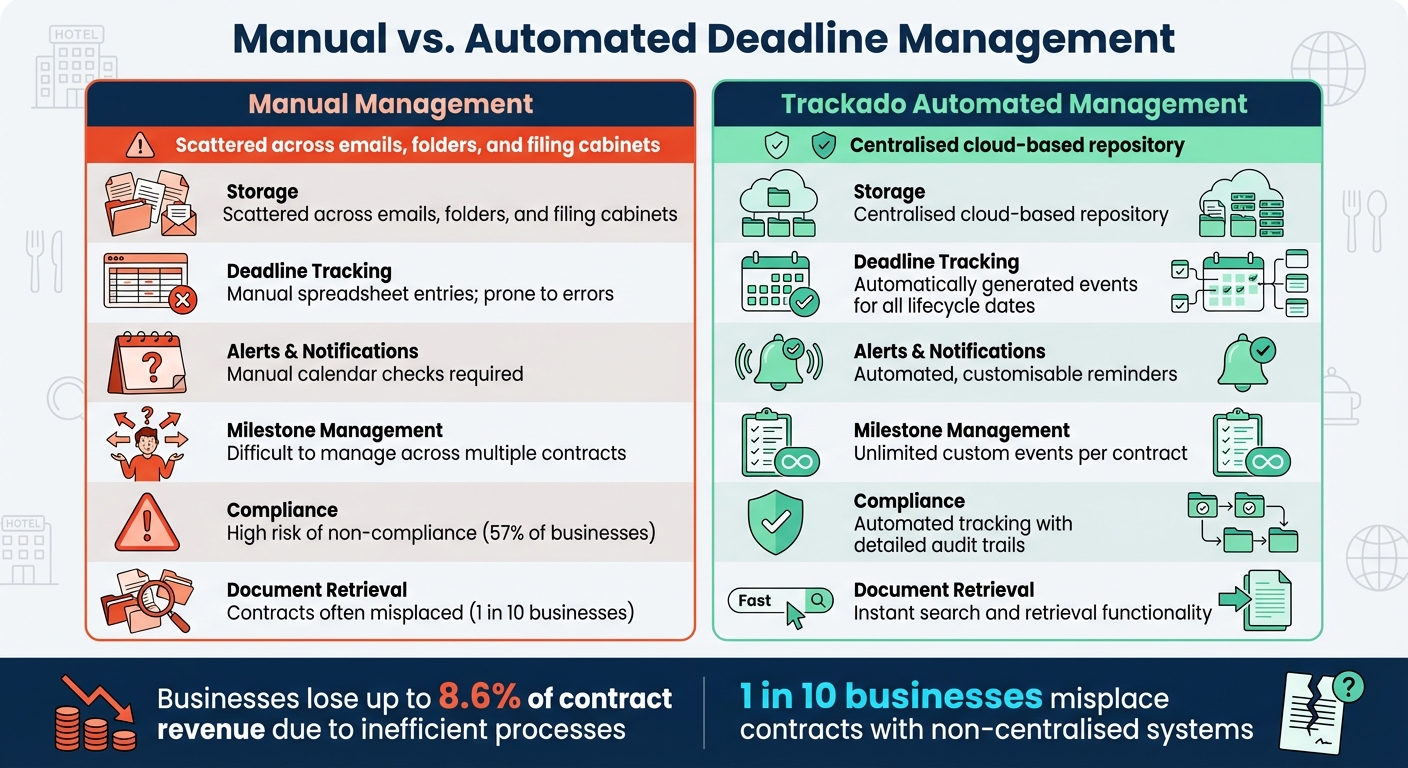
Manual vs Automated Contract Deadline Management in Hospitality
Trackado brings together a suite of tools aimed at simplifying hospitality contract management, replacing outdated methods with a modern, cloud-based solution.
Key Features for Deadline Management
Trackado eliminates the chaos of juggling emails, spreadsheets, and physical files by consolidating everything into one centralized system. It automatically generates events for critical contract dates, such as start and end dates, as well as cancellation deadlines. For industry-specific needs like attrition dates or pick-up deadlines, users can create custom events for any task on any date. Plus, the platform allows unlimited events and reminders per contract, with configurable alerts to keep you on track. These reminders are seamlessly integrated as calendar entries linked to each contract, offering a clear overview of all obligations.
Using AI-powered contract management tools, Trackado extracts key details, identifies risks, and flags potential issues within contract terms, saving countless hours of manual work. Task-based approval workflows, equipped with conditional routing and integrated e-signature capabilities, speed up the contract process. Role-based access controls ensure sensitive hospitality data is only accessible to authorized stakeholders.
These features highlight the stark difference between manual and automated contract management, as shown below.
Comparison: Manual vs. Automated Deadline Management
Switching from manual to automated systems provides noticeable benefits in efficiency, accuracy, and compliance. For instance, businesses can lose up to 8.6% of contract revenue due to inefficient processes, and 1 in 10 businesses misplace contracts when using non-centralized systems.
| Feature | Manual Management | Trackado Automated Management |
|---|---|---|
| Storage | Scattered across emails, folders, and filing cabinets | Centralized in a cloud-based repository |
| Deadline Tracking | Relies on manual spreadsheet entries; prone to errors | Automatically generated events for all lifecycle dates |
| Alerts & Notifications | Requires manual calendar checks | Automated, customizable reminders |
| Milestone Management | Difficult to manage across multiple contracts | Unlimited custom events per contract |
| Compliance | High risk of non-compliance (57% of businesses) | Automated tracking with detailed audit trails |
| Document Retrieval | Contracts are often misplaced | Instant search and retrieval functionality |
While these operational efficiencies are crucial, Trackado also prioritizes security and compliance, which are particularly important for hospitality businesses in the UK.
Security and Compliance for Hospitality Businesses
For hospitality businesses handling guest and vendor data, adhering to GDPR and applicable data protection regulations is non-negotiable. Trackado provides secure European data hosting, ensuring compliance with privacy regulations while safeguarding sensitive information about guests and vendors. The platform employs TLS/SSL encryption to protect contracts from unauthorized access – a critical feature given that document fraud accounts for 13.7% of all fraud cases.
Trackado also offers automated audit trails, recording every action taken on a document. This transparency ensures accountability and simplifies regulatory audits. As Janvi Doshi from Volody explains:
"The hospitality industry has strict rules to follow… spanning food safety and data privacy. Businesses need to make sure their agreements follow all the necessary laws. If they do not, they could face large fines, legal problems, or harm to their reputation"
. With 57% of businesses identifying non-compliance as a major revenue obstacle, Trackado’s automated system significantly reduces the financial and legal risks tied to manual errors.
To help businesses experience these advantages, Trackado offers a 30-day free trial – no credit card required. This allows users to explore the platform’s features and see the benefits for themselves.
Conclusion and Key Takeaways
Staying on top of hospitality contract deadlines isn’t just about organisation – it’s crucial for protecting your revenue. As we’ve discussed, businesses can lose up to 8.6% of contract revenue due to inefficient contracting processes. In the highly competitive hospitality market, such losses can seriously impact profit margins.
This is why relying on manual processes is no longer enough. Switching to automated systems isn’t merely a tech upgrade – it’s a game-changer. Automated tools provide real-time visibility and customizable alerts, ensuring you’re notified well before a contract expires. This gives you the opportunity to renegotiate on terms that work in your favor.
Centralizing agreements also simplifies your workflow by creating a single, reliable source of truth. Features like multi-stage alerts give you plenty of time to review and renegotiate, while standardized templates ensure contract compliance and speed up the process.
Automation takes these benefits even further by turning insights into actionable solutions. With tools like Trackado, you can try out features such as secure European data hosting, TLS/SSL encryption, and automated audit trails – all during a 30-day free trial (no credit card required). These features safeguard your business from financial, legal, and operational risks while streamlining your contract management.
The real question is: how quickly can you implement an automated system that grows with your business? By automating deadline management, you minimize risks, improve efficiency, and free up your team to focus on delivering exceptional guest experiences.
FAQs
What deadlines should I track in hospitality contracts?
Monitoring essential deadlines in hospitality contracts is a must. These include payment schedules, deliverable deadlines, review periods, contract expirations, renewal dates, and compliance obligations. Staying on top of these timelines ensures everything runs smoothly, prevents breaches, and avoids missing critical opportunities.
How can I reduce attrition risk in group bookings?
To reduce the risk of attrition in group bookings, focus on negotiating flexible attrition clauses with the venue. Start by estimating attendance as accurately as possible to set realistic minimum requirements. Additionally, notify the hotel promptly if there are any changes to your booking. These measures not only improve communication but also help you avoid unexpected penalties or fees.
What’s the quickest way to automate contract reminders?
The fastest way to handle contract reminders efficiently is by using specialized contract management software equipped with features like automated alerts and expiry tracking. Tools like Trackado consolidate all your contract information in one place, send timely notifications for renewals or obligations, and ensure you never miss a critical deadline. This kind of system simplifies your workflow and minimizes the chances of mistakes or missed opportunities.