
Contract compliance risk happens when a party in an agreement fails to meet their obligations – like missing deadlines, violating regulations, or neglecting renewal terms. For small and mid-sized businesses (SMBs), managing this risk is especially hard with scattered contracts and manual processes. Poor contract management can cost businesses up to 9% of annual revenue, and in some industries, losses can exceed 15%.
To address this, here’s a practical five-step framework:
- Centralize Contracts: Gather all agreements in one place and document key details like dates, values, and regulatory ties.
- Identify Obligations & Risks: Pinpoint high-risk clauses (e.g., data protection, liability) and categorize obligations into actions, restrictions, and documentation needs.
- Score Risks: Prioritize risks using a simple matrix based on likelihood and impact (financial, legal, operational, etc.).
- Apply Mitigation Measures: Adjust contract terms and improve processes to reduce exposure. Assign clear accountability for high-risk agreements.
- Monitor & Reassess: Regularly review contracts, update risk scores, and maintain audit trails to stay ahead of changes.
Automated tools like Trackado can help SMBs centralize contracts, track obligations, and send alerts for critical deadlines, making compliance easier to manage.
Key takeaway: A structured approach to contract compliance can prevent costly mistakes and improve business outcomes.
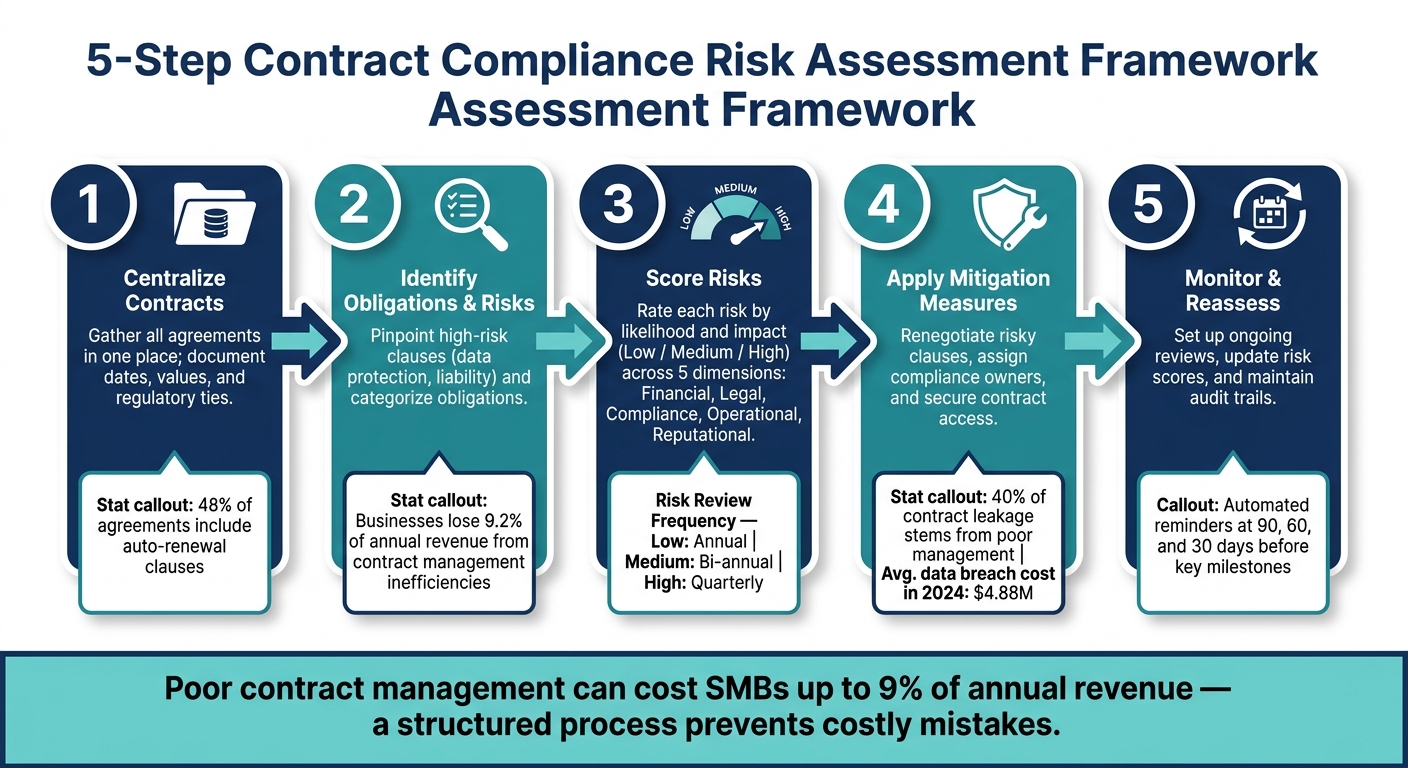
5-Step Contract Compliance Risk Assessment Framework
Step 1: Centralize Contracts and Map Compliance Exposure
Before tackling risks, you need a clear picture of what you’re dealing with. For many SMBs, contracts are scattered across different platforms, making it tough to manage risks effectively.
Building a Contract Inventory
Start by securing your digital contract storage and bringing all your active agreements into one place – vendor contracts, customer agreements, NDAs, employment contracts, and partnership deals. Each type comes with its own set of risks, so categorizing them upfront will simplify the process.
For each contract, document key details like effective and expiration dates, total value, governing jurisdiction, and any relevant data types (like PII, PHI, or payment card data). This metadata serves as the backbone for your compliance review. Keep in mind that 48% of business agreements include automatic renewal clauses, which could extend commitments unnoticed if not tracked.
Mapping Compliance Exposure
With your inventory complete, the next step is linking each contract to the regulations it falls under – for example, HIPAA for health data, CCPA for California residents, PCI DSS for payment card data, or GDPR for EU-related matters.
This process highlights which contracts carry regulatory responsibilities and ties them to the business processes and vendors involved. Many teams fall into the trap of a "compliance assumption error": believing a contract is compliant simply because it was drafted by legal counsel. Regulations evolve, and mapping ensures those assumptions are tested against current standards.
A contract may be fully compliant with applicable regulations yet still contain unfavorable payment terms or lopsided liability obligations. Compliance and commercial risk are separate problems that both need attention.
This step sets the stage for identifying and addressing risks later. Once you’ve pinpointed which contracts trigger regulatory obligations, you can move forward with a focused plan to assess and mitigate risks.
How Trackado Can Help
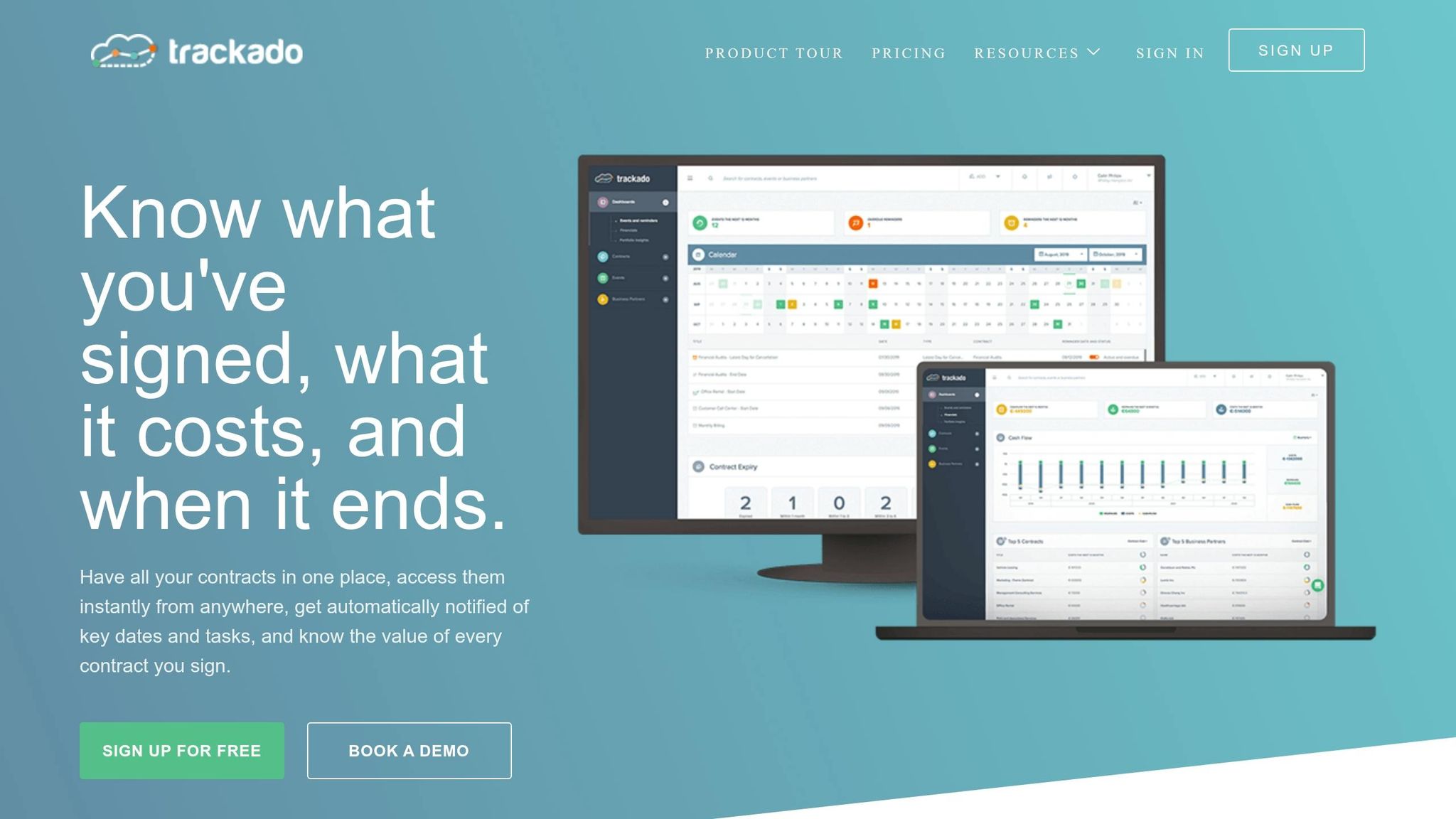
Trackado simplifies this process. Its structured contract repository centralizes all agreements, letting you organize them by partner, category, or department. With custom fields, you can tag contracts with compliance-specific details – for instance, marking a contract as "HIPAA-applicable" or identifying the data type as "PII." This makes it easy to filter and review your portfolio during audits or compliance checks.
Manual tracking inefficiencies become a thing of the past. Trackado’s assistive AI can extract key metadata from uploaded contracts, speeding up the creation of your inventory. Once contracts are centralized and compliance exposures are mapped, you’re ready to tackle specific risk areas in Step 2.
sbb-itb-49df6ae
Step 2: Identify Compliance Obligations and Risk Areas
Now that your contracts are centralized and compliance exposures mapped, the next step is to dive deeper into the contract language. This phase moves you from simply knowing what you have to understanding what those contracts demand of you. By pinpointing specific risk triggers, you can better manage potential compliance issues.
Identifying High-Risk Clauses
Pay close attention to clauses that pose the greatest compliance risks for SMBs. These typically fall into categories like:
- Data protection requirements (e.g., GDPR, HIPAA, CCPA)
- Cybersecurity standards (e.g., ISO, NIST)
- Audit and inspection rights
- Indemnification language
- Termination triggers
It’s essential to analyze how these clauses interact with one another. For instance, a liability cap might be undermined by broad indemnification terms. Reading clauses in isolation won’t give you the full picture.
Cybersecurity clauses, in particular, often require clear commitments around data access, breach notifications, and incident response protocols.
Categorizing Compliance Obligations
Once you’ve identified risky clauses, group the obligations into three main categories:
- Required Actions: Tasks you must complete, such as submitting quarterly reports or meeting SLA benchmarks.
- Prohibited Activities: Actions you must avoid, like unauthorized data sharing or working with sanctioned entities.
- Documentation Requirements: Records you need to maintain, such as audit logs or compliance certificates.
Be explicit when documenting these obligations. For example, you might note: "Required Action: Conduct annual security risk assessment and submit results by March 31."
Skipping this step can be costly. Businesses lose an average of 9.2% of annual revenue due to inefficiencies in contract management, such as missed deadlines or overlooked obligations.
Using Trackado to Track Obligations
Tools like Trackado can simplify the process of managing compliance obligations. Its custom fields allow you to label contracts with specific obligation types, regulatory requirements, and assigned owners. For example, you can tag a vendor agreement to require annual SOC 2 documentation or flag a customer contract as subject to CCPA data-sharing restrictions.
Trackado’s milestone tracking feature helps you set clear deadlines and checkpoints, ensuring no obligation is missed. Plus, its AI-powered metadata extraction significantly reduces the manual effort of pulling obligation details from dense contract text. This makes it a practical solution even for small teams without dedicated legal resources.
Once you’ve identified and organized your obligations, you’ll be ready to assess their likelihood and potential impact in the next step.
Step 3: Score the Likelihood and Impact of Compliance Failures
Now that you’ve categorized your obligations in Step 2, the next task is to pinpoint which compliance risks need the most attention. Not every risk is created equal, and treating all of them the same can drain resources unnecessarily. A simple scoring system can help you zero in on the risks that truly matter.
Risk Scoring Framework
To prioritize effectively, score each obligation based on two factors: the likelihood of failure and the impact of that failure. Use a three-tier scale – low, medium, or high – for both dimensions. Then, map these scores on a risk matrix to determine an overall risk level.
When evaluating impact, consider five key categories:
- Financial: Think about uncapped liabilities or missed penalty deadlines.
- Legal: This includes risks like breach of contract claims.
- Compliance: For instance, violations of GDPR or HIPAA.
- Operational: Issues such as unclear ownership of deliverables.
- Reputational: The fallout from damaged partnerships or public perception.
This multi-faceted approach ensures you’re not just looking at financial exposure but are also accounting for other critical areas.
| Risk Level | Review Action | Frequency |
|---|---|---|
| Low | Standard review; routine monitoring | Annual |
| Medium | Additional scrutiny; department head review | Bi-annual |
| High | Senior management approval; mitigation plan | Quarterly |
Prioritizing High-Risk Areas
Once you’ve scored the risks, focus on those that rank high in both likelihood and impact. For example, a data processing agreement with a cloud vendor might score high on likelihood (due to daily data transfers) and high on impact (since GDPR violations carry heavy penalties). These are the risks that need immediate attention.
Keep an eye on auto-renewal clauses as well. These clauses can lock you into unfavorable terms if overlooked. Nearly 48% of business agreements include automatic renewal provisions, making them medium-risk by default and high-risk if the contract value is substantial.
Tracking Risk Priorities in Trackado
After assigning risk scores, you need a system to manage and act on them. Trackado offers custom fields where you can tag contracts with their risk level – Low, Medium, or High – along with the specific risk category and the assigned owner. Its search and filter tools allow you to quickly locate high-risk contracts across your portfolio, reducing the chance of anything slipping through the cracks.
To stay ahead of deadlines, Trackado also provides automated reminders at 90, 60, and 30 days before key milestones. This ensures your team gets timely alerts for obligations with the highest exposure, eliminating the need for constant manual checks. Once risks are flagged, you can focus on defining and implementing mitigation strategies for the most critical areas.
Step 4: Define and Apply Mitigation Measures
Now that you’ve scored and prioritized your risks, it’s time to take action. Mitigation operates on two fronts: refining contract terms and improving internal processes.
Contract-Level Mitigations
Start by addressing high-risk clauses like liability caps, indemnity terms, auto-renewals, and jurisdiction provisions. Renegotiate unclear or one-sided terms – sometimes even small adjustments can significantly reduce financial exposure.
To streamline this, create a pre-approved clause library and a contract playbook. These tools provide clear fallback positions and ensure consistency in your approach.
Research consistently shows a significant share of contract value leakage stems from poor management rather than bad deal terms, making compliance assessment a business-critical function, not just a legal formality.
Additionally, include clauses that grant clear audit rights and outline specific data security requirements for counterparties. These provisions make it easier to verify compliance on both sides.
Operational and Technical Safeguards
Revising contracts isn’t enough; your internal systems need to back them up. Assign a compliance owner to each high-risk contract. This person will monitor obligations, flag potential issues, and escalate problems as needed. Without someone accountable, things can easily slip through the cracks.
The average global data breach cost in 2024 was $4.88 million, underscoring the need to secure contract access. Limit who can view or edit sensitive agreements, store them in encrypted systems, and avoid using email threads or shared drives for management. These steps help protect your organization from costly breaches.
Tracking Remediation Actions in Trackado
Tracking your mitigation efforts ensures they’re fully implemented. Trackado allows you to assign remediation tasks, set deadlines, and link updated contracts to their original versions. This provides a clear record of what changed, when it changed, and why.
Such timestamped records are invaluable for audits. Instead of scrambling to piece together a paper trail, you’ll already have the proof. As Vaishnavi Srinath, Product Marketing Manager at Signeasy, explains:
"Since transitioning to Trackado, everything has been very smooth, centralized, and super user-friendly. Whenever I suggest new features, they listen well and are willing to implement them." – Marc Fielmich, Privacy & Security Officer, iChoosr
Trackado also offers milestone tracking and automated reminders to ensure ongoing obligations aren’t forgotten once a contract is signed and stored.
These mitigation measures set the stage for continuous monitoring, which you’ll explore in the next step.
Step 5: Monitor, Reassess, and Document Compliance Activity
Once you’ve implemented risk mitigation strategies, the work doesn’t stop there. Ongoing monitoring is crucial to ensure your compliance efforts remain effective. Contracts, regulations, and business relationships are constantly evolving, so a one-time assessment won’t cut it. Continuous monitoring turns your compliance plan into a dynamic, working system.
Setting Up Monitoring Procedures
For every high-priority contract, create a clear monitoring plan. This plan should outline:
- Who is responsible for oversight
- What evidence needs to be collected
- How often reviews will occur
- Where records will be stored
When drafting or revising contracts, avoid vague terms like "periodically" or "as needed." These phrases can lead to confusion and make it harder to hold parties accountable. In fact, nearly half of organizations fail to effectively track some of their contracts, which can lead to compliance gaps.
Focus your monitoring efforts based on the risk level. Contracts that involve core business functions, large monetary values, or sensitive data demand more frequent reviews than routine, low-risk agreements.
Reassessing Risks on a Regular Schedule
The risk scores you established earlier (in Step 3) aren’t static. Changes such as new regulations, acquisitions, or vendor compliance issues can alter the risk profile of even low-priority contracts. At a minimum, conduct a full reassessment annually.
Additionally, set up triggers for unscheduled reviews. Examples include entering new markets, onboarding high-value customers, or addressing compliance failures. These periodic and event-driven assessments ensure your risk evaluations stay current and relevant, while also supporting robust audit trails.
Maintaining Evidence and Audit Trails
Good record-keeping serves two essential purposes: recovering costs from contract underperformance and protecting your organization during regulatory investigations. Document every compliance-related decision, including what action was taken, who approved it, and when. A timestamped trail of evidence not only simplifies audits but also helps internal teams understand the history of a contract without needing to track down the original stakeholders. These records quickly become indispensable assets.
How Trackado Supports Ongoing Monitoring
Trackado simplifies the entire monitoring process, eliminating the need for a cumbersome manual system. Its automated reminders ensure you never miss deadlines or renewal dates, while milestone tracking keeps recurring obligations front and center across your contract portfolio.
Trackado’s assistive AI further reduces manual effort by extracting critical metadata like dates, parties, and payment terms. During audits or reviews, you can export contract data into Excel or PDF, providing a clean, shareable record of your compliance activities. For SMBs juggling contracts across multiple teams or partners, this centralized visibility makes ongoing monitoring manageable and efficient.
Conclusion: Building a Repeatable Compliance Process
Let’s sum it up: contract compliance isn’t a one-and-done task – it’s an ongoing effort. This guide walked through a practical five-step framework to keep things on track: centralize your contracts, identify obligations, score risks, apply mitigations, and monitor continuously. These steps turn contracts from static files into actively managed tools for your business.
Here’s why this matters: for SMBs, poor contract management can drain up to 9% of annual revenue – and in more complex industries, that figure can climb above 15%. A structured process helps you catch potential compliance issues early, before they snowball into costly legal or financial headaches.
A signed contract is just the starting point. The real work is tracking the weeks, months, and years of obligations that follow. That’s where a structured compliance process pays for itself.
A repeatable process doesn’t just happen. It requires clear ownership, automated reminders (like a contract renewal planner for 90, 60, and 30 days before renewals), regular spot-checks on high-risk agreements, quarterly reviews, and a yearly performance evaluation.
Tools like Trackado are designed to make this process manageable. It helps centralize contracts, automate deadline alerts, and even generate audit-ready reports. For SMBs looking to stay compliant without adding unnecessary complexity, Trackado offers the visibility and control you need. Interested? They even provide a 30-day free trial to help you get started.
FAQs
Which contracts should we assess first?
When managing contracts, begin with those that carry the highest risk profiles. These often include vendor agreements, customer contracts, employment agreements, partnerships, and NDAs. Pay close attention to high-risk clauses such as liability caps, indemnity provisions, termination rights, auto-renewal terms, and jurisdiction clauses. It’s also crucial to prioritize contracts tied to parties that pose potential financial, compliance, or reputational risks. Tackling these early helps address critical issues and reduces potential exposure.
What’s the simplest way to score contract compliance risk?
The easiest way to evaluate contract compliance risk is by looking at two key factors: likelihood and severity of potential issues. Using tools like risk matrices or heat maps can make it easier to spot and prioritize high-risk areas. Concentrate on risks that are both likely to occur and carry significant consequences to make your compliance process more efficient.
How often should we recheck contracts for compliance changes?
Regular contract reviews depend on the type of agreement and its obligations. For long-term contracts, quarterly reviews are ideal to stay on top of any updates or changes. On the other hand, short-term contracts may only need one or two reviews before they expire.
To maintain compliance throughout the contract lifecycle, it’s crucial to have regular monitoring in place and set up automated alerts for important deadlines and key dates. These steps help ensure nothing slips through the cracks.