
Contracts can expose businesses to hidden risks like missed deadlines, compliance issues, and financial losses. Poor management leads to significant revenue leakage – on average, organizations lose 9.2% of their annual revenue due to contract mismanagement. To address these challenges, businesses can use contract risk identification and analytics. Here’s how:
- Centralize Contracts: Store all agreements in one secure, searchable repository to eliminate blind spots and improve visibility.
- Extract Key Data: Use AI tools to identify critical details like renewal dates, payment terms, and compliance clauses.
- Monitor Risks with Dashboards: Track metrics like obligation fulfillment rates and risk scores in real-time.
- Use Predictive Analytics: Forecast potential risks, such as non-compliance or financial exposure, before they escalate.
- Mitigate Risks: Create workflows to address high-risk contracts and use tools for quick amendments and approvals.
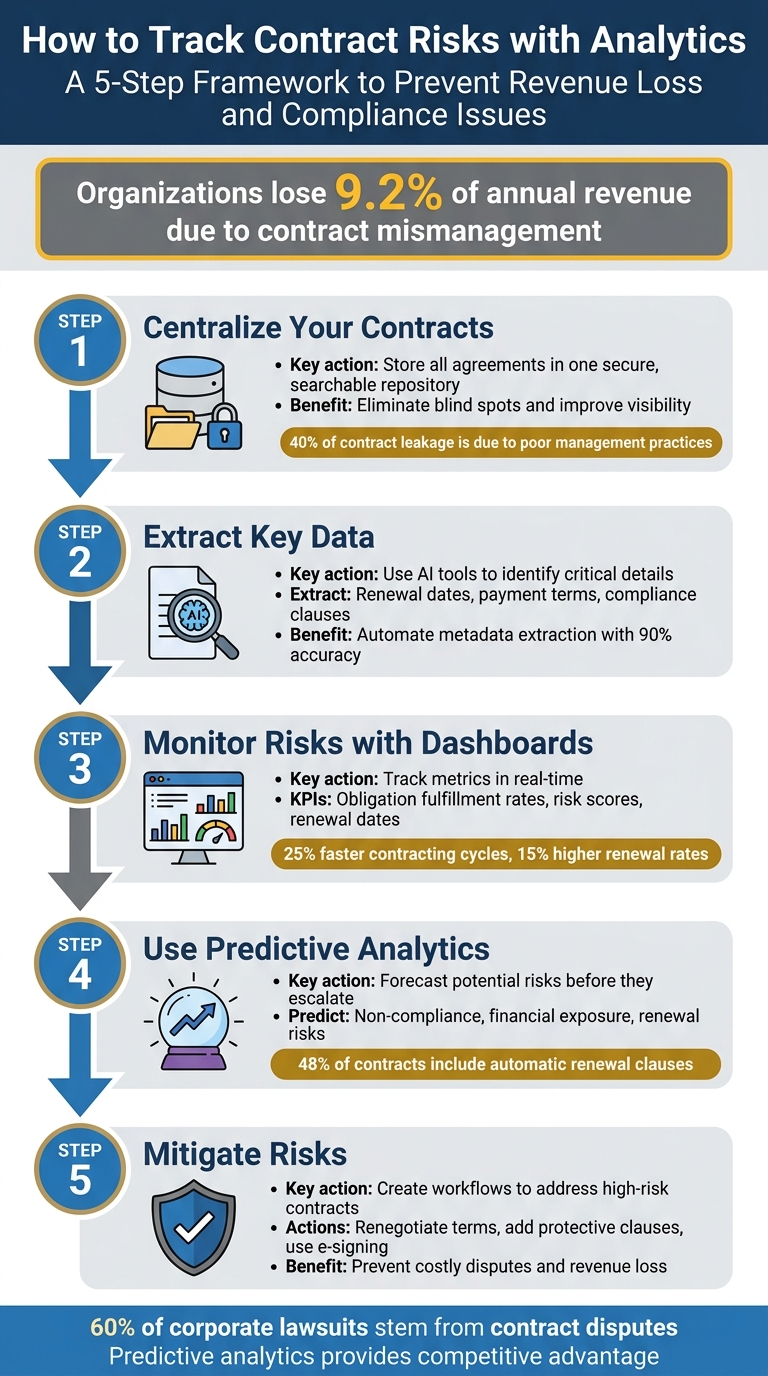
5-Step Process to Track Contract Risks with Analytics
Step 1: Centralize Your Contracts in One Place
Why a Central Contract Repository Matters
When contracts are scattered across email inboxes, filing cabinets, and personal devices, it’s nearly impossible to keep track of them all. This lack of organization leads to blind spots – making it harder to monitor risks. In fact, research shows that poor management practices account for approximately 40% of contract leakage. On top of that, nearly half (48%) of agreements include automatic renewal clauses, which can trap your business in unfavorable terms if they’re not closely monitored.
A centralized repository changes the game by serving as a single source of truth for all your agreements. Instead of wasting hours hunting through various locations, you can quickly filter contracts by partner, type, department, or renewal date. This kind of visibility is crucial – after all, you can’t manage risks if you don’t know they exist.
Take SOHAR Port and Freezone as an example. In January 2025, they introduced an automated contract workflow to fix process inefficiencies. The results? They cut contract processing time by 80% and significantly reduced compliance risks. Similarly, Assante, a Canadian wealth management firm handling over $40 billion in assets, adopted a comprehensive contract management solution. This helped them avoid financial risks, reduce account freezes caused by paperwork delays, and streamline client onboarding.
Centralizing your contracts is the first step toward better risk management. Tools like Trackado make this process straightforward – let’s dive into how it works.
How Trackado Centralizes Your Contracts
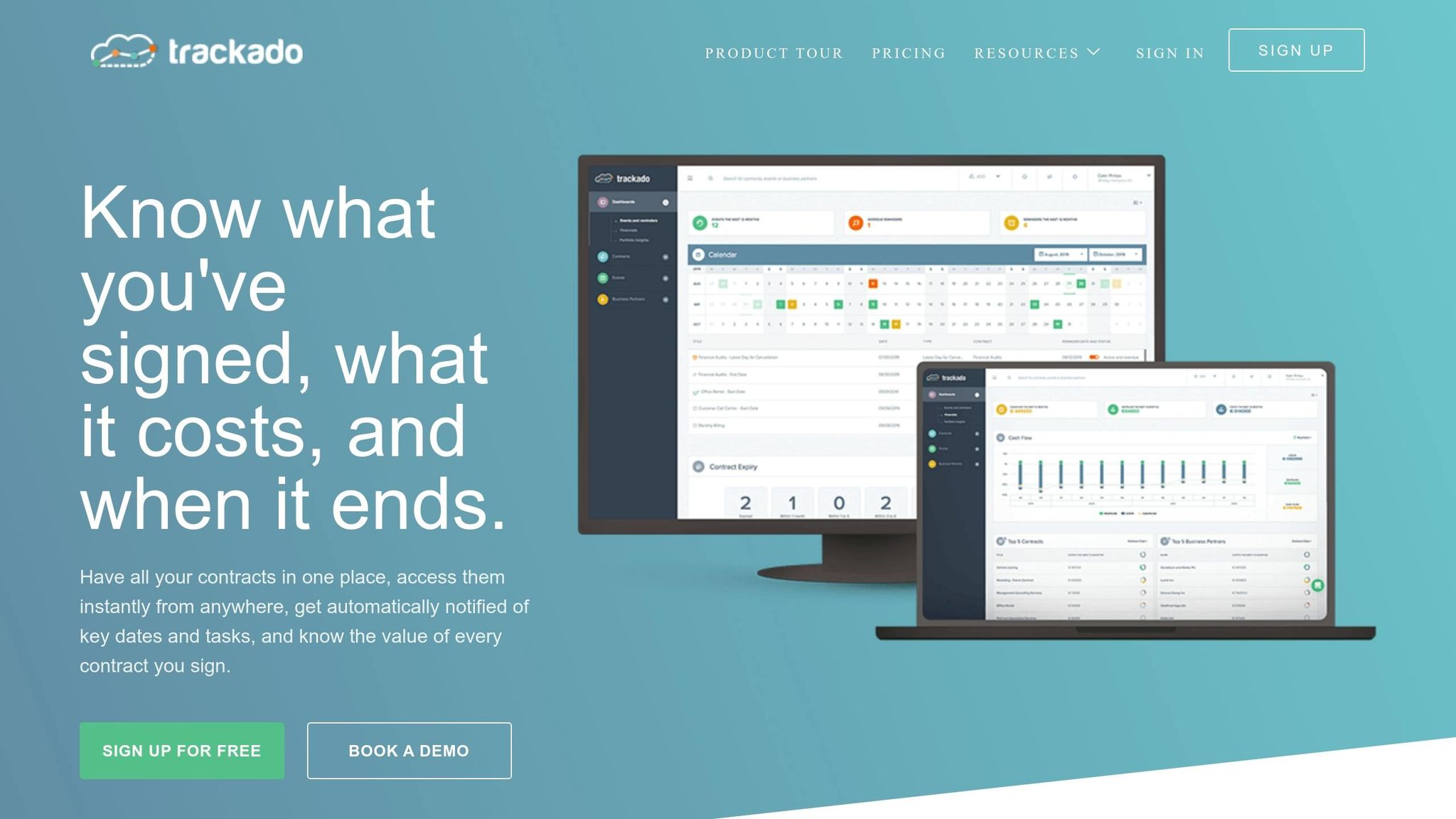
Trackado offers a secure, structured contract repository where you can store and organize all your agreements. Whether it’s vendor contracts, customer agreements, NDAs, or employment documentation, everything is housed in one searchable cloud-based platform.
The platform’s AI-powered tools automatically pull out critical details like key dates, payment terms, and obligations. Hosted in European data centers and fully aligned with GDPR requirements, Trackado ensures your sensitive data remains secure. Role-based access controls allow you to customize who can view or edit specific contracts, offering both transparency and protection. This way, your team can focus on effective risk monitoring without worrying about unauthorized access.
sbb-itb-49df6ae
Step 2: Extract Key Data and Identify Risk Indicators
What Data to Extract from Contracts
When working with centralized contracts, focus on pulling out the critical data points that highlight potential risks.
Start with the basics: expiration dates, payment schedules, auto-renewal clauses, termination rights, liability caps, and indemnification terms. These are the foundation of effective risk monitoring. Pay close attention to non-standard clauses, as they can create vulnerabilities during disputes or unexpected situations.
Be on the lookout for deviations from standard templates. For example, unusually short termination-for-convenience periods or missing data privacy clauses can signal potential risks. Analytics tools are particularly useful here – they can flag these issues instantly, whereas manual reviews often miss them.
| Risk Category | Key Data to Extract | Why It Matters |
|---|---|---|
| Financial | Auto-renewal terms, payment schedules, uncapped liability | Avoids missed deadlines and prevents overpayment. |
| Legal | Non-standard indemnity, jurisdiction, breach terms | Lowers litigation risk and ensures enforceability. |
| Compliance | Missing GDPR/HIPAA clauses, regulatory filing dates | Keeps contracts aligned with industry regulations. |
| Operational | Unclear deliverables, missed milestones, data entry errors | Improves contract administration and daily workflows. |
Once you’ve identified these key data points, the next step is to use AI to automate metadata extraction.
Automate Metadata Extraction with Trackado
After identifying the risk indicators, automating metadata extraction becomes essential for efficient risk monitoring. Manual extraction is time-consuming and prone to errors, but AI-powered tools can process unstructured text and transform it into structured, actionable data within seconds.
Trackado’s AI stands out by analyzing all types of agreements, including legacy PDFs and scanned documents. It efficiently extracts key metadata such as parties, dates, payment terms, and obligations.
What makes modern AI tools like Trackado particularly powerful is their ability to understand context. They don’t just look for keywords – they grasp the meaning behind clauses. For instance, even if a "termination for cause" clause is worded differently, the AI can still recognize its intent. This ability to flag non-standard language that deviates from templates or industry norms provides valuable insights for proactive risk management.
"Contract data extraction fundamentally differs from simple keyword searches by converting unstructured contract text into structured, reportable data fields." – Ironclad
Trackado also allows businesses to create custom fields tailored to their specific needs. Whether it’s tracking exclusivity periods, monitoring PII exchange requirements, or capturing niche regulatory clauses, the platform adapts to your priorities. It boasts about 90% accuracy for most extraction tasks out of the box. However, human review remains critical for high-stakes or complex provisions. This "trust but verify" approach ensures AI handles the bulk of the work while your team focuses on interpreting results and making sound decisions.
Step 3: Monitor Risks with Dashboards and KPIs
Which Risk KPIs to Track
Once you’ve clause extraction and classification, the next move is to translate that information into key performance indicators (KPIs) that highlight potential risks. The goal? Focus on metrics that directly tie to your business goals.
Start by tracking the obligation fulfillment rate – the percentage of contractual obligations met on time. This metric serves as an early warning system for compliance issues. Keep an eye on renewal and expiration dates to avoid service interruptions or unwanted auto-renewals. Monitoring these dates ensures you’re ahead of potential risks tied to contract renewals.
Another critical metric is the contract risk score distribution. Whether generated by AI or rule-based systems, these scores help legal teams zero in on contracts needing immediate attention. Similarly, the non-standard term frequency – the proportion of contracts with custom clauses – can signal areas of increased legal exposure.
Don’t overlook value leakage, which measures the gap between expected contract value and actual outcomes. Combine this with metrics like missed milestones and audit trail completeness to ensure every contract has a full version history and logged approvals.
According to recent findings, 35% of organizations are already using analytics tools to assess their contracting processes. Additionally, 9% of general counsel now highlight advanced contract analytics as a key tool for improving oversight and cutting costs. For instance, one dashboard example revealed that $123 million of a $170 million portfolio was stuck in the draft stage, spotlighting significant pipeline risk.
| Risk KPI | Calculation | Why It Matters |
|---|---|---|
| Obligation fulfillment rate | Obligations met on time ÷ total obligations | Tracks post-signature performance and accountability |
| Contract risk score | AI-generated or rule-based scoring | Helps prioritize contracts needing immediate review |
| Non-standard term frequency | % of contracts with custom clauses | Highlights exposure from deviations to standard templates |
| Renewal rates | % of contracts renewed on time | Prevents service lapses and penalties from auto-renewals |
| Compliance rate | % of contracts meeting regulatory requirements | Ensures audit readiness and reduces legal risks |
| Value leakage | Expected value minus actual realized value | Identifies lost revenue from pricing errors or service-level agreement failures |
By focusing on these KPIs, you can establish dashboards that provide real-time insights, seamlessly connecting to the data extracted in earlier steps.
Set Up Dashboards for Real-Time Risk Monitoring
Once you’ve defined your KPIs, dashboards become your go-to tool for real-time oversight. They transform raw data into actionable visuals – think charts, tables, and scorecards – all in one centralized view.
"A contract management dashboard is a centralized, real-time view of your contract lifecycle, presented through visual components such as charts, tables, scorecards, and metrics." – Conga Team
Dashboards can be tailored to specific roles. Executives might focus on financial exposure and portfolio health, while legal teams dive into risk indicators, and sales teams monitor renewal rates and contract value.
Incorporate color-coded visual cues to flag urgent issues, and set up automated alerts to notify contract owners about key dates or high-risk scores. Alerts can be configured for 90-, 60-, and 30-day intervals, with escalation triggers for overdue items.
Tools like Trackado offer advanced dashboard features, letting you visualize contract data across various categories – by partner, department, or even custom attributes. You can drill down from high-level metrics, like total portfolio value, to specific contract details and activity history. Dashboards can also segment data by jurisdiction, helping you pinpoint areas with higher legal risk.
Organizations that actively track contract metrics report 25% faster contracting cycles and 15% higher renewal rates.
Step 4: Use Predictive Analytics to Prevent Risks
Forecast Risk Scenarios with Analytics
Predictive analytics takes contract management to the next level by helping organizations anticipate and address risks before they become major issues. By analyzing historical contract data, AI can identify potential non-compliance, financial vulnerabilities, and legal risks.
For example, it can compare new contract terms against pre-approved language libraries, flagging non-standard clauses or high-risk terms. These insights are then assigned risk scores based on factors like past disputes, vendor performance, and industry benchmarks. Tools like heat maps visually highlight contracts that need urgent attention.
"Predictive analytics in contract lifecycle management uses AI, machine learning, and historical contract data to forecast potential risks, non-compliance issues, and financial exposure before they occur." – SutiSoft
Predictive models also simulate scenarios such as vendor price hikes, currency changes, and termination penalties. They even predict renewal risks using metadata and historical trends. This is especially crucial given that 48% of contracts include automatic renewal clauses, which can lock companies into unfavorable terms if not managed properly.
The impact of poor contract management is significant: 40% of contract leakage is due to ineffective practices. Predictive analytics helps mitigate this by categorizing risks into financial, compliance, operational, legal, and renewal-related areas.
Set Up Automated Alerts for Early Warning
Once risks are identified, timely action is key. Automated alerts ensure that your team can respond to potential issues before they escalate. These systems track critical milestones and provide real-time notifications for compliance deadlines or possible SLA violations.
Platforms like Trackado go beyond basic calendar reminders. They continuously monitor contract metadata, sending alerts at intervals like 90, 60, and 30 days before key dates. Alerts can also flag anomalies – such as deviations from standard terms or clauses that might increase legal risks.
You can configure alerts for various risk categories, including:
- Financial triggers: Payment defaults or unexpected pricing changes.
- Compliance deadlines: Regulatory filings or audit requirements.
- Operational milestones: Delivery schedules or performance reviews.
- Renewal windows: Notice periods or auto-renewal deadlines.
These alerts can be routed to the appropriate team members – legal teams for compliance issues, finance for payment-related concerns, and operations for SLA tracking. For high-value contracts, quarterly reassessments can be scheduled to identify new risks as they emerge.
Step 5: Report and Mitigate High-Risk Contracts
Generate Reports for Risk Analysis
Creating detailed risk reports is essential for identifying and prioritizing contracts that need immediate attention. A scoring model that evaluates both impact and likelihood on a 1–5 scale can help. This approach produces scores ranging from 1 to 25, allowing contracts to be categorized into four risk levels: Critical (20–25), High (12–16), Medium (5–10), and Low (1–4).
Contracts classified as critical or high risk should be flagged for urgent review, while medium-risk ones can follow routine monitoring. Mismanaged contracts can have serious consequences – businesses lose an average of 9.2% of annual revenue due to missed obligations or inconsistent processes. Advanced analytics tools can help by drastically cutting review times, flagging risky clauses like unclear payment terms, non-standard language, or unfavorable indemnity clauses in under 10 minutes.
Risk reports should focus on key areas such as financial, legal, compliance, and operational risks. A gap analysis can highlight discrepancies between active contracts and standard templates, pinpointing missing protections or unmet regulatory requirements. Heat maps are especially useful for visualizing which contracts pose the greatest risks, helping leadership quickly identify where to allocate resources.
Mitigate Risks with Workflows and E-Signing
Once high-risk contracts are identified, it’s time to act. Mitigation workflows are essential for ensuring these contracts are handled appropriately. Tools like Trackado’s approval workflows route flagged contracts to the right stakeholders based on their risk level. For example, critical contracts can be automatically escalated to the legal team and require executive sign-off before moving forward.
Mitigation strategies might include renegotiating terms, adding protective clauses, or requiring additional insurance. With Trackado’s integrated e-signing feature, these changes can be executed quickly. Instead of waiting days for physical signatures or switching between platforms, teams can amend contracts and secure approvals all within a single system. This reduces delays and minimizes the risk of costly mistakes.
Conclusion
Using analytics to track contract risks can revolutionize how your business handles agreements. By implementing these five steps, you shift from constantly reacting to problems to actively preventing risks. Centralizing contracts eliminates hidden liabilities buried in scattered emails and folders. AI-powered tools make it easy to extract critical data, turning overlooked clauses into actionable insights. Automated dashboards and KPIs give you real-time visibility into renewals and compliance deadlines, while predictive analytics help identify potential issues before they escalate. Standardized reporting and workflows ensure that high-risk contracts get the attention they need.
The stakes are high. Poor contract management can drain up to 10% of annual revenue. Additionally, about 60% of corporate lawsuits stem from contract disputes. For small and mid-sized businesses without dedicated legal teams, these losses can be catastrophic. Outdated tools like spreadsheets and scattered storage systems aren’t equipped to handle today’s complex agreements – especially when 48% of contracts include automatic renewal clauses that could lock you into unfavorable terms.
This ability to predict and address risks offers a competitive edge.
"Organizations that adopt predictive contract analytics today will outperform competitors tomorrow."
– SutiSoft Editorial Team
Trackado simplifies contract management by centralizing agreements, automating metadata extraction, and integrating risk monitoring with e-signing – all without unnecessary complexity. Spotting contract risks early isn’t just a smart move; it’s a crucial step to protect revenue, minimize legal exposure, and free your team to focus on growth rather than tedious administrative tasks.
The future of contract management lies in automation and data-driven strategies. Start implementing these steps today to make smarter, more informed decisions tomorrow.
FAQs
What contract risks should I prioritize first?
When managing contracts, it’s crucial to zero in on risks that could have the greatest consequences. These include:
- Financial exposure: Think about risks like auto-renewals that slip by unnoticed or clauses with uncapped liability, which can lead to unexpected costs.
- Regulatory compliance: Outdated or non-compliant terms can result in penalties or legal trouble, making it essential to ensure all agreements meet current standards.
- Performance issues: Ambiguities in service level agreements can lead to unmet expectations and disputes.
Using tools like Trackado can make this process more manageable. These platforms are designed to spot risky clauses, identify compliance gaps, and flag unclear language early on. By tackling these areas proactively, you can reduce the chances of facing major financial or legal setbacks.
How accurate is AI at extracting contract data from PDFs?
Modern AI tools excel at pulling contract data from PDFs, handling both scanned and digital documents with high precision. The accuracy largely hinges on the quality of the AI technology and the validation methods in place. For critical compliance tasks, human review is often advised to ensure reliability. As AI evolves, it transforms static documents into structured, actionable insights that aid in compliance, forecasting, and managing contracts effectively.
Which KPIs matter most for contract risk dashboards?
When it comes to managing contract risks, the most impactful KPIs zero in on identifying, tracking, and addressing potential issues. These metrics help organizations stay on top of compliance, streamline operations, and reduce risk exposure.
Here are some key areas to monitor:
- Obligation Fulfillment: Ensuring all contractual obligations are met.
- Contract Cycle Time: Measuring how long it takes to draft, negotiate, and finalize contracts.
- Renewal Rates: Tracking the percentage of contracts successfully renewed.
- Value Leakage: Identifying any lost value due to missed terms or inefficiencies.
- Risks Identified and Mitigated: Keeping count of risks uncovered and successfully addressed.
Additionally, more targeted metrics like risk severity levels and the effectiveness of mitigation strategies play a crucial role in minimizing both financial and operational vulnerabilities. Together, these KPIs provide a clear picture of how well risks are being managed and reduced.