
Missing contract deadlines or compliance obligations can cost businesses millions – up to $40M per incident. Manual tracking methods, like spreadsheets and calendar reminders, are error-prone and time-consuming, leading to missed deadlines and increased risks.
Real-time alerts solve this issue by automatically monitoring contracts and notifying the right people when action is needed. These systems use AI to extract key data, track deadlines, and flag potential issues instantly, reducing compliance risks and cutting governance costs by 60%. With 99% on-time compliance rates and faster issue resolution, companies save time, money, and avoid costly mistakes.
Key Benefits:
- Automated Notifications: Alerts triggered for deadlines, renewals, or regulatory updates.
- Time Savings: Reduces manual work by up to 15 hours per week.
- Improved Compliance: 99% on-time compliance and fewer missed obligations.
- Cost Efficiency: 60% reduction in governance expenses and up to 12% less spend leakage.
- Audit Readiness: Maintains detailed logs for faster, hassle-free audits.
Real-time alerts turn contracts into actively monitored assets, ensuring nothing critical slips through the cracks. These systems are a must for businesses looking to avoid penalties, streamline operations, and stay ahead of compliance risks.
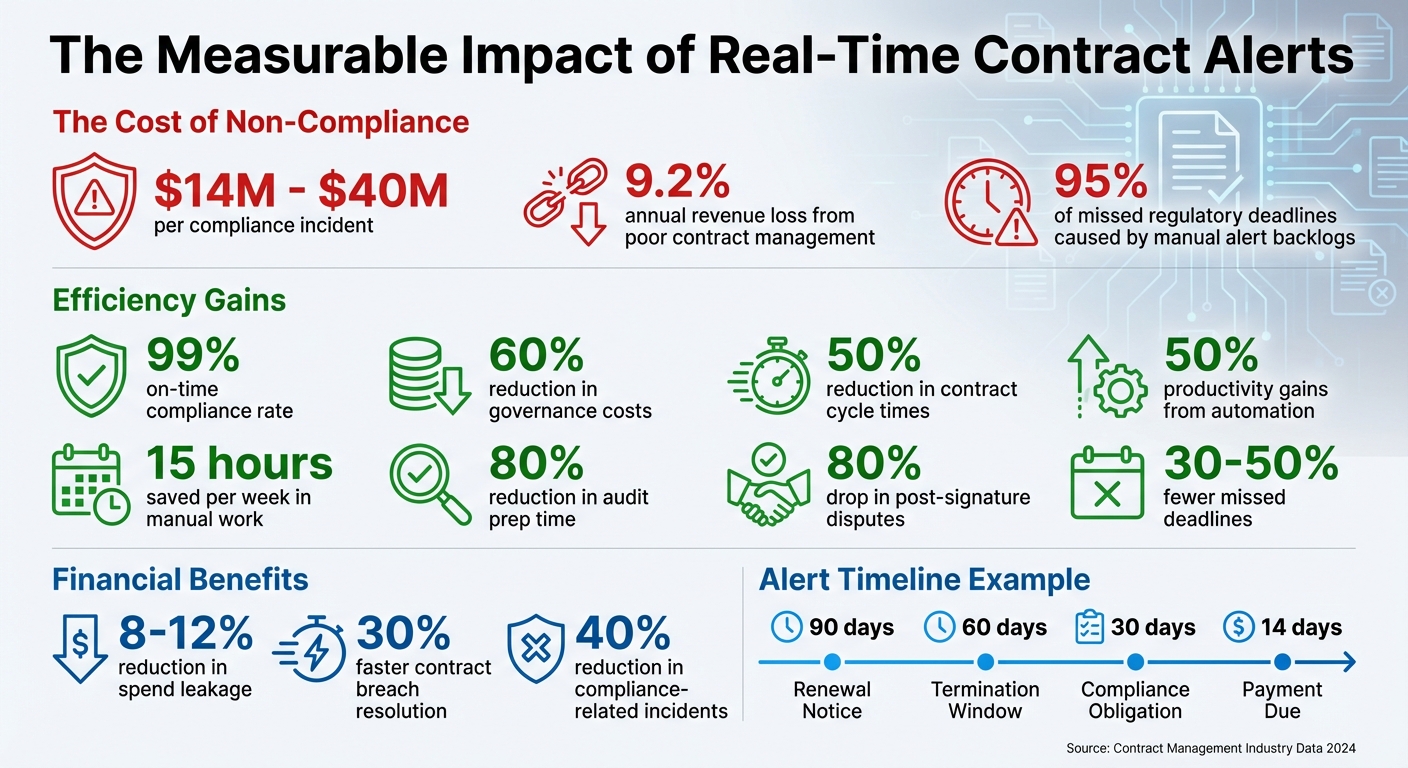
Real-Time Contract Alerts: Key Benefits and ROI Statistics
What Are Real-Time Compliance Alerts?
Real-time compliance alerts are instant notifications triggered by specific contract-related events, such as approaching deadlines, missed obligations, or regulatory updates. Unlike manual reminders that require setup and constant monitoring, these alerts operate automatically, ensuring the right people are informed at the right time without manual intervention.
"Real-time contract compliance alerts are automated notifications triggered by key contract milestones, regulatory changes, or compliance events – delivered instantly to relevant stakeholders to ensure timely action and accountability." – Sirion
Think of these alerts as an early warning system for contract management. Instead of relying on someone to check a calendar or spreadsheet, the system continuously monitors contracts and sends notifications via email, SMS, dashboards, or tools like Slack and Microsoft Teams. If the initial recipient doesn’t act within seven days, the alert automatically escalates to a supervisor.
The process is powered by AI, which extracts key contract data and compares it to predefined thresholds using a rule-based engine.
How Alerts Are Triggered
These alerts rely on AI-driven processes to activate as contract details evolve. It all begins with AI-powered data extraction. Once a contract is uploaded, natural language processing identifies critical details such as renewal dates, termination clauses, service level agreements, and regulatory requirements. Advanced systems can extract over 1,200 contract fields from unstructured text, converting them into actionable, trackable data.
This extracted data is then fed into a rule-based monitoring engine that constantly evaluates contract terms against dates, performance metrics, and external factors. You can configure specific conditions to trigger alerts. For example, the system might flag contracts 90 days before auto-renewal or notify you if a vendor’s service uptime drops below 99.9%. Unlike manual checks, this monitoring runs continuously, even outside business hours.
To ensure timely action, alerts can be set up at multiple thresholds. This layered approach helps prevent issues from escalating unnecessarily.
Common Use Cases
Real-time alerts have practical applications across several areas, including renewal management, regulatory compliance, and service level monitoring.
Renewal management is perhaps the most common. The system notifies your team well in advance – typically 90 days – of upcoming auto-renewal windows. This gives procurement teams enough time to decide whether to renew, renegotiate, or terminate, avoiding unwanted extensions that could lock in unfavorable terms.
For regulatory compliance, the system monitors contracts to ensure they align with current laws. If regulations like GDPR, HIPAA, or MiFID II are updated, the system flags affected clauses for revision. It also tracks expiring insurance certificates, licenses, and permits, preventing operational disruptions.
With service level agreements, alerts notify you when performance metrics are at risk. For instance, if a vendor’s delivery schedule slips or uptime falls below agreed thresholds, the system alerts the vendor manager. This enables quick action, whether it’s claiming service credits or resolving the issue before it worsens.
Additionally, financial triggers help identify payment anomalies, spend leakage, or key financial milestones. These alerts ensure you don’t miss opportunities to save or address financial discrepancies.
sbb-itb-49df6ae
How Real-Time Alerts Work in Contract Management Systems
Real-time alerts in contract management systems operate on a structured process that transforms static documents into actively monitored assets. This process involves three key steps: centralization, configuration, and continuous monitoring. Together, these steps ensure your team can stay ahead of potential compliance risks.
Centralizing Contract Data
The first step in enabling alerts is centralizing your contracts into a single, unified system. When contracts are scattered across emails, shared drives, and filing cabinets, effective monitoring becomes nearly impossible. Centralization consolidates all agreements into one digital repository where AI tools can index, extract, and monitor them consistently.
This approach ensures uniform policy enforcement across all contracts, whether they involve a $5,000 vendor or a $5 million partner. With all contracts processed through the same rules engine, AI tools like Optical Character Recognition (OCR) and Natural Language Processing (NLP) can extract critical details – renewal dates, payment schedules, service thresholds, and regulatory clauses – converting dense legal jargon into actionable data. Without centralization, some contracts may slip through the cracks, leaving your organization vulnerable.
Once your contracts are centralized and structured, the next step is setting up the specific conditions that will trigger alerts.
Configuring Alerts
After centralizing your contracts, you can define the conditions that trigger notifications. Modern contract management systems let you customize alerts based on contract type, partner, department, or financial thresholds. For instance, you can configure an alert to notify you 90 days before a contract auto-renews.
It’s a good idea to set alerts at multiple intervals to give your team enough time to act without last-minute rushes. For example, payment obligations might require a 14-day lead time, while compliance deliverables often need a 30-day notice.
| Alert Type | Typical Trigger | Recommended Lead Time |
|---|---|---|
| Renewal Notice | Expiration date | 90 days |
| Payment Due | Invoice or milestone date | 14 days |
| Compliance Obligation | Deliverable/reporting deadline | 30 days |
| Termination Window | End of notice period | 60 days |
Alerts can also be assigned by role, ensuring continuity even when personnel changes occur. For example, routing notifications to roles like "Procurement Manager" or "Legal Counsel" ensures no critical updates are missed. Additionally, setting up escalation paths – such as notifying senior management if an alert goes unacknowledged for 24 hours – further strengthens your process.
Platforms like Trackado simplify this by offering customizable fields and milestone tracking. Whether you need alerts tailored by contract type, partner, or financial threshold, these systems ensure the right people get notified via email, dashboards, or tools like Slack and Microsoft Teams.
Monitoring and Responding
Once alerts are configured, continuous monitoring ensures your team gets actionable insights in real time. Dashboards serve as the "central nervous system" of the system, displaying compliance metrics, deadlines, and high-risk contracts in one place. Each user sees a tailored view: procurement teams focus on renewals, finance monitors payments, and legal handles regulatory obligations.
When an alert is triggered, the dashboard highlights it, enabling your team to respond immediately without digging through spreadsheets or emails. For instance, if a breach is flagged, the system logs the incident and notifies the appropriate manager to take corrective action before the issue escalates. This immediate visibility reduces missed deadlines and penalties, helping to prevent costly compliance breaches.
Modern systems also maintain immutable audit trails, which record every alert, action, and stakeholder involved. These logs can streamline regulatory audits, generating complete audit packages in hours. Companies using advanced systems report 99% on-time compliance and a 60% reduction in governance costs.
"Real-time dashboards serve as the central nervous system of modern compliance management, providing digital interfaces that immediately display compliance and risk metrics tailored to each user’s role and responsibilities." – Sirion
The results of automated alerts are clear. Companies that adopt these systems experience 30% to 50% fewer missed deadlines and resolve contract breaches 30% faster. For example, one organization avoided a $250,000 auto-renewal penalty thanks to a 60-day automated reminder. This shift from passive contract storage to active management delivers measurable benefits and peace of mind.
Key Benefits of Real-Time Alerts for Contract Compliance
Using centralized contract data and setting up customizable alert thresholds, real-time alerts transform contract management into a proactive system. This approach helps reduce financial losses, avoid regulatory penalties, and prevent operational hiccups.
Improved Deadline Management
Automated alerts take the hassle out of manual tracking by continuously monitoring contract data and sending notifications through email, SMS, or collaboration tools. Companies adopting these alerts have seen contract cycle times drop by more than 50%. AI tools, with over 90% accuracy, pinpoint critical contract events. Alerts can be configured for specific timelines – like 120, 90, 60, and 30 days before a contract expires – giving teams enough time to handle complex negotiations. If an alert goes unacknowledged, the system automatically escalates it to supervisors or backup team members.
"Many hours saved, many dollars saved in contracts that we meant to terminate and forgot."
- Jennifer Neville, Associate Corporate General Counsel, Sevita
Reduced Risk of Penalties
These alerts don’t just keep track of deadlines – they actively help prevent costly compliance failures. By monitoring for issues like expired insurance certificates, licenses, or missed service-level agreements, automated systems can prevent up to 80% of compliance violations. Organizations using these tools report 99% on-time compliance with obligations, a 60% reduction in governance costs, and an 8–12% decrease in spend leakage. Assigning alerts to roles instead of individuals ensures continuity, as manual alert backlogs are responsible for 95% of missed regulatory deadlines.
Better Preparedness for Audits
Real-time alerts also simplify audit preparation by maintaining a detailed, chronological record of every action, timestamp, and user interaction. This allows companies to generate complete audit packages in minutes, cutting audit prep time by 80%. The system captures the entire lifecycle of compliance events, making it easier to provide evidence during regulatory reviews.
"Detailed audit trails create transparency, support audits, and ensure organizations can demonstrate compliance when required."
- Sirion
Trackado’s centralized repository and automated milestone tracking ensure contracts are always audit-ready. With secure European data centers, enterprise-grade encryption, and adherence to standards like SOC 2, HIPAA, and GDPR, Trackado offers the visibility teams need to handle audits with confidence.
Implementing Real-Time Alerts in Trackado
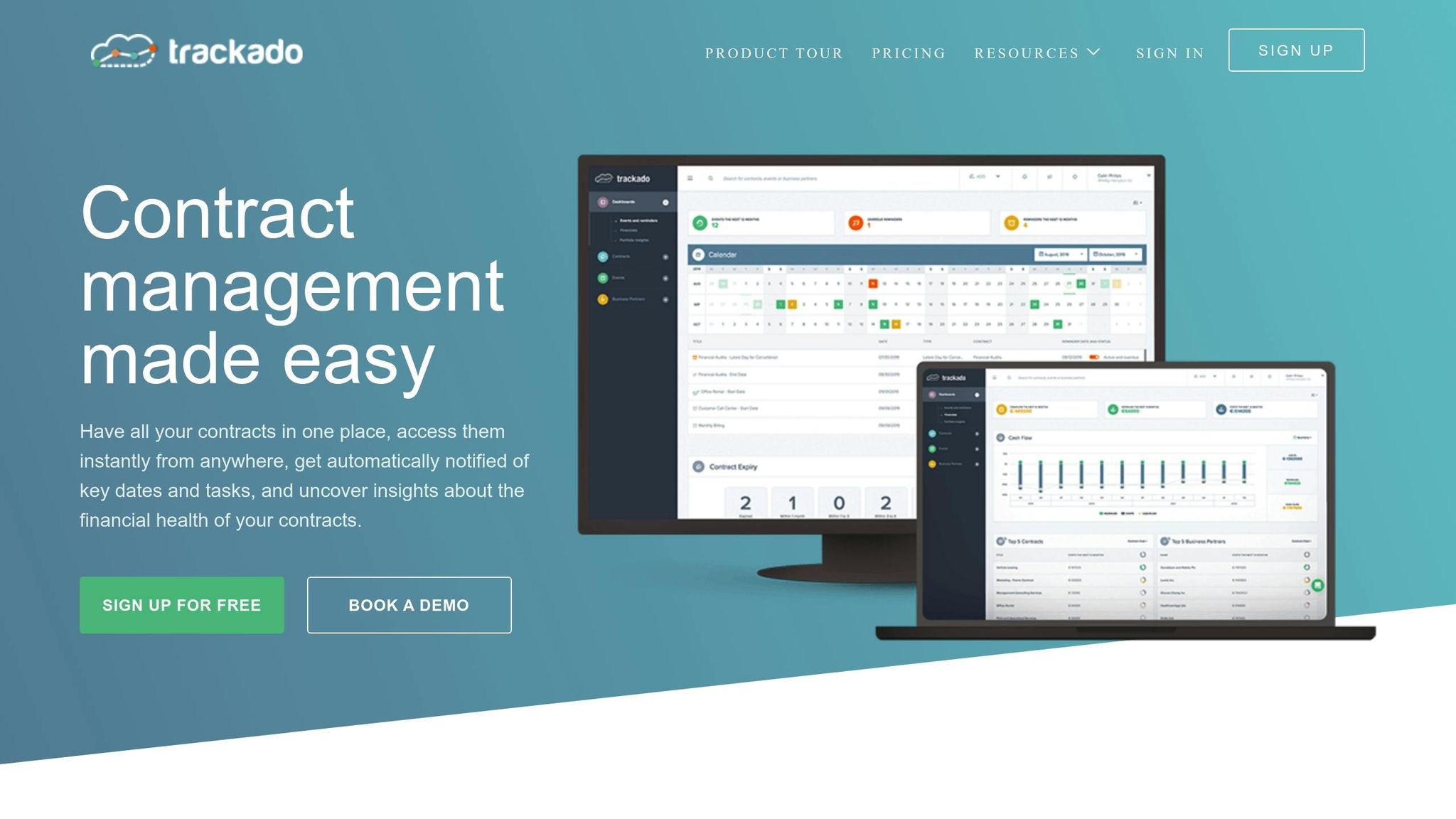
Trackado simplifies the process of setting up real-time alerts, making it easier to manage contracts and avoid missed deadlines. Here’s how to make the most of its features.
Uploading and Organizing Contracts
Start by importing all your contracts into Trackado’s centralized repository. This eliminates the hassle of searching through scattered emails or shared drives – a problem that affects 71% of businesses, causing them to lose track of over 10% of their contracts. Conduct a thorough audit of agreements across departments to establish a comprehensive, unified database.
Trackado’s AI-powered tools can extract key details like termination dates and payment milestones from static PDFs, transforming them into structured, searchable data with 80–90% accuracy. Use standardized fields such as counterparty name, agreement type, effective dates, and total contract value to make filtering and reporting more efficient. Predefined dropdown menus further ensure data is entered consistently.
Setting Up Custom Alerts
Configure milestone-based alerts to stay ahead of important deadlines. For example, set renewal notifications to trigger 90, 60, 30, and 14 days before a contract’s expiration. This gives you plenty of time to review terms and negotiate strategically. Assign alerts to specific roles or departments, like legal, procurement, or finance, to establish accountability. If a primary owner doesn’t respond in time, Trackado’s escalation paths automatically notify a manager, keeping the process on track.
Each alert can include clear instructions for the next steps, minimizing delays. Additionally, Trackado’s task-based approval workflows integrate with these notifications, cutting down manual tracking time by 75–90%.
Once your alerts are in place, you can oversee activities in real time using Trackado’s intuitive dashboards.
Leveraging Dashboards for Oversight
Trackado’s dashboards provide a centralized view of your contract portfolio, including contract status, financial metrics, and compliance risks. Use them to track renewal success rates, cost savings, ROI, and compliance adherence across all your agreements. The dashboard highlights upcoming expiration dates and flags high-risk vendors, helping you identify potential bottlenecks early.
With customizable fields and filters, you can organize contracts by partner, category, or department, gaining a clear picture of costs, revenues, and critical dates. Plus, Trackado ensures your data is secure with SSL encryption and hosting in secure European data centers.
| Alert Type | Typical Trigger | Recommended Lead Time |
|---|---|---|
| Renewal Notice | Contract expiration date | 90 days |
| Compliance Obligation | Deliverable or reporting deadline | 30 days |
| Termination Window | End of notice period | 60 days |
| Payment Due | Invoice or milestone date | 14 days |
Measuring the Impact of Real-Time Alerts on Compliance
Real-time alerts not only improve deadline management and reduce risks but also provide measurable proof of their effectiveness. Tracking their impact helps justify the investment and identify areas for further improvement.
Key Metrics to Track
Start by establishing benchmarks. Measure your current contract cycle times, missed deadlines, and how long it takes to prepare for audits. These figures give you a baseline to compare against after implementing real-time alerts.
Focus on four main metric categories:
- Process Efficiency: Look at how much contract cycle times are reduced.
- Compliance and Risk: Track how often incidents occur and whether obligations are met.
- Operational Response: Measure how quickly alerts are acknowledged and acted upon.
- Financial Impact: Assess cost savings and any value gained.
For example, organizations using real-time monitoring and predictive tools have reported a 40% reduction in compliance-related incidents. Some platforms boast 99% on-time obligation compliance and an 80% drop in post-signature disputes. Poor contract management, on the other hand, can lead to an annual revenue loss of up to 9.2%. Clearly, tracking these metrics ties directly to financial and operational success.
Quantifying ROI
These metrics aren’t just numbers – they translate into real financial benefits. To calculate ROI, compare the total benefits (like savings from avoided fines, fewer labor hours, early-payment discounts, and dodged auto-renewals) with the costs of the system, including subscriptions, implementation, and training.
For instance, advanced compliance platforms can reduce governance costs by 60%. Effective contract management can cut spend leakage by 8% to 12%. Automation, meanwhile, often leads to 50% productivity gains by removing the need for manual tracking. Even audit prep time shrinks dramatically – from weeks of manual work to just minutes with automated systems.
| Compliance Metric | What It Measures | Financial Impact |
|---|---|---|
| Contract Compliance Rate | Percentage of contracts meeting requirements | Reduces penalties and lowers legal risks |
| Missed Obligation Frequency | Number of unmet commitments or breaches | Prevents revenue loss and service interruptions |
| Error Rates | Mistakes during contract reviews or approvals | Cuts rework costs and avoids problematic contracts |
| Value Realization | Financial returns compared to initial projections | Ensures agreements deliver expected financial gains |
These metrics provide a clear, quantifiable way to assess the value of real-time alerts and their impact on your compliance efforts.
Conclusion
Real-time alerts have reshaped how businesses handle contract compliance. Gone are the days of relying on periodic spreadsheet reviews and hoping nothing critical is overlooked. Instead, companies now leverage proactive systems that flag potential violations early, well before they snowball into costly penalties. This shift from reactive problem-solving to proactive management allows teams to address renewals and obligations weeks – or even months – in advance, avoiding last-minute chaos. The result? Reduced risks and streamlined operations.
The financial stakes are high: non-compliance can cost organizations anywhere from $14 million to $40 million per incident and drain up to 9.2% of annual revenue. Automated monitoring, on the other hand, delivers tangible benefits, including 50% productivity gains, up to 60% reductions in governance expenses, and an 80% drop in post-signature disputes.
But the advantages go beyond just numbers. Real-time alerts bring peace of mind. Automated escalation ensures that if a document owner overlooks an alert, supervisors are immediately notified. Notifications delivered through Slack, Microsoft Teams, and email ensure critical updates reach stakeholders where they already work. And when it’s time for audits, immutable logs automatically track every action and timestamp, reducing prep time to mere minutes.
For businesses ready to leave manual tracking behind, Trackado offers a solution that combines centralized visibility with automated workflows. With AI-powered data extraction, customizable alerts, and integrated dashboards, Trackado turns scattered contracts into a single, reliable source of truth – ensuring deadlines, renewals, and compliance requirements are never missed.
Real-time alerts aren’t just helpful – they’re essential. The real question is: how much longer can your organization afford to wait?
FAQs
Which contract events should trigger real-time alerts?
Real-time alerts play a crucial role in staying on top of critical events like renewal dates, expiration dates, payment schedules, delivery deadlines, and compliance milestones. They can also flag potential issues, such as missed performance metrics or unfulfilled obligations, ensuring stakeholders are promptly informed. These notifications are essential for maintaining compliance, avoiding penalties, and fostering strong contractual relationships by enabling timely responses to key deadlines and risks.
How do you choose the right lead times for each alert?
When dealing with high-value contracts or agreements with strict regulations, it’s essential to set early alerts and schedule frequent reminders. This ensures you stay ahead of critical deadlines and avoid missing key obligations. By taking this proactive approach, you can better manage the risks tied to these types of contracts and maintain compliance without unnecessary stress.
What metrics show real-time alerts improve compliance?
Real-time alerts significantly boost compliance efforts, delivering measurable outcomes like up to 40% higher compliance rates and audits completed 50% faster, according to businesses leveraging these systems. These numbers highlight how automated alerts streamline processes, ensuring organizations meet their contract obligations with greater efficiency.