
Cloud contract management systems are transforming how businesses handle sensitive agreements, offering better security, accessibility, and cost savings compared to local storage. However, not all platforms provide the same level of protection. Here’s what you need to know:
Key Security Features to Prioritize:
- Encryption: Protects data at rest and in transit using industry-standard protocols like TLS/SSL.
- Authentication & Access Controls: Multi-factor authentication (MFA) and role-based access controls (RBAC) ensure only authorized users can access or modify contracts.
- Audit Trails: Tracks all user activities, providing transparency and aiding compliance efforts.
- Compliance Certifications: Look for platforms certified under SOC 2 Type 2, ISO 27001, and GDPR to ensure adherence to strict security standards.
- Continuous Monitoring: Real-time threat detection and automatic updates minimize risks.
Popular Options:
- Trackado: Ideal for small and medium-sized businesses (SMBs), offering robust encryption, secure European data centers, and affordable pricing plans starting at $39/month.
- Enterprise Platforms: Designed for large organizations, featuring advanced RBAC, AI-powered monitoring, and certifications like SOC 2 Type 2. Higher costs and complex implementation may be drawbacks.
- General Cloud-Based Systems: Balance security and cost, suitable for SMBs needing professional-grade security without enterprise complexity.
Quick Comparison:
| Feature | Trackado | Enterprise Platforms | General Cloud Systems |
|---|---|---|---|
| Encryption | TLS/SSL, GDPR-compliant | Advanced, end-to-end | Standard protocols |
| Access Controls | MFA, RBAC | Advanced RBAC, MFA | MFA, RBAC |
| Audit Trails | Comprehensive | Detailed, customizable | Basic to advanced |
| Certifications | GDPR | SOC 2, ISO 27001 | Varies |
| Pricing | $39–$299/month | High | Moderate |
| Target Audience | SMBs | Large organizations | SMBs |
Choosing the right platform depends on your organization’s size, budget, and security needs. For SMBs, Trackado offers strong security at an affordable price, while enterprise platforms cater to larger-scale operations with more complex requirements.
1. Trackado
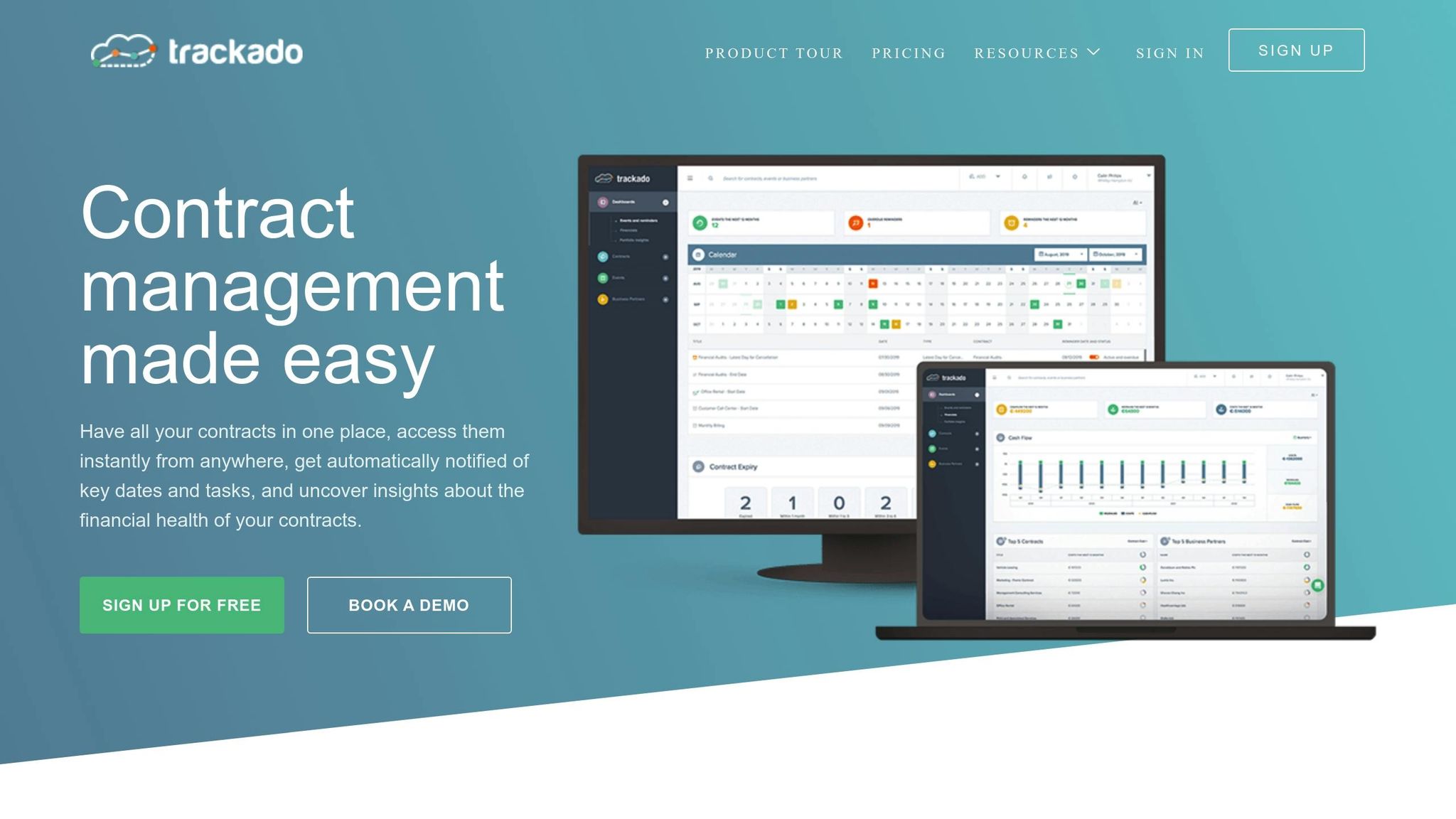
Trackado is a cloud-based contract management solution designed for small and medium-sized businesses (SMBs). It centralizes contract storage in secure European data centers and prioritizes enterprise-level security without overcomplicating the user experience. This emphasis on security directly addresses the risks associated with contract management.
Encryption
Trackado ensures data security by using TLS/SSL encryption for data in transit and file encryption for data at rest. This dual-layer approach safeguards sensitive information across its European data centers.
"Trackado keeps your data private and safe with TLS/SSL and file encryption, ensuring what is yours stays yours." – Trackado
Hosting data in European facilities also helps organizations comply with cloud contract privacy regulations, offering peace of mind for businesses operating under strict privacy laws.
Authentication and Access Controls
Trackado incorporates secure session management, anti-forgery protections, and advanced access controls to limit unauthorized access. These measures streamline accountability while keeping sensitive information secure.
The platform also features AI-powered data extraction, which automatically identifies and pulls key details from contracts. This reduces the need for manual intervention, lowering the chances of errors or data exposure.
To further enhance security, Trackado provides comprehensive audit trails, tracking every action within the system and ensuring transparency.
Audit Trails
Audit trails in Trackado record all contract and user activities, making it easy to monitor and export data for compliance or internal reviews. For example, Kieran Lynch, Head of Legal and Compliance at Rakuten Europe, highlighted how Trackado simplified their audit process:
"And Trackado also improves our audit processes! We are a subsidiary of a listed company, so our audit requirements are high and at a recent audit, when I was able to access Trackado and simply export a list of new contract partners for the year I knew we have made the right choice." – Kieran Lynch, Head of Legal and Compliance, Rakuten Europe
Trackado also helps organizations stay on top of important dates like contract renewals and compliance deadlines with milestone tracking and automated reminders. Additionally, the platform’s e-signing feature keeps the entire contract execution process secure by eliminating the need to use external tools. All signature-related activities are logged in the audit trail, ensuring a complete record of the process.
Pricing Plans
Trackado offers a range of pricing options to make its enterprise-level security features accessible to SMBs:
- Starter Plan: $39 per month for up to 3 users and 60 contracts.
- Business Plan: $129 per month for 8 users and 300 contracts, with enhanced workflow features.
- Enterprise Plan: $299 per month for 25 users, unlimited contracts, and SAML authentication support.
- Free Plan: Available for 1 user and up to 15 contracts, ideal for testing the platform.
2. Enterprise Contract Platform
Enterprise contract platforms are specifically designed to meet the complex security needs of large organizations managing extensive contract portfolios. These systems incorporate multiple layers of protection, from encryption to advanced access controls, creating a secure framework tailored for enterprise-scale operations. Let’s take a closer look at these key security features.
Encryption
Enterprise platforms rely on advanced encryption techniques to protect data both at rest and in transit. This dual-layer approach ensures that contract data remains secure throughout its lifecycle. Many platforms adopt end-to-end encryption, which ensures that even if unauthorized users gain access, the information remains indecipherable.
By shifting data from local devices to secure cloud environments, these platforms eliminate risks like data loss from stolen or damaged devices. This approach also ensures consistent security protocols across the entire contract repository.
When evaluating a platform, it’s essential to confirm it employs modern encryption protocols capable of resisting current threats. Look for documented standards that outline the specific protocols used and how they safeguard sensitive contract information.
Authentication & Access Controls
Role-based access control (RBAC) is a cornerstone of enterprise platforms, enabling organizations to define who can view, edit, or approve contracts. By limiting access to only those who need it, RBAC minimizes internal risks and ensures accountability.
To further enhance security, enterprise platforms often integrate multi-factor authentication (MFA). While authentication verifies a user’s identity, authorization determines the level of access granted. Platforms should offer flexible RBAC configurations, allowing administrators to assign permissions based on roles, departments, or specific projects. This ensures that access aligns with organizational policies.
Audit Trails
Audit trails provide a detailed record of all activities within the system, tracking who accessed documents, when they were accessed, and what changes were made. This transparency not only holds users accountable but also helps detect suspicious activity before it escalates.
Many enterprise platforms include 24/7 monitoring and visual dashboards, giving administrators real-time insights into contract activities and security metrics. These tools make it easier to spot unusual patterns or potential threats quickly.
Detailed logging capabilities are especially valuable during regulatory audits or internal security reviews. Platforms that allow customizable reporting and easy export of audit data help organizations stay prepared for compliance checks and demonstrate proper access management.
Compliance Certifications
Top-tier enterprise platforms hold certifications that validate their security measures. SOC 2 Type 2 and ISO 27001 are key benchmarks, showing that the platform has passed independent audits and adheres to stringent security standards. These certifications reassure organizations that the platform has robust security controls in place.
Additionally, platforms should comply with industry-specific regulations like GDPR or HIPAA, depending on the organization’s needs. Certifications such as the Cloud Security Alliance (CSA) STAR further validate a platform’s ability to secure cloud-based contract management systems.
Organizations should ensure their chosen platform maintains up-to-date certifications and continuously improves its infrastructure to address vulnerabilities. These certifications signify a commitment to security and provide confidence in the platform’s ability to protect sensitive data.
Comparing Enterprise Cloud Platforms to On-Premises Solutions
Enterprise cloud platforms often deliver stronger security features compared to traditional on-premises systems. The table below highlights some key differences:
| Security Feature | Enterprise Cloud Platform | Traditional On-Premises |
|---|---|---|
| Encryption | Advanced encryption for data at rest and in transit | Varies by local IT capabilities |
| Access Controls | Role-based permissions with detailed audit trails | Often manual and prone to errors |
| Compliance | Automated checks for GDPR, HIPAA, SOC 2, ISO 27001 | Requires manual management |
| Updates | Automatic updates and patches | Relies on dedicated IT teams |
| Monitoring | Continuous 24/7 monitoring and threat detection | Limited monitoring capabilities |
| Cost | Lower overall security costs | Higher costs for in-house infrastructure |
Cloud-based platforms are typically more secure and cost-effective when configured correctly. They reduce the need for expensive in-house security infrastructure by offering features like encryption, continuous monitoring, and automated compliance checks. However, organizations must understand the shared responsibility model, where both the provider and the organization play a role in maintaining the platform’s security.
3. Cloud-Based Contract System
Cloud-based contract systems offer a smart mix of convenience and security, making them a great choice for small to medium-sized businesses (SMBs) that need strong protection without the complexity of enterprise-level systems. These platforms shift sensitive contract data from vulnerable personal devices – prone to theft, loss, or weak security – into professionally managed cloud environments equipped with high-level security features.
When set up properly, cloud-based systems can provide better security at a lower cost compared to traditional on-premises solutions. It’s important to understand the shared responsibility model: cloud providers handle infrastructure security, data center protection, and encryption, while organizations are responsible for access controls, user credentials, and monitoring system activity. Let’s dive into how encryption, authentication, audit trails, and compliance certifications work together to secure these systems.
Encryption
Encryption is a key feature of cloud-based contract systems, protecting data both when it’s stored and when it’s being transmitted. Encryption at rest keeps contracts secure within the cloud, while encryption in transit ensures data remains protected as it moves between devices or systems. Platforms that use industry-standard protocols like TLS/SSL for data in transit and robust file encryption for data at rest are essential for safeguarding sensitive information.
By centralizing contracts in secure cloud data centers rather than leaving them on individual devices, businesses reduce the risks tied to lost or stolen devices, all while benefiting from enterprise-grade security measures.
Authentication & Access Controls
Multi-factor authentication (MFA) adds a critical layer of protection by requiring users to verify their identity through multiple methods – such as SMS codes, app notifications, or biometric scans – in addition to passwords. This ensures only authorized personnel can access sensitive contracts.
Role-based access control (RBAC) enhances security by assigning specific permissions based on an individual’s role within the organization. For example, some users may only view contracts, while others can edit or approve them. When choosing a cloud-based system, look for platforms that allow administrators to align these permissions with existing security policies, reducing internal risks and boosting accountability.
Audit Trails
Audit trails are another important security feature, tracking who accessed contracts, when they were accessed, and what changes were made. These logs help identify unauthorized activity and support compliance by providing clear evidence of proper data handling.
Cloud-based systems often go a step further by offering real-time updates and dashboards that show contract statuses and activity. This added visibility is something traditional on-premises solutions often lack, making it easier to monitor and manage contracts effectively.
Compliance Certifications
When selecting a cloud-based contract system, it’s crucial to look for platforms with recognized certifications like SOC 2 Type 2, ISO 27001, and Cloud Security Alliance (CSA) STAR. These certifications demonstrate that the provider meets high security standards. Additionally, compliance with major regulations like GDPR and HIPAA is vital, as many platforms include automated compliance checks and integrated audit trails to simplify the process.
Always verify that a provider maintains up-to-date certifications and offers continuous monitoring. This not only helps with compliance management but also reflects a commitment to strong security practices.
sbb-itb-49df6ae
Strengths and Weaknesses
When evaluating cloud contract management systems, it’s crucial to weigh their security advantages against the potential trade-offs. Each option comes with its own set of strengths and challenges. For instance, cloud-based tools often include robust built-in protections, but they require organizations to fully understand the shared responsibility model. This model means cloud providers handle infrastructure security, while organizations are responsible for managing access controls and user credentials. On the other hand, traditional systems and enterprise platforms may offer security features that align better with specific organizational needs. The key is finding the right tool to match your security requirements.
Here’s a closer look at the main strengths and weaknesses of different cloud contract management security approaches:
| Solution Type | Key Strengths | Key Weaknesses |
|---|---|---|
| Trackado | • TLS/SSL encryption for data in transit and file encryption for data at rest. • Hosted in secure European data centers with enterprise-level protections. • Affordable for SMBs without requiring in-house infrastructure. • Automatic security updates and professional management. • Simplifies audit processes with easy data export options. • Responsive customer support. |
• No explicit weaknesses reported. |
| Enterprise Contract Platform | • Compliance with certifications like SOC 2 Type 2, ISO 27001, and CSA STAR. • Advanced features, including AI-driven threat detection and anomaly monitoring. • Detailed role-based access controls with granular permissions. • Strong integration capabilities through secure APIs. • 24/7 monitoring and real-time visibility dashboards. |
• High costs may deter smaller organizations. • Complex implementation requiring dedicated security resources. • Risk of misconfiguration due to feature complexity. • May include unnecessary features for organizations with simpler needs. |
| Cloud-Based Contract System | • Enhanced security at a lower cost compared to on-premises systems. • Professionally managed security without requiring in-house expertise. • Automatic updates and patches, reducing manual effort. • More robust built-in protections than most organizations can achieve independently. • Centralized storage eliminates risks from lost or stolen devices. |
• Requires thorough vendor evaluation and understanding of shared responsibilities. • Misconfigurations are a common risk. • Organizations lose direct physical control over infrastructure. • Risks like "shadow IT" and insufficient security controls are significant. • Continuous monitoring is necessary to prevent configuration drift. |
As the table highlights, one of the biggest advantages of cloud solutions is cost efficiency. Properly secured cloud systems often provide better protections at a lower cost than on-premises alternatives. This is especially advantageous for SMBs, as they gain access to enterprise-grade security features without the expense of building them internally.
However, the effectiveness of cloud solutions hinges on proper configuration. Tools like Cloud Security Posture Management (CSPM), regular configuration audits, and ongoing monitoring are essential to prevent unauthorized access and maintain security.
Another major benefit of cloud-based systems is their high visibility. These platforms offer real-time access to contract statuses and updates through intuitive dashboards and reporting tools. Additionally, they integrate seamlessly with ERP and CRM systems via secure APIs, unlike traditional solutions that often create data silos.
When selecting a vendor, organizations should prioritize those with certifications like SOC 2 Type 2 and ISO 27001. These certifications demonstrate strong security practices and regular third-party audits. For businesses in regulated industries, compliance with frameworks such as GDPR and HIPAA is also crucial.
Emerging technologies are further enhancing cloud security. Features like AI-powered anomaly detection, intelligent data classification, and predictive analytics are helping organizations proactively address threats to their contract repositories. These advancements allow for automated monitoring and quicker identification of potential risks.
Ultimately, the goal is to align security features with organizational needs. For many SMBs, solutions like Trackado strike the right balance between security, usability, and affordability, delivering enterprise-grade protections without unnecessary complexity.
Conclusion
Choosing the right cloud contract management platform means finding a balance between security, functionality, and cost. Key features like encryption, multi-factor authentication, role-based access controls, audit trails, and compliance certifications form the backbone of a secure system.
Start by evaluating vendor certifications. Certifications such as SOC 2 Type 2 and ISO 27001 indicate that a platform has been assessed for robust security controls and undergoes regular third-party audits. For industries with strict regulations, compliance with standards like GDPR and HIPAA ensures vendors follow established security protocols and remain accountable.
Ensure the platform uses end-to-end encryption to protect both contract data and metadata. This dual-layer security keeps your information safe whether it’s being stored, transmitted, or accessed.
Layered security measures like multi-factor authentication and role-based access controls are essential, particularly for users with elevated privileges. Even if passwords are compromised, these measures reduce the risk of unauthorized access. A solution that balances these security essentials with cost considerations can meet both operational and budgetary needs.
For small and medium-sized businesses, affordability is as important as security. Cloud solutions often provide stronger protection at a lower cost compared to on-premises systems. Platforms like Trackado offer enterprise-level security features – such as TLS/SSL encryption, secure European data center hosting, and automatic updates – without the need for costly infrastructure or specialized security teams. This makes advanced security attainable for organizations with limited resources.
Continuous monitoring is another critical component of a secure system. Regular configuration audits help prevent vulnerabilities caused by misconfigurations, a common issue in cloud environments. Secure API connections to your existing business tools and implement comprehensive logging to maintain clear audit trails. It’s also important to understand the shared responsibility model: cloud providers handle infrastructure security, but your organization is responsible for managing access controls, user credentials, and proper configurations. This collaboration works best when vendors are carefully vetted and security practices are consistently monitored.
Look for platforms that incorporate AI-driven anomaly detection and predictive analytics. These tools can identify unusual patterns or potential threats early, adding another layer of protection to your contract data.
Ultimately, the right platform will align with your organization’s risk tolerance, compliance needs, and operational requirements. A phased approach that prioritizes essential security features without unnecessary costs ensures your sensitive contract data stays protected while maintaining efficiency and audit readiness.
FAQs
What essential security features should you look for in a cloud contract management platform?
When choosing a cloud-based contract management platform, it’s essential to focus on strong security measures to protect your sensitive data. Start by ensuring the platform offers data encryption – this secures your contracts both during transfer and while stored, blocking unauthorized access.
Another key feature to look for is multi-factor authentication (MFA). By requiring multiple verification steps, MFA significantly enhances system security.
Lastly, don’t overlook the importance of audit trails. These allow you to monitor all activity within the platform, offering transparency and accountability. Together, these security features help safeguard your contracts and maintain compliance, giving you confidence in your data’s protection.
What is the shared responsibility model, and how does it affect the security of cloud-based contract systems?
The shared responsibility model defines how security duties are split between the cloud service provider and the customer. When it comes to cloud-based contract systems, the provider takes care of securing the infrastructure – things like physical servers, networks, and storage. Meanwhile, the customer is in charge of safeguarding their data, managing user access, and configuring settings properly.
To keep your system secure, it’s essential to adopt practices like encryption, multi-factor authentication (MFA), and maintaining audit trails to track activity. Platforms such as Trackado can make this easier by providing enterprise-level security features, including SSL encryption and secure hosting. These tools not only protect your contracts but also streamline compliance and management processes.
What are the benefits of using a cloud-based contract management system instead of a traditional on-premises solution?
Cloud-based contract management systems, like Trackado, make it easy to manage contracts from virtually anywhere. With just an internet connection, you can access your contracts on any device – no need for complicated local installations. This convenience keeps your team connected and working efficiently, no matter where they are.
These systems also take the stress out of tracking deadlines. Features like automated reminders ensure you’re always aware of critical dates, whether it’s a renewal or a key milestone. Plus, they bring all your financial data into focus, offering a centralized view of costs, revenues, and essential contract metrics.
Security is another major advantage. With tools like encryption and secure hosting, cloud-based platforms safeguard your sensitive information while streamlining contract management for businesses, big or small.