
Most businesses lose money due to poor contract management. Missed deadlines, unclear responsibilities, and scattered contract storage cost companies up to 9% of annual revenue. Here’s the solution: a simple system to track obligations, assign accountability, and centralize contracts.
Key Steps:
- Identify obligations: Track payments, deadlines, SLAs, and compliance requirements.
- Assign ownership: Make individuals – not departments – responsible for tasks.
- Centralize storage: Use one searchable repository for all contracts.
- Automate reminders: Set alerts for deadlines and approvals.
- Monitor compliance: Use KPIs like obligation completion rates and missed renewals.
A structured workflow ensures nothing slips through the cracks, saving time, money, and legal headaches. Keep reading for a step-by-step guide to contract management.
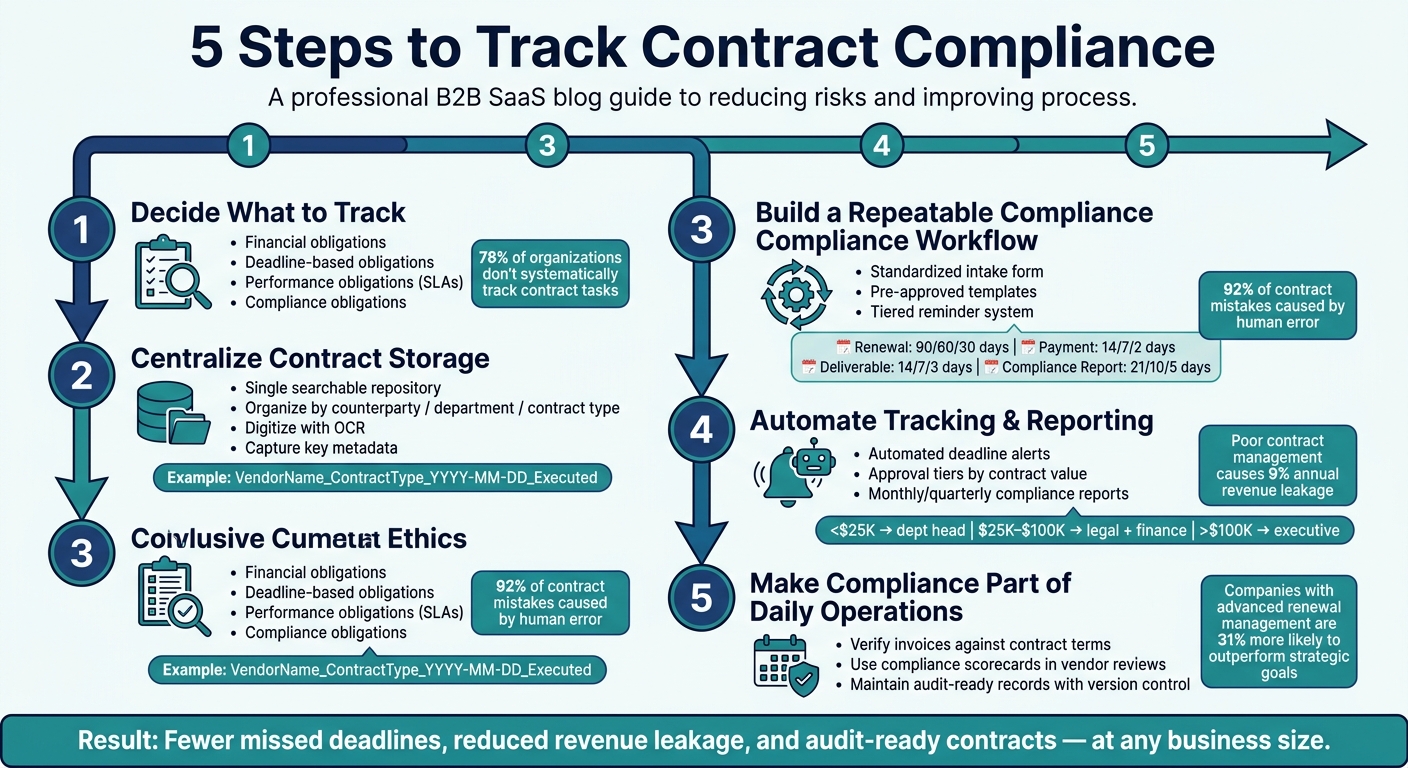
5-Step Contract Compliance System for SMBs
Step 1: Decide What to Track
To effectively manage contract risks, start by determining which obligations need active monitoring. This step is crucial for building a system that focuses on the most important aspects without becoming overwhelming.
Identify Core Contract Obligations
Contract obligations typically fall into a few main categories:
- Financial obligations: These include payment terms (e.g., Net-30), invoicing schedules, late fee triggers, and minimum spend requirements.
- Deadline-based obligations: Examples include cancellation notice periods (like a 60-day written notice), auto-renewal windows, and contract expiration dates.
- Performance obligations: These cover service-level agreements (SLAs), such as uptime guarantees or response time commitments.
- Compliance obligations: These relate to data handling guidelines, insurance requirements, and certifications specific to your industry.
“A renewal date tells you when a contract ends. An obligation tells you what you have to do before then.” – PactAlert
Start by reviewing five to ten active contracts and listing all actionable obligations. This will help you spot any gaps in your current tracking efforts.
Set Compliance KPIs
Once you’ve identified what to track, establish key performance metrics to gauge how well you’re managing these obligations. Here are a few examples:
| KPI | What It Measures | Warning Sign |
|---|---|---|
| Obligation Completion Rate | Percentage of obligations met on time | Below 90% |
| Missed Renewal Rate | Percentage of contracts expiring without a decision | Anything above 0% |
| Contract Compliance Rate | Percentage of active contracts meeting all tracked terms | A downward trend over time |
| Cost of Non-Compliance | Financial losses from penalties or revenue leakage | Any upward trend |
Focus on two or three KPIs that address your biggest risks – such as missed renewals or late payments – to start building a solid foundation.
Assign Owners for Each Obligation
A major reason obligations are missed is the lack of clear accountability. In fact, 78% of organizations don’t systematically track their contract-related tasks. The solution? Assign a specific individual – not just a department – to each obligation.
For example:
- Finance can handle payment terms.
- Operations can oversee SLA monitoring.
- Legal can manage regulatory compliance clauses.
“Unowned obligations are the ones that get missed. It’s that simple.” – Ironclad
To make this process actionable, convert each obligation into a task with an assigned owner and a deadline. For instance, a clause requiring “60-day written notice for cancellation” should become a task assigned to a specific person, with a due date set 90 days before the contract ends. This creates a 30-day buffer to ensure the task is completed on time.
sbb-itb-49df6ae
Step 2: Centralize Contract Storage
Once you’ve identified what to track, the next step is figuring out where your contracts are stored. For many SMBs, contracts are scattered across emails, shared drives, and even physical files. This disorganized setup makes it nearly impossible to maintain proper compliance. Centralizing all contracts in one place is essential for simplifying compliance efforts.
Organize Contracts in One Repository
The goal here is simple: create a single, easily accessible location where authorized team members can find any contract within seconds. Before moving your contracts, establish a clear and consistent structure. A good starting point is to organize them by counterparty (vendor, client, or partner), department (Sales, HR, Procurement, Finance), and contract type (e.g., MSA, NDA, SOW, Lease, SLA). To make identification even easier, adopt a naming convention like VendorName_ContractType_YYYY-MM-DD_Executed.
Designate a contract owner for each department to oversee uploading and tagging contracts. Start with high-value or high-risk agreements, as these are often the most critical to your operations. Once those are in place, you can gradually add older, lower-priority contracts. This phased approach keeps the process manageable and ensures you see benefits quickly.
Digitize Contracts and Capture Key Data
After centralizing your contracts, make sure they’re both searchable and standardized. For paper contracts, scan them at 300 dpi to PDF format with OCR (optical character recognition) to enable full-text search. Save each contract as a single PDF file, not as separate pages, and apply your naming convention during the scanning process. Once uploaded, capture essential metadata for each contract, such as:
- Parties involved
- Effective and end dates
- Renewal type (e.g., auto or manual)
- Notice period
- Contract value
- Payment terms
- Internal owner
Wherever possible, standardize these fields using dropdown menus or predefined options. For example, use fixed lists for contract types and statuses like Draft, Active, Expired, and Terminated. This consistency ensures that filtering and reporting are accurate and reliable. Without standardized metadata, even the most organized repository is just a tidier collection of files.
Use a Contract Management Tool
Once your contracts are organized and digitized, technology can help you get more out of them. A contract management tool doesn’t just store files – it makes the data within those contracts useful. Tools like Trackado are designed for SMBs and allow you to organize contracts by partner, department, or category using customizable fields. Assistive AI features can even pre-fill key metadata, cutting down on manual data entry.
From there, you can set up automated reminders for deadlines, track milestones, and manage access based on roles. These features help your team stay on top of contract obligations without needing to juggle multiple systems. With the right tool, you can quickly filter contracts by criteria like counterparty or end date, saving time and reducing the risk of missed deadlines.
Step 3: Build a Repeatable Compliance Workflow
Now that your contracts are centralized and your data is structured, the next step is ensuring you can maintain compliance over time. A one-time cleanup won’t cut it – you need a reliable system that keeps your team on track whenever a new contract comes in, an obligation is due, or an issue arises. By building a repeatable workflow, you can stay proactive and accountable in managing your contracts.
“The biggest pitfall, especially for SMBs, is not having a structured process.” – Mark Zeise, CEO and founder, Trackado
Standardize How New Contracts Are Added
With your contracts organized, it’s time to follow a contract automation checklist to standardize how new ones are added. Start by designing an intake system – a simple, consistent form that captures essential details like parties involved, contract type, value, owner, and critical dates before the contract is stored. This step ensures no key information is missed.
Whenever possible, rely on pre-approved templates for common agreements such as NDAs, vendor contracts, and service agreements. Using templates reduces errors, ensures consistency in legal language, and saves time. For high-value contracts, make sure you have an approval workflow in place so the right people review the document before it’s signed. Considering that human errors cause 92% of contract management mistakes, a structured intake process is your best defense against costly slip-ups.
Track Obligations and Due Dates
Once a contract is in your system, the focus shifts to meeting its obligations. Break down the contract’s language into clear tasks – identify deliverables, payment deadlines, compliance reports, and renewal dates – and assign each task to a specific individual rather than just a department. This approach ensures accountability.
To stay ahead of deadlines, set up a tiered reminder system like the one below:
| Event Type | First Alert | Second Alert | Final Alert |
|---|---|---|---|
| Renewal | 90 days prior | 60 days prior | 30 days prior |
| Payment | 14 days prior | 7 days prior | 2 days prior |
| Deliverable | 14 days prior | 7 days prior | 3 days prior |
| Compliance Report | 21 days prior | 10 days prior | 5 days prior |
Tools like Trackado allow you to automate these reminders, ensuring that the right person gets notified without the need for manual tracking. By linking your contract data to daily compliance activities, you can keep everything running smoothly.
Handle and Escalate Non-Compliance Issues
Assigning clear responsibilities is only part of the solution – having an escalation process in place ensures that missed deadlines don’t snowball into bigger problems. Set a rule that any missed obligation exceeding 48 hours triggers an alert to the department head, along with a remediation task and a specific due date. This keeps everyone accountable and prevents small oversights from turning into larger risks.
If a compliance gap does occur, document it immediately. Record what went wrong, who was responsible, and the potential impact. Not only does this help resolve the immediate issue, but it also creates a record for identifying patterns and improving processes during audits.
Step 4: Automate Tracking and Reporting
Once your workflow is in place, automation can take over the repetitive tasks of tracking and reporting. This frees up your team to focus on making informed decisions rather than getting bogged down in manual processes.
Set Up Deadline Reminders and Alerts
Deadlines are critical, and automated alerts ensure nothing slips through the cracks. Use your centralized system to prioritize reminders based on the importance of contract dates. For example:
- Set renewal and notice period alerts at 90, 60, and 30 days before the deadline.
- Use tighter windows, like 14 and 7 days, for payment milestones and deliverables.
- For high-stakes obligations – such as penalties, data protection, or contracts exceeding $100,000 – enable same-day alerts that stay active until resolved.
To avoid notification overload, group lower-priority reminders into a weekly digest and reserve real-time alerts for critical deadlines. Tools like Trackado allow you to attach automated reminders directly to key contract dates. These can be routed to the contract owner, with escalation to their manager if no action is taken within a specific timeframe.
Automate Approval Workflows
Manual approvals can slow down contract processing. Automated workflows eliminate delays by routing contracts according to predefined rules. No more chasing signatures or approvals.
Set up approval tiers based on contract value or complexity. For instance:
- Contracts under $25,000 go to the department head.
- Contracts between $25,000 and $100,000 require sign-off from legal and finance.
- Contracts above $100,000 or involving sensitive data need an executive sponsor.
You can apply the same logic to amendments or renewals with significant changes, not just new agreements. The system will also maintain a detailed audit trail for every step of the approval process. If no action is taken within three business days, automated nudges and escalations ensure the process keeps moving.
Once approvals are automated, use regular contract compliance reports to maintain oversight.
Generate Compliance Reports
Automation doesn’t stop at tracking – it extends to reporting. A well-designed compliance dashboard highlights areas of concern before they escalate into major issues. Instead of just showing overdue tasks, it should pinpoint where risks are developing.
Key metrics to track include:
- Obligation completion rates
- Renewals due in 30/60/90 days
- Unassigned contracts
- Open non-compliance issues sorted by severity
Schedule monthly reports for teams like finance and procurement, and provide quarterly summaries for leadership. Keep reports concise: start with a “top issues” overview, followed by detailed breakdowns by department, vendor, or contract value.
According to research from World Commerce & Contracting, poor contract management leads to value leakage averaging 9% of annual revenue. Much of this stems from missed obligations and unmanaged risks – issues that consistent reporting can catch early. Over time, these reports can also uncover patterns, such as a vendor that frequently misses deadlines or a department that regularly overlooks notice periods. This turns compliance tracking into a proactive management tool rather than just a reactive chore.
Step 5: Make Compliance Part of Daily Operations
Automated alerts and structured workflows are great tools, but true compliance happens when it’s woven into the fabric of daily operations. Automation can manage alerts and reports, but the real key is seamlessly incorporating contract obligations into routine tasks. The idea isn’t to pile on extra processes – it’s to make compliance a natural part of how things get done every day.
Connect Compliance with Finance and Procurement
One common issue is that finance teams process invoices without always checking if the amounts, terms, or timing align with the contract. This oversight can lead to revenue leakage. To avoid this, invoices need to be verified against contract terms – things like payment schedules, net terms, discounts, and penalties for late payments. Also, don’t overlook pricing adjustments hidden in contract amendments.
The contract should be treated as the ultimate reference for all payment decisions. If an invoice doesn’t match the agreed-upon terms, flag it before it gets approved. This approach strengthens the link between financial processes and contract compliance.
Use Compliance Data in Vendor Reviews
Vendor reviews often rely on memory or anecdotal feedback, which can result in subjective evaluations. Instead, use compliance data to provide an objective view of whether a vendor has delivered on their promises.
A simple scorecard can track key metrics like on-time delivery rates, SLA performance, and unresolved compliance issues for each vendor. Incorporate this data into quarterly reviews. Over time, patterns will emerge – whether it’s a vendor consistently missing deadlines or one that exceeds expectations – helping you make informed decisions about renewals or renegotiations.
“Organizations with advanced renewal management are 31% more likely to outperform their strategic goals.” – Deloitte
That kind of advantage comes from making decisions based on solid data, not guesswork.
Keep Records Updated and Audit-Ready
Accurate record-keeping is the final piece of the compliance puzzle, especially when paired with data-driven vendor reviews. Contracts are living documents – they change as amendments are signed, scopes shift, and terms evolve. Every change should be logged immediately. Treat each amendment as a signal to update your records. You can also use a contract renewal planner to stay ahead of upcoming deadlines. Use tools like Trackado that offer version control and automatically log timestamps, approvals, and document activity. This ensures the latest agreement is always your go-to reference, while older versions remain securely archived.
Set up an audit schedule to stay ahead. Perform monthly spot-checks on high-value contracts, quarterly reviews of all active agreements, and ad-hoc reviews whenever a contract is modified. This routine keeps your records accurate and ensures you’re prepared for an audit without scrambling to piece together a paper trail.
Conclusion: Begin Simple – Then Scale
Starting with a straightforward contract compliance system can set the stage for growth as your business evolves. By centralizing contracts, streamlining workflows, and automating repetitive tasks, you not only meet your obligations but also improve how your operations run. Even if you’re managing just a handful of agreements, having a single source of truth early on helps reduce risks and enhances efficiency. This initial structure serves as a stepping stone for smoother processes as your contract portfolio expands.
Once you’ve simplified your process, comparing top contract management software features and using a reliable tool can further solidify your compliance efforts.
“By having a centralized contract management tool, you have not only facilitated the way you work, but you have also automatically taken steps toward compliance.” – Mark Zeise, CEO and founder of Trackado
Trackado makes it easy for small and mid-sized teams to get started without the need for a complicated IT setup. Their free plan supports up to 15 contracts, allowing you to begin with minimal commitments and scale to Business or Enterprise plans as your needs grow. As Mark Zeise highlights, “A lot of our clients tell us they really appreciate the simplicity of the system, it requires very little effort but has a huge impact on their efficiency.”
As your business grows, Trackado evolves with you, offering customizable fields, adaptable workflows, and well-organized categorizations – ensuring you won’t need to switch platforms down the line.
FAQs
Which contract obligations should I track first?
When managing obligations, prioritize those that could lead to the greatest financial, legal, or operational risks if overlooked. Pay close attention to critical milestones like renewal dates, termination notice periods, and payment schedules to prevent unexpected auto-renewals or cash flow disruptions. After that, keep an eye on performance-related commitments, such as SLAs (Service Level Agreements) or delivery timelines. Tools like Trackado make this process easier by consolidating all these details in one place and offering automated reminders to help you stay on top of your obligations without unnecessary hassle.
What’s the simplest way to centralize contracts fast?
To centralize contracts quickly, consider using a cloud-based contract management platform like Trackado. This tool allows you to store all agreements in a secure digital repository, avoiding the chaos of scattered documents. With features such as email-in functionality, manual uploads, and AI-powered metadata extraction (for details like renewal dates and payment terms), organizing contracts becomes straightforward and hassle-free – no complex setups required.
How do I set reminders without spamming my team?
To avoid bombarding your team with unnecessary alerts while staying compliant, focus on targeted, role-based notifications. Assign reminders to specific roles, such as Procurement Manager or Legal Counsel, ensuring only the relevant team members receive updates.
You can also set up reminders at multiple intervals – like 90, 30, and 7 days in advance – giving stakeholders enough lead time without overwhelming them. For added assurance, establish escalation paths so senior management is notified only if initial alerts go unacknowledged. This approach keeps communication effective and minimizes noise.