
Robotic Process Automation (RPA) is reshaping contract management by automating repetitive tasks like data entry, document routing, and deadline tracking. This reduces errors, speeds up processes, and allows teams to focus on complex, high-value work. Companies using RPA have reported up to 30% cost savings and 40% faster contract processing times.
Key Takeaways:
- Efficiency Boost: RPA bots handle tasks like clause extraction and classification, renewal reminders, and approvals faster and with greater accuracy than humans.
- Cost Reduction: Automation can cut operational expenses significantly and save thousands of work hours annually.
- Improved Compliance: Automated alerts and standardized templates help ensure contracts meet regulatory and internal standards.
- Enhanced Security: Role-based access, encrypted storage, and detailed audit trails protect sensitive data.
By integrating RPA with tools like CRM, ERP, and e-signature platforms, businesses can streamline every stage of the contract lifecycle. Start small with high-volume, repetitive tasks, and scale gradually for maximum impact. The future of contract management lies in combining RPA with AI-driven tools for smarter, faster, and more secure processes. This includes leveraging AI tools for contract risk prediction to identify potential liabilities before they become issues.
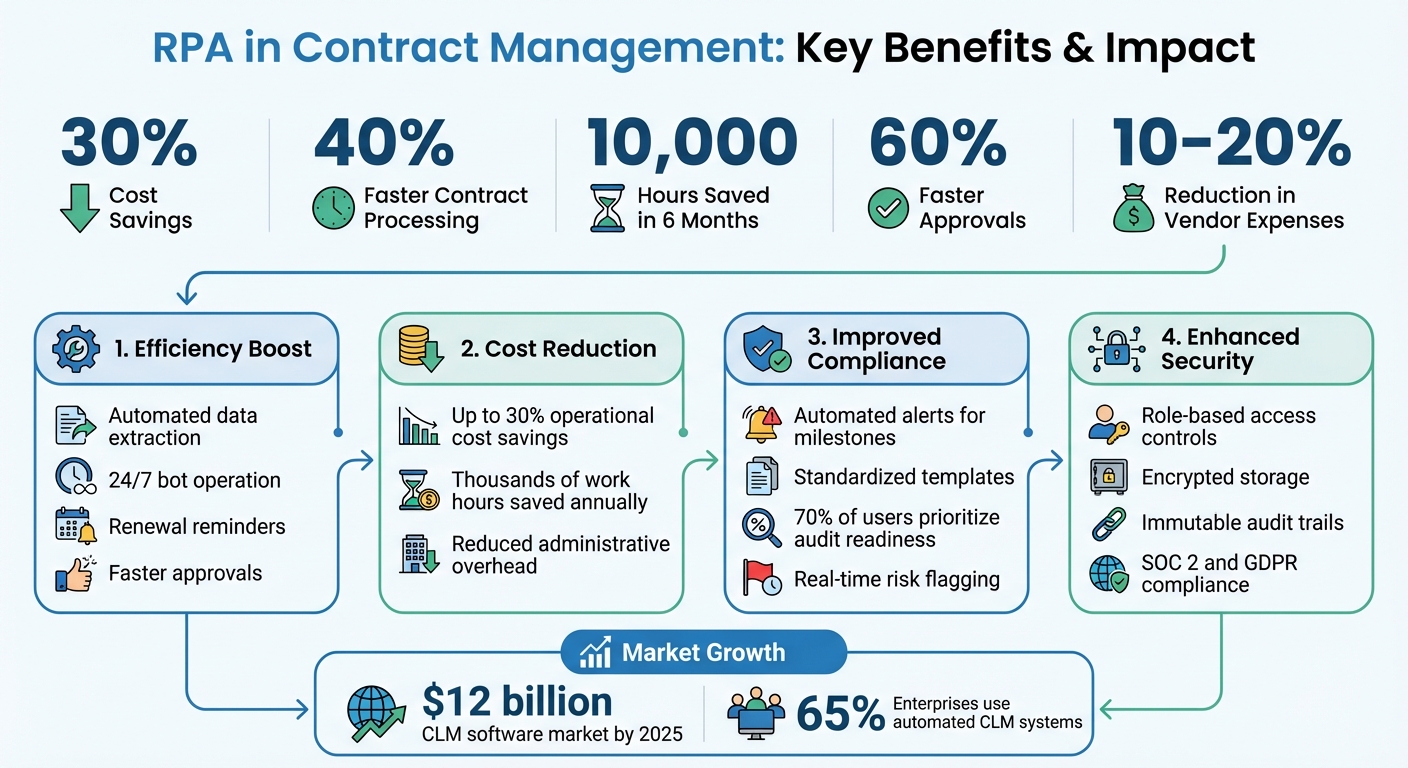
RPA Benefits in Contract Management: Key Statistics and Cost Savings
Main Benefits of Using RPA in Contract Management
Reducing Costs and Administrative Work
RPA takes over repetitive tasks like data entry, document organization, and routing approvals. These bots work significantly faster than humans – operating around the clock without breaks – and can cut operating costs by up to 30% for businesses that implement them.
For example, a PwC case study highlighted how a global tech company reduced contract processing time by 40% using RPA while nearly eliminating data entry errors. In some cases, organizations have saved up to 10,000 hours in just six months by automating legal and compliance workflows. Tasks like contract drafting, which once took days, are now completed in minutes as bots retrieve templates and pre-approved clauses automatically.
This streamlined approach allows contract managers to focus on higher-level priorities, such as negotiating better terms or analyzing vendor performance. Beyond saving time and money, this shift also improves data accuracy and strengthens security.
Improving Data Accuracy and Security
In addition to reducing costs, RPA ensures better data quality by removing human error. Manual processes often lead to typos, misplaced files, or inconsistent data entry, but RPA bots follow predefined rules with perfect accuracy. AI-powered tools extract essential metadata – like party names, dates, and monetary values – directly from contracts, ensuring reliable information for decision-making.
"RPA bots are designed to execute tasks with 100% accuracy, eliminating human mistakes." – Mustafa Kürşat Yalçın, Vizio.ai
Security also gets a boost. Role-based access controls restrict document visibility to authorized users, reducing the risk of data breaches. Every action taken – whether it’s an approval, modification, or access – is logged in an unalterable digital audit trail, promoting transparency and accountability. Features like version control ensure that teams are always working with the most up-to-date contract terms, avoiding confusion or errors.
Better Compliance and Risk Management
RPA doesn’t just make processes faster – it also helps organizations stay compliant and manage risks effectively. Bots can monitor key contract milestones, like renewal dates or payment deadlines, and send automated reminders to stakeholders, preventing costly oversights. By using standardized clause libraries, RPA ensures contracts are drafted with pre-approved language, reducing the chance of including risky or non-compliant terms.
Advanced tools even analyze contract language in real time, flagging unusual provisions or possible regulatory violations on risk dashboards. Immutable audit trails, with timestamped records of every action, make businesses audit-ready – a critical need for 70% of contract management software users. RPA can also analyze past performance data to predict potential issues, like missed delivery deadlines or breaches, allowing teams to address risks proactively.
| Risk Category | RPA Mitigation Capability | Compliance Benefit |
|---|---|---|
| Operational Risk | Automated alerts for milestones | Prevents missed deadlines and service lapses |
| Legal Risk | Standardized clause libraries, risk scoring | Ensures adherence to internal and external standards |
| Financial Risk | Automated invoice validation, spend analytics | Reduces overpayments and "value leakage" |
| Security Risk | Role-based access, encrypted storage | Protects sensitive data and ensures privacy |
| Audit Risk | Timestamped audit trails | Provides clear records for regulatory review |
sbb-itb-49df6ae
How RPA Changes the Contract Lifecycle
RPA transforms contract management by automating repetitive tasks across every stage – from creation to renewal or termination. With bots handling the heavy lifting, teams can shift their focus to more strategic work. The result? Faster processing, fewer errors, and better visibility throughout the entire lifecycle. Let’s dive into how RPA improves data handling, deadline tracking, and contract reviews, significantly reducing manual effort.
Automating Data Extraction and Entry
RPA bots equipped with OCR (Optical Character Recognition) technology can scan unstructured documents and quickly extract important details. Whether it’s client names, contractor identities, fee amounts, or expiration dates, these bots capture and input the data directly into systems without human intervention.
During contract creation, RPA simplifies the drafting process by pulling standardized templates and auto-filling them with pre-approved terms and data collected from digital forms. This eliminates the need for manual data entry. Regular audits of extraction rules can further refine the accuracy of these processes.
| Extraction/Entry Task | How RPA Streamlines It |
|---|---|
| Contract Drafting | Retrieves templates and inserts pre-approved clauses and terms automatically. |
| Data Capture | Extracts key details (e.g., dates, parties, fees) using OCR from scanned documents. |
| System Integration | Syncs extracted data with CRM, ERP, and CLM tools via APIs. |
| Document Filing | Organizes files in cloud storage with consistent naming and classification. |
For example, Trackado uses AI-powered extraction to automate contract data capture, showcasing how RPA supports a seamless workflow from start to finish.
Tracking Deadlines and Milestones
Missing a contract renewal deadline or payment milestone can lead to costly mistakes. RPA bots keep a constant watch on critical dates – like renewals, payments, and expirations – and send automated reminders to stakeholders as deadlines approach. This ensures key milestones are never overlooked.
RPA doesn’t stop at reminders. It also monitors performance against Service Level Agreements (SLAs) and other contractual commitments. If a vendor misses a delivery deadline or a payment is overdue, the bot flags the issue and escalates it to the appropriate team. This proactive system holds everyone accountable.
To enhance efficiency, configure multi-interval alerts that give teams enough time to prepare for renewals or renegotiations. For high-value contracts, establish an approval matrix that escalates decisions to senior leadership – like the CFO or CEO – only when specific financial thresholds are exceeded. This ensures critical agreements receive the right level of attention without overwhelming the entire team.
Simplifying Contract Reviews and Audits
Once data is accurately captured and deadlines are under control, RPA takes contract reviews to the next level. Bots use AI-powered clause analysis to compare contract language against pre-defined "playbooks", flagging non-standard or risky terms for legal review. Modern systems even feature risk-scoring dashboards to identify compliance issues or high-risk clauses in real time.
After a contract becomes active, RPA continuously monitors it for alignment with internal policies, industry standards, and regulatory requirements. If a clause violates a new regulation or internal policy, the bot alerts the compliance team. Every modification, approval, and signature is logged with a timestamp, creating an immutable audit trail – a key feature for the 70% of contract management software users who prioritize audit readiness.
By converting unstructured data into centralized, searchable repositories, RPA ensures quick, organized access for audits. Contracts are routed to the correct stakeholders based on predefined rules, such as contract value or department, so no steps are skipped during the review process.
"By embracing the power of AI and great contract management skillsets, organizations can unlock unprecedented value, enhance compliance, and see contract managers elevated to strategic business partners." – World Commerce & Contracting (WorldCC)
Begin by mapping out your workflows to identify the 10–15% of steps that add real value, then automate the rest. Create a centralized repository of pre-approved clauses to minimize the need for manual legal reviews. This approach can cut processing times by up to 40%.
Steps to Implement RPA in Contract Management
Rolling out RPA in contract management requires a thoughtful approach. From mapping workflows to piloting solutions, a structured plan helps avoid costly mistakes and ensures smooth adoption. These initial steps pave the way for selecting the right RPA tool and running a successful pilot program.
Assessing Current Processes and Workflow
To leverage RPA’s efficiency and contract compliance benefits, start by analyzing your current workflows. Look for repetitive, rules-based tasks that rely heavily on data. RPA works as an overlay on existing IT systems, handling clerical tasks like invoice validation, data entry, or filing contracts. Begin by mapping the entire contract lifecycle to pinpoint high-volume, low-value tasks ripe for automation. For example, if your team processes hundreds of NDAs each month with identical approval paths, that workflow is an ideal candidate for automation.
Engage key stakeholders early – contract management, procurement, IT, and finance teams should all weigh in to ensure the RPA solution aligns with governance standards and avoids creating new inefficiencies. Document metrics like cycle times, error rates, and delays in approvals to create benchmarks for improvement. This groundwork ensures that the automation efforts are focused where they’ll make the biggest impact.
Choosing the Right RPA Tools
The right RPA tool should integrate seamlessly with your existing ERP, CRM, and e-signature systems, requiring minimal IT changes. It should act as a non-intrusive overlay, mimicking human actions during transaction processing. Tools with AI-powered features, such as OCR and machine learning, can automatically extract key contract details like client names, fees, and expiration dates from unstructured documents. Training the AI model typically requires at least five sample files to help it recognize the unique elements of your contracts.
With 65% of enterprise companies already using automated Contract Lifecycle Management systems, it’s clear that a tool supporting both automation and human oversight is essential. Collaborate closely with IT and finance teams to ensure the tool fits technical and budgetary needs. Test it on high-volume tasks, like invoice validation, to quickly see returns on your investment.
For example, Trackado offers features such as AI-powered data extraction, customizable fields, and integrated e-signing, all of which align well with RPA workflows. Its robust API capabilities also enable smooth integration with existing systems, ensuring consistent data across platforms. Once the right tool is chosen, the next step is pilot testing to refine automation rules.
Testing and Scaling RPA Solutions
Start with a pilot program focused on a single contract type or department. This controlled approach helps identify potential issues, such as unclear rules or integration challenges, before they disrupt critical operations. When using AI-driven data extraction, test the system on "unlabeled" documents – files it hasn’t encountered during training – to confirm accuracy.
Set baseline metrics – like cycle times, approval delays, rework rates, and renewal coverage – to measure performance improvements. Properly calibrated automated workflows can speed up approvals by as much as 60%. Assign champions from legal or finance teams to guide the transition and provide ongoing feedback.
Once the pilot is successful, scale gradually. Start with high-volume contract types, such as NDAs or standard service agreements, and integrate the RPA solution with your CRM and ERP systems early. This avoids data silos and reduces manual entry. Use initial test results to refine the bot’s rules, enhance its ability to identify key clauses, and strengthen compliance monitoring.
Advanced RPA Integration Methods
After successfully running your RPA pilot, the next step is integrating automation into your existing tech stack. RPA bots work alongside current IT systems to carry out rules-based tasks. By connecting RPA with contract platforms and APIs, you can boost both efficiency and accuracy. This approach lays the groundwork for combining RPA with contract management tools, taking your operations to the next level.
Integrating RPA with Contract Management Tools
Linking RPA to your contract management system ensures a smooth flow of information across various departments. Adding e-signature tools to the mix can speed up approvals while maintaining a secure audit trail. This is particularly helpful for post-award tasks like verifying supplier invoices against contract terms, where RPA enhances both speed and precision.
Document libraries also benefit from automated data extraction capabilities. Tools like SharePoint, when paired with AI-driven document processing models, can classify files and extract essential details – like client names, fees, and start dates – without manual input. Advanced API integration further automates the process by pulling contract data directly into enterprise systems. This eliminates manual data entry and ensures that contract terms are accurately reflected across all platforms.
| Integration Type | Business Impact | Key Systems Involved |
|---|---|---|
| CRM/ERP Integration | Maintains data consistency and reduces manual work | Salesforce, Microsoft Dynamics, SAP |
| E-Signature Integration | Speeds up signing processes from days to hours | DocuSign, Adobe Sign |
| AI/OCR Integration | Automates data extraction and identifies risks | Contract Risk Checker, SharePoint, Microsoft 365 |
| ITSM/HRMS Integration | Standardizes contract processes across teams | ServiceNow, Workday |
Using APIs to Improve Automation
APIs take automation further by enabling real-time data flow between systems. Unlike RPA bots, which mimic human actions, APIs create a direct and stable connection between platforms. This makes APIs essential for syncing data between your contract repository and financial systems in real-time.
For example, APIs can link contract platforms with CRMs, CPQs, and billing software, ensuring seamless data transfer without manual effort. Event-based triggers, such as webhooks, can automatically generate invoices or send renewal reminders as soon as a contract is signed. This eliminates delays and helps your team stay on top of critical deadlines.
In 2024, Colonies implemented PandaDoc’s API to streamline lease preparation across multiple properties and countries. Under the leadership of Thomas Guillot, VP Digital, the integration customized leases to meet regional legal requirements. This reduced the time spent obtaining signatures by 25% and significantly cut down on document errors.
"PandaDoc’s API integration has been a transformative tool for Colonies as we continue to scale across new properties and countries… saving countless hours in document preparation and significantly reduced errors." – Thomas Guillot, VP Digital, Colonies
Before deploying API-driven workflows, test them in a sandbox environment to ensure they are stable and accurate. Using version control allows you to track contract changes and provides legal teams with clear document histories. By combining RPA with API integration, you create a contract management system that is efficient and flexible enough to meet your organization’s specific needs.
Conclusion: The Future of RPA in Contract Management
RPA is transforming contract management from a behind-the-scenes legal process into a key business driver that directly influences profitability and risk control. Companies that avoid automation face potential revenue losses, while those embracing RPA can cut operational costs by up to 30% and shorten contract lifecycles by as much as 40%.
This shift is paving the way for hyper-automation – a future where end-to-end workflows seamlessly connect ERP, CRM, and collaboration tools, far beyond isolated automation tasks. The rise of AI copilots is already making waves, offering features like automated redlining, predictive compliance alerts, and blockchain-backed audit trails for secure contract management. With the Contract Lifecycle Management software market expected to hit $12 billion by 2025, the momentum is undeniable.
The takeaway is clear: RPA isn’t about replacing human expertise – it’s about amplifying it. By automating repetitive tasks, professionals can redirect their energy toward strategic activities like high-stakes negotiations and long-term planning. A phased approach works best – start with high-volume, straightforward contracts like NDAs to achieve quick wins, then expand to more complex agreements. Look for tools with strong APIs for smooth integration across procurement, finance, and sales platforms.
To remain competitive, organizations must act now to prevent revenue loss from unmet obligations or missed contract renewals. Intelligent automation, including contract analytics, can uncover overpayments and reduce vendor expenses by 10% to 20%. The real question isn’t whether to adopt RPA in contract management – it’s how fast you can roll it out to outpace the competition.
FAQs
How does RPA enhance accuracy and security in contract management?
Robotic Process Automation (RPA) enhances accuracy in contract management by taking over repetitive tasks such as data extraction, validation, and approval workflows. These automated processes significantly cut down on human errors, ensuring that contract data remains precise and consistent. On top of that, AI-powered tools can automatically pinpoint and extract essential details, reducing the chances of oversight or misinterpretation.
In terms of security, RPA brings in features like encryption, access controls, and automated compliance checks to keep sensitive contract data safe. By storing documents in centralized, secure repositories and automating key reminders, RPA not only protects information from unauthorized access but also ensures that critical deadlines or obligations are met. This blend of improved accuracy and robust security makes contract management more efficient while lowering potential risks.
What are the first steps to successfully implement RPA in contract management?
To get started with Robotic Process Automation (RPA) in contract management, begin by taking a close look at your current processes. Lay out the workflows, pinpoint where inefficiencies or bottlenecks occur, and establish clear objectives. This will help you identify the areas where automation can make the most difference.
Once you’ve mapped out your goals, focus on organizing your contract documents. Use a secure, cloud-based platform to centralize everything, making it easier to access and manage. Standardizing templates and forms is another key step – this minimizes errors and makes data entry more straightforward, setting the stage for effective automation.
From there, implement automated approval workflows to keep contracts moving smoothly through each stage. Adding e-signature tools can further simplify and accelerate the signing process. Together, these strategies create a streamlined system that saves time, reduces manual effort, and improves overall contract management.
How can RPA be used to enhance contract management systems?
Robotic Process Automation (RPA) can transform contract management by taking over repetitive and time-consuming tasks. Imagine having bots handle data entry, process documents, and manage approval workflows – all while reducing the chance of human error. These bots aren’t just standalone tools; they can connect with your existing systems through APIs or built-in features, keeping data updated and interactions smooth.
On top of that, AI-powered data extraction tools can identify and pull essential details from contracts, organizing them within the system for easier analysis. RPA can even automate actions tied to contract milestones, like renewals or compliance deadlines, ensuring nothing slips through the cracks. No more manual tracking or missed deadlines.
By simplifying these tasks, RPA not only saves time but also improves accuracy and increases efficiency, making contract management far more streamlined.