
AI is transforming how businesses manage contracts. Instead of manually combing through pages of legal text, AI tools can now identify, categorize, and analyze clauses in seconds. This saves time, reduces costs, and ensures consistency in contract reviews.
Here’s what you need to know:
- Manual clause categorization is slow and expensive. Extracting clauses from a single contract can take 30 minutes, costing businesses hundreds of hours annually.
- AI-powered tools cut clause extraction time to just 12 seconds per contract. They also improve risk detection accuracy from 68% to 94%.
- Natural Language Processing (NLP) drives AI’s efficiency. It analyzes context, not just keywords, ensuring accurate categorization even for complex or varied language.
- Customization is possible. AI can be trained to recognize unique clauses with just a few examples, tailored to specific business needs.
- AI enhances compliance and risk management. It flags high-risk clauses, compares contracts against standard templates, and ensures ongoing regulatory adherence.
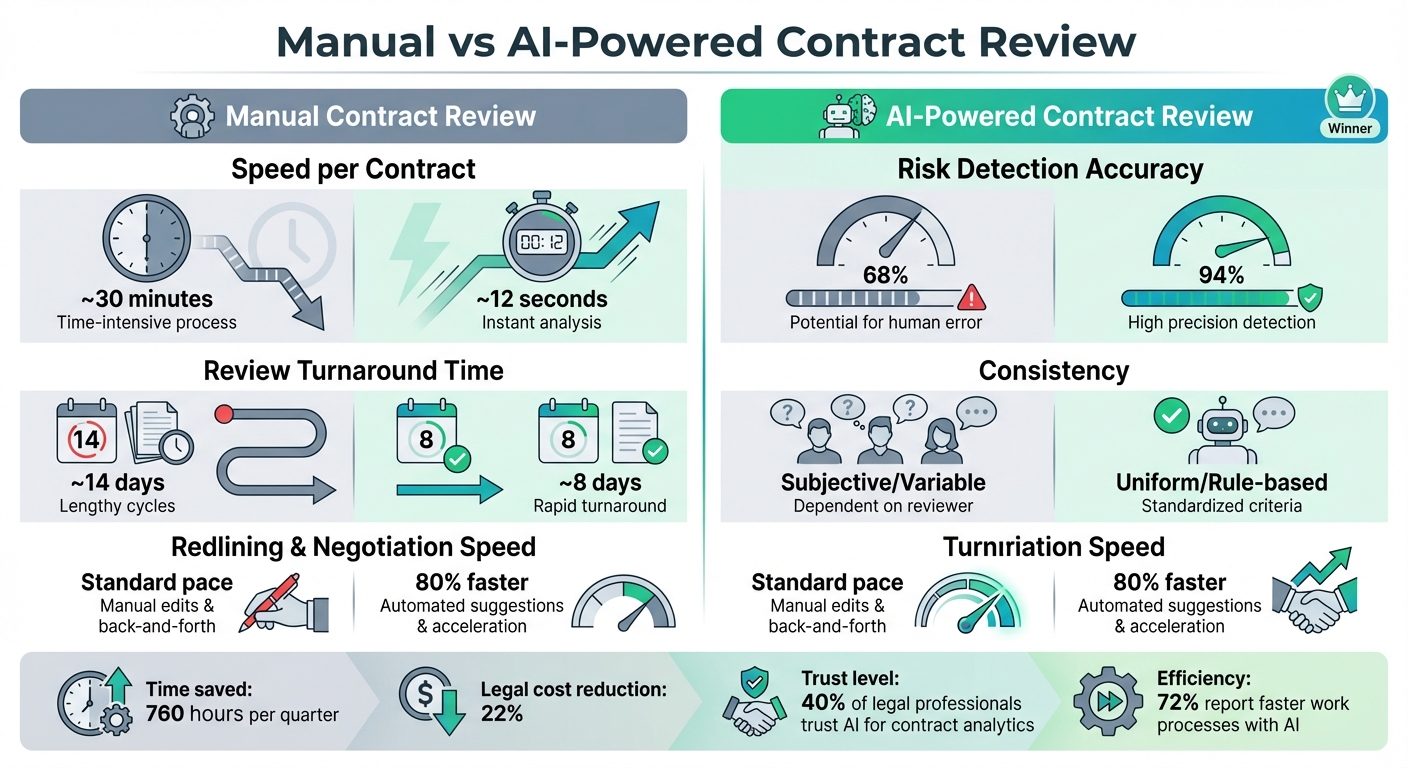
AI vs Manual Contract Review: Speed, Accuracy, and Efficiency Comparison
How AI Identifies and Categorizes Clauses
AI doesn’t just skim through keywords; it uses Natural Language Processing (NLP) to break down contract text, analyzing sentence structures and context before sorting clauses into categories. Here’s how it works:
Natural Language Processing and Machine Learning
Once the text is tokenized, machine learning models like BERT, Random Forest, or SVM step in to determine clause types – whether it’s indemnification, exclusivity, or something else. What’s impressive is that AI doesn’t rely solely on exact keywords. For instance, it can recognize an exclusivity clause even if the word "exclusive" isn’t there, identifying phrases like "purchase 100% of requirements" as conceptually the same.
"Natural Language Processing adds another set of ‘eyes’ to quickly and efficiently scan contracts for errors, omissions, and deviations."
- Gary Sangha, Founder & CEO, LexCheck
AI systems also utilize both macro and micro NLP. Macro NLP takes a high-level view of the entire document, classifying and assessing risks, while micro NLP dives into the nitty-gritty, like acronym definitions, citations, and specific terms. Whether you’re reviewing a short NDA or a detailed master service agreement, this dual approach ensures no detail slips through the cracks.
Customizing Clause Recognition
Standard contract management software features handle common clauses well, but many organizations need custom setups for their unique needs. With just 5–20 labeled examples and lists of relevant phrases, you can train the system to identify specialized terms like "Service Agreement" or "Compensation."
Detection settings can be fine-tuned to match your requirements:
- Exact Match: Finds only identical clauses.
- Highly Similar: Captures similar phrasing (ideal for most cases).
- Somewhat Similar: Detects clauses with highly variable language.
For example, in September 2025, OpenAI’s finance team deployed a custom contract data agent to process over 1,000 contracts monthly – up from just a few hundred. By using retrieval-augmented prompting and tailoring the system to their specific contract language, they halved their review turnaround time. This efficiency is a key benefit of optimizing contract workflows.
"We’re not just parsing, we’re reasoning – showing why a term is considered non-standard, citing the reference material, and letting the reviewer confirm the ASC 606 classification."
- Siddharth Jain, AI Engineer, OpenAI
This level of customization not only improves detection accuracy but also ensures consistent classification across all documents.
Maintaining Consistency Through Automation
AI categorization applies uniform logic, eliminating the subjective interpretations that often come with manual reviews. For example, it understands that "non-disclosure" and "keep confidential" mean the same thing, even if phrased differently. This goes beyond simple keyword matching.
"Machine models, once trained on a vetted dataset, apply the same logic uniformly, reducing subjective bias and missed clauses."
AI also standardizes extracted data, such as converting various date formats (like "January 21, 2026" or "01/21/26") into a single, consistent format. To keep improving, the system uses Active Learning, flagging low-confidence extractions for human review. Feedback from these reviews helps refine future performance, ensuring the process gets smarter over time.
sbb-itb-49df6ae
Faster Contract Review and Compliance
AI has revolutionized the way contracts are reviewed and checked for compliance. By categorizing clauses, it can instantly compare them to your organization’s "golden standard" templates or playbooks. Whether it’s an NDA or a vendor agreement, every contract is measured against the same benchmark. Deviations – like missing provisions, non-standard phrasing, or unauthorized clause changes – are flagged in seconds. This seamless process connects clause categorization with rapid compliance checks.
Comparing Clauses Against Standards
Using semantic similarity, AI matches contract text with your clause library, allowing legal teams to focus on what really matters. Cory Sumsion, Head of Commercial Legal at Signifyd, puts it this way:
"Rather than reading a third-party NDA from top to bottom, we’ll use AI to highlight the risks that we care about. If they’re there, we’ll quickly make those changes. And if not, then we’ll approve it and get it done, usually within minutes".
This efficiency turns what used to take weeks into a process that can now be completed in just minutes – ideal for handling high volumes of contracts.
Identifying Non-Standard Clauses and Risks
AI goes beyond simple comparisons by scoring clauses for risk based on regulatory requirements and internal policies. It flags issues like broad indemnities, uncapped liabilities, or unusual termination terms automatically. The accuracy of these risk assessments ensures potential problems are caught early.
Take FinTechX, for example. In 2025, this cross-border payments provider implemented an AI conflict detection engine to manage over 150,000 clauses across 12 jurisdictions. The results? A 78% drop in conflict-related legal tickets within the first quarter, with average resolution times shrinking from 4 days to just 6 hours. This saved the company $250,000 annually. Such advancements are setting a new standard for automated compliance monitoring.
Automating Compliance Monitoring
AI doesn’t just stop at reviewing and flagging risks – it also ensures ongoing compliance. These systems can be updated with the latest legal standards, making it easier to spot missing or outdated provisions. Jerry Levine, Chief Evangelist and General Counsel at ContractPodAi, explains:
"AI tools can automatically evaluate contract terms against these evolving standards, identify gaps, and suggest updates".
High-risk clauses don’t just sit in a queue either. AI can trigger workflows that route these contracts directly to senior counsel for immediate attention.
A great example of this is Orangetheory Fitness. The company used AI to standardize over 1,000 membership agreement templates across its franchise network. By automating redlining and clause categorization, a project originally expected to take six months was completed in just three. Charlene Barone, former Director of Legal Ops, shares her perspective:
"The easiest and fastest way to get buy-in for AI is to use it for something that you hate doing – even if it gets you 10% further than where you would have been on your own, you’ll start liking it".
Implementing AI-Powered Clause Categorization
Bringing AI-powered clause categorization into practice involves a few key steps: preparing your data, training the system, and setting up a robust review process with human oversight.
Preparing Contracts for AI Analysis
Before diving into AI tools, your contracts need to be in a format that machines can process. For scanned or non-digital documents, Optical Character Recognition (OCR) software can convert them into machine-readable text. It’s also important to clean up your data by standardizing metadata and templates to ensure consistency.
One critical detail: avoid splitting clauses across multiple pages. AI systems often struggle with detecting clauses that aren’t contained within a single page, which could lead to missed or inaccurate results. A recent survey revealed that 75% of legal tech users view accuracy as their top concern when adopting AI, so investing time in organizing your data upfront is crucial.
Once your data is clean and ready, the next step is training your AI system to identify clauses accurately.
Training and Configuring AI Tools
To train your AI, you’ll need a collection of annotated clauses. Even a small dataset – like five positive examples and one negative – can get the ball rolling. However, larger enterprise systems may require significantly more examples for reliable results.
Diversity in your training data is key. Providing varied examples of clause language will improve the AI’s ability to generalize, while repetitive, nearly identical examples won’t add much value. You can also fine-tune the system by setting similarity thresholds, such as "Exact match", "Highly similar", or "Somewhat similar", to adjust how the AI identifies clauses. Many modern tools include features like a "Training Impact" score, which rates the effectiveness of your training examples as Weak, Medium, or Strong, helping you optimize your dataset.
A good starting point is a pilot project with a single, high-volume contract type – like NDAs. This allows you to test the system’s performance and make adjustments before scaling it to other contract types across your organization.
After training, it’s essential to implement a feedback loop to refine the AI’s outputs over time.
Setting Up Review and Feedback Processes
Human oversight plays a vital role in ensuring the accuracy of AI-generated results, especially for nuanced or edge cases. For example, OpenAI has implemented an internal contract data agent that processes over 1,000 contracts monthly. Finance experts then review the structured outputs, where the AI highlights non-standard terms and provides explanations. Wei An Lee, an AI Engineer at OpenAI, describes the process:
"The amazing thing is that the heavy lifting happens with AI – and then our teams wake up in the morning to data that’s ready for them to review".
Establish a correction logging system to capture every adjustment reviewers make – whether it’s relabeling a clause or changing a risk score. This feedback can then be used for retraining the AI, making it smarter over time. Using active learning, you can focus human reviews on cases where the AI has low confidence, reducing the overall manual workload.
Aim for a model with an F1-score above 92%, while keeping manual overrides by subject matter experts below 5%. Regular updates to your clause library will further improve the system’s accuracy and relevance.
Benefits of AI in Clause Categorization
AI takes the efficiency of automated categorization to a whole new level, delivering clear, measurable advantages that directly improve contract management processes.
Time and Cost Savings
The time savings AI delivers are nothing short of impressive. For instance, AI can reduce the time it takes to extract clauses from 30 minutes to just 12 seconds per contract. For organizations handling a high volume of contracts, this translates to saving up to 760 hours per quarter. Contract review cycles also see a sharp reduction, dropping from 14 days to 8 days. Even redlining and negotiations get a boost, with speeds increasing by up to 80% thanks to AI-driven fallback language. All these efficiencies help cut legal costs, as teams become less reliant on external legal support.
"What once took hours now takes minutes." – LegalSifter
These time and cost reductions also pave the way for improved accuracy and stronger risk management.
Improved Accuracy and Consistency
AI removes the variability that comes with manual reviews. While one lawyer might view a clause as high-risk and another might not, AI applies consistent logic to every document. With the ability to detect high-risk clauses with 94% accuracy, AI platforms can analyze and categorize over 1,200 different data fields and clause types – a level of detail that’s nearly impossible to achieve manually at scale. AI also excels at catching critical details that humans might miss, such as mandatory clauses like indemnification or data processing terms, which are sometimes overlooked during manual reviews.
This combination of speed, precision, and consistency strengthens risk management efforts across the board.
Enhanced Risk Management and Compliance
AI helps identify risks early by scanning for ambiguous language, non-compliant terms, and high-risk provisions like uncapped liabilities or broad indemnities. It can even detect contradictory obligations within the same agreement, such as conflicting termination notice periods. When new regulations emerge, AI tools provide real-time contract data alerts and assess gaps between existing contract terms and updated requirements, such as GDPR or CCPA.
| Feature | Manual Review | AI-Powered Review |
|---|---|---|
| Speed | ~30 minutes per contract | ~12 seconds per contract |
| Risk Detection | 68% accuracy | 94% accuracy |
| Consistency | Subjective/Variable | Uniform/Rule-based |
| Turnaround Time | ~14 days | ~8 days |
Legal professionals are increasingly placing their trust in AI. Currently, 40% trust AI for contract analytics, and 35% rely on it to flag risky clauses. Additionally, 72% report faster work processes when using AI tools. It’s clear that AI-powered clause categorization is quickly becoming a must-have for efficient and competitive contract management.
Conclusion
AI-powered clause categorization is reshaping how organizations approach contract management. Instead of viewing contracts as static files, AI transforms them into structured, searchable data, enabling smarter, faster decision-making. Tasks like clause extraction, which used to take 30 minutes, now take just 12 seconds, while high-risk detection accuracy jumps from 68% to 94%.
But it’s not just about speed. AI brings real operational benefits. Legal teams often spend over 30% of their time searching through contracts, and common contract management mistakes can lead to value leakage costing up to 9% of annual revenue. By applying consistent logic across thousands of documents, AI ensures no critical detail slips through the cracks – whether it’s a missing data protection clause or an unfavorable termination term.
Trackado builds on these advancements by offering AI-powered tools that centralize and simplify contract management. Features like AI-driven data extraction, customizable fields, and automated compliance tracking help shift contract management from a reactive chore to a proactive, data-focused approach. This means better oversight of costs, revenues, and deadlines, all while maintaining top-tier security through European data centers with SSL and encryption.
Adopting AI isn’t just about adopting new technology – it’s about removing manual inefficiencies, cutting legal expenses by 22%, and avoiding missed obligations. As Alina Heiner, Founder and Director at maven, explains:
"The AI is really helpful as well to just sum up the most important things… When I get sent a contract, how the AI puts it together and makes it easy to have a quick overview about the most important points is really helpful".
With around 80% of businesses already utilizing or exploring AI in their operations, the question isn’t whether to adopt AI-powered clause categorization, but how quickly it can be implemented to stay ahead of the competition.
FAQs
How does AI make clause categorization more accurate than manual methods?
AI takes clause categorization to the next level by leveraging natural language processing (NLP) and machine learning to understand and determine the purpose of each clause. This reduces the risk of mistakes that can happen with manual reviews and delivers consistent, dependable results every time.
By automating this process, AI doesn’t just make things more precise – it also frees up valuable time. Teams can shift their focus to more strategic work instead of getting bogged down with repetitive, time-consuming tasks. Plus, AI’s ability to handle massive amounts of data at lightning speed makes it an essential tool for efficient contract management today.
How does AI use Natural Language Processing to analyze contracts?
Natural Language Processing (NLP) gives AI the ability to process and understand the intricate language found in contracts, much like a human might. By dissecting sentences, identifying legal jargon, and interpreting the surrounding context, NLP transforms dense, unstructured legal text into structured data. This makes it easier to search, filter, and analyze information.
Take platforms like Trackado, for example. They use NLP to pull out essential details like party names, effective dates, and payment terms. Additionally, these platforms group clauses into predefined categories, which unlocks features such as searchable document repositories, automated reminders, and compliance tracking. What’s more, as users provide feedback, the system improves its accuracy and speed, making contract analysis not only faster but also scalable for larger workloads.
Can AI tools be tailored to identify clauses unique to my business?
AI tools can be fine-tuned to identify clauses specific to your business by training them with examples from your contracts. This training allows the system to understand the patterns and language unique to your agreements, ensuring precise recognition and classification.
With this tailored approach, businesses can simplify contract management, cut down on manual work, and concentrate on the bigger picture – handling obligations and seizing opportunities efficiently.