
Financial contract analytics simplifies the process of extracting critical insights from contracts, turning them into actionable data. By leveraging AI tools, businesses can uncover contract risks, ensure compliance, and improve profitability. The process involves collecting data, analyzing key terms, and organizing contracts in centralized systems. This process is increasingly driven by real-time contract data to ensure accuracy. This approach helps businesses make informed decisions, assess contract performance, and streamline workflows.
Key Highlights:
- What It Is: Using AI to analyze contracts for financial insights.
- Why It Matters: Improves decision-making, identifies risks, and boosts profitability.
- Core Components:
- Data collection from contracts and external systems.
- Extracting and processing financial terms and obligations.
- Storing contracts in a centralized, secure system.
- Profitability Metrics: Net profit margin, ROI, contribution margin, and more.
- Advanced Techniques: Scenario modeling, lifetime value analysis, and cost breakdowns.
- Tools Like Trackado: Automate data extraction, track key metrics, and manage workflows efficiently.
By adopting these methods, businesses can transform how they manage contracts to align with broader financial goals.
Main Components of Financial Contract Analytics
Transforming raw contract data into actionable insights hinges on three key elements. These components work together to help organizations unlock valuable financial intelligence from their contracts.
Data Sources You Need
The foundation of financial contract analytics lies in collecting data from contract records. These records include essential financial details – like budgets, income, expenses, and usage percentages – that inform critical business decisions and highlight potential issues before they affect profitability.
Modern contract management systems enhance this process by offering configurable fields for financial data, such as GL Codes and Entity assignments. These fields allow organizations to track detailed, company-specific financial information that standard templates might overlook. Additionally, integrating external systems like ERP platforms can streamline data input and provide a more complete financial picture.
For businesses managing extensive contract portfolios, spreadsheets remain a practical tool for bulk-importing financial transactions tied to contracts. This flexibility ensures that even legacy methods can contribute to robust analytics.
Data Extraction and Processing
Turning static contract documents into meaningful financial insights starts with data extraction. This involves identifying key financial terms, deadlines, and obligations embedded in contracts. Utilizing both clause extraction and classification can significantly improve the speed and accuracy of this process. Beyond monetary figures, understanding the context – such as conditions tied to payments or penalties – is equally important.
The next step is processing the extracted data. This includes standardizing formats, verifying accuracy, and linking related data points. For instance, a contract might outline base fees, variable costs, and performance bonuses, all of which need to be categorized correctly and tied to specific deliverables or timelines.
To ensure alignment with broader financial goals, data from accounting systems, databases, and cloud platforms can feed into contract-specific analytics. Centralizing this information ensures that financial contract analytics integrate seamlessly with overall business intelligence efforts.
Central Contract Storage
Centralized storage is the backbone of financial contract analytics. It simplifies how contracts are accessed, organized, and analyzed. When contracts are scattered across emails, departments, or file servers, it becomes difficult to maintain consistency. A centralized system solves this by streamlining version control and ensuring analytics reflect the most up-to-date terms.
Such systems allow contracts to be categorized by partner, department, or financial impact. This enables targeted analysis, like assessing vendor profitability or identifying renewal opportunities within specific spending brackets. Implementing secure digital contract storage is also critical. Features like audit trails, encryption, and access controls protect sensitive financial information while allowing authorized users to retrieve the data they need.
Beyond organization, centralized storage can automate key financial alerts. For example, systems can notify users about payment due dates, renewal deadlines, or milestone triggers, ensuring that obligations are met and opportunities are not missed.
Methods for Profitability Assessment
Assessing contract profitability involves more than just looking at revenue figures. It requires a deep dive into how each agreement impacts your overall financial performance, considering both the obvious and hidden factors.
Basic Profitability Metrics
Start with the basics to understand how contracts contribute to your bottom line.
- Net Profit Margin: This is the percentage of revenue left after subtracting all costs. For example, a $100,000 service contract with $75,000 in costs results in a 25% net profit margin. This metric highlights which contracts are driving the most profit.
- Profitability Index: By comparing the present value of future cash flows to the initial investment, this index helps evaluate contracts with high upfront costs or long durations. A value above 1.0 signals a profitable agreement, while anything below that indicates potential losses.
- Contribution Margin: Focusing only on variable costs (those directly tied to fulfilling the contract), this metric shows how much a contract contributes to covering fixed expenses. For instance, a software licensing deal generating $50,000 in revenue with $15,000 in variable costs yields a $35,000 contribution margin – or 70%.
- Return on Investment (ROI): ROI measures how efficiently a contract turns costs into profit. If a $100,000 investment results in $25,000 in net profit, the ROI is 25%. This metric is especially helpful for identifying renewal opportunities and similar high-performing contracts.
While these metrics provide a solid starting point, more advanced techniques can give a clearer picture of long-term profitability.
Advanced Analysis Techniques
Basic metrics are just the tip of the iceberg. Advanced methods dig deeper into the complexities of contract performance over time.
- Deal Profitability Analysis: This approach evaluates contracts throughout their lifecycle, factoring in acquisition costs, ongoing support, and potential upselling. For example, a low-margin agreement could become profitable when renewals or expansions are considered.
- Scenario Modeling: By simulating various outcomes – like a 10% increase in material costs or a six-month delay – you can better understand how different factors affect profitability. This helps you prepare for risks and make smarter decisions.
- Break-Even Analysis: Knowing the point where revenue matches total costs is crucial. For instance, if a consulting contract requires 500 hours of work at $150 per hour to break even, any additional work beyond this point eats into your profits.
- Customer Lifetime Value (CLV): Instead of focusing solely on individual contracts, this analysis looks at the total financial value of a client relationship. A $50,000 initial contract might grow into $500,000 over time when factoring in renewals and added services.
- Sensitivity Analysis: This technique identifies which variables – like labor rates or project duration – have the biggest impact on profitability. Understanding these sensitivities helps you concentrate on mitigating the most critical risks.
Detailed Cost Analysis
To truly understand profitability, you need to get into the details of your costs.
- Activity-Based Costing (ABC): Instead of spreading overhead evenly across all contracts, ABC assigns costs based on actual resource usage. For example, tracking project management hours or technical support calls helps uncover the true cost of serving specific clients. This insight can lead to more accurate pricing for future contracts.
- Cost-Volume-Profit (CVP) Analysis: CVP separates fixed costs (like software licenses) from variable costs (such as materials or labor) to analyze how different contract sizes affect profitability. For example, contracts under $25,000 might struggle to cover fixed costs, while larger deals spread these expenses more effectively.
- Variance Analysis: Compare actual performance against budgeted expectations to find areas for improvement. For instance, tracking variances in costs, timelines, or resource use can highlight systemic issues in how contracts are estimated or executed.
- Total Cost of Ownership (TCO): TCO goes beyond direct costs like materials and labor to include hidden expenses such as training, maintenance, and opportunity costs. This comprehensive view ensures your pricing reflects the full financial impact of each contract.
Best Practices for Financial Contract Analytics
To make the most out of financial contract analytics, organizations need a structured approach. This means relying on standardized data and fostering collaboration among teams to generate insights that can genuinely impact the business. Here’s how to do it effectively:
Standardizing Metrics and Data Collection
Inconsistent data collection can lead to flawed comparisons, making it hard to identify trends or evaluate performance across contracts. The solution? Standardization.
Start by establishing clear data standards. For example, use consistent formats for dates (MM/DD/YYYY), currency (USD with two decimal places), and contract categories. Avoid confusion by sticking to one term for similar types of contracts – don’t mix labels like "Professional Services", "Consulting", and "Advisory Services." Choose one and apply it universally.
It’s also helpful to create a template that captures key contract details, such as contract value, start and end dates, payment terms, milestones, and responsible parties. Validation rules should be in place to catch errors, like negative amounts or unrealistic timeframes.
Document your procedures and ensure everyone involved in managing contract data understands the importance of consistency. When all departments follow the same data entry rules, analytics become far more reliable, and collaboration improves across the board.
Team Collaboration Workflows
Analyzing financial contracts isn’t a one-team job. It requires input from finance, sales, legal, and operations – each bringing their own expertise to the table. When these teams work together, analytics become more insightful and actionable.
Hold regular cross-departmental meetings to review contract performance. For instance, finance can present profitability metrics, sales can share updates on the pipeline, and operations can flag delivery issues. These discussions often reveal patterns that might go unnoticed if teams operate in silos.
Shared dashboards are another key tool. They allow each team to focus on the metrics that matter most to them. Sales might track revenue trends and customer lifetime value, while operations monitors delivery costs and resource usage. Finance benefits from a comprehensive view that ties everything together.
Communication is just as important. If operations notices a recurring issue – like certain contract types consistently going over budget – they need a clear way to escalate that information to finance and sales. Clear communication protocols ensure that insights are shared promptly and effectively.
With aligned teams and streamlined workflows, continuous monitoring becomes easier and more impactful.
Regular Updates and Performance Tracking
To keep contract analytics relevant and aligned with business goals, regular updates and performance reviews are a must.
Schedule monthly updates to refresh your data and track key contract performance metrics such as contract profitability, execution time, and renewal rates. Quarterly reviews are a good opportunity to refine processes and capture lessons learned.
Benchmark your performance against both historical data and industry norms. For example, if your average contract margin drops from 35% to 28% over six months, it’s time to take a closer look at your pricing strategies or cost structures. Historical comparisons can help uncover both challenges and opportunities.
Lastly, stay informed about the latest developments in contract analytics. Follow industry publications and attend conferences to learn about new tools and techniques. Keeping up with advancements ensures your organization stays competitive and continues to get the most out of its data. Regular learning is key to staying ahead in this evolving field.
sbb-itb-49df6ae
How Trackado Supports Financial Contract Analytics
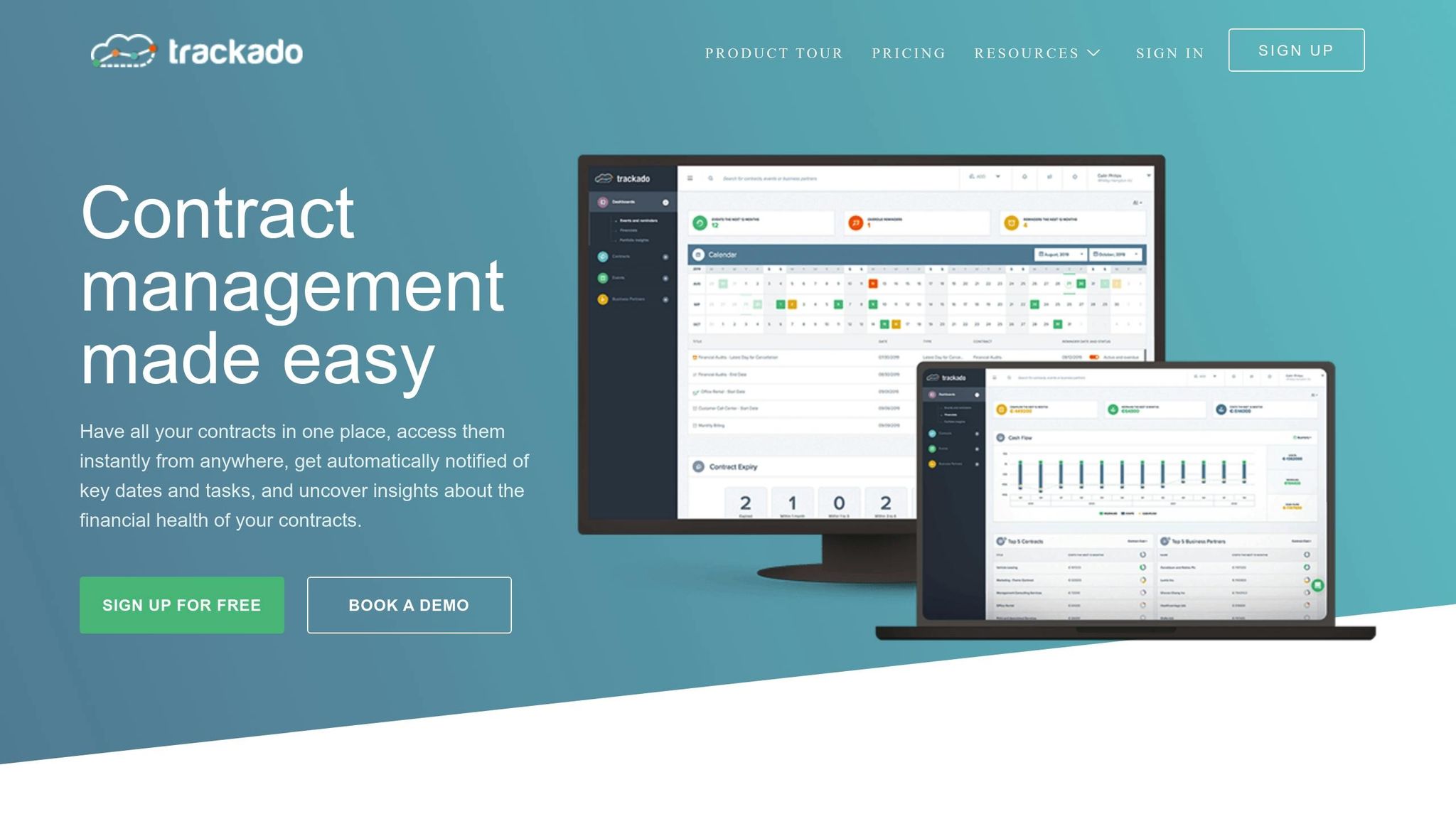
Trackado combines centralized storage, automated insights, and flexible workflows into a single, user-friendly platform for managing financial contract analytics.
Central Storage and Automated Insights
Effective financial contract management starts with having everything in one place. Trackado centralizes your contract documents, eliminating the chaos of scattered files.
Its AI-powered data extraction pulls essential financial details automatically – contract values, payment terms, renewal dates, and milestone schedules. This automation not only saves time but also minimizes errors and ensures consistency across your database.
Trackado goes beyond storage by offering automated insights that keep you informed. You can quickly identify top-performing contracts, track payment schedules to optimize cash flow, and spot opportunities without sifting through endless spreadsheets. These insights are updated automatically as new contracts are added or existing ones are updated.
To keep you on track, Trackado provides automated reminders for key financial deadlines. Whether it’s a payment due, a renewal date, or a milestone review, the system ensures your team stays proactive and avoids costly oversights.
Custom Fields and Workflow Automation
Trackado’s flexibility allows you to adapt workflows to your specific financial needs. With unlimited custom fields (available in Business and Enterprise plans), you can track the metrics that matter most to your organization – like gross margins, cost allocations, or performance bonuses.
Milestone tracking helps you monitor financial progress and budgets, giving you the visibility to address potential cost overruns before they escalate.
Approval workflows streamline the review process while maintaining financial controls. You can design approval chains tailored to your organization, ensuring high-value contracts get the oversight they require. This automation speeds up contract execution without compromising on accountability.
The platform also includes integrated e-signing, so once financial terms are approved, contracts can be signed digitally without switching systems. This seamless process accelerates finalization, improving cash flow timing and reducing delays.
Financial Dashboards and Reports
Trackado’s dashboards provide a clear, organized view of your financial contracts. You can sort contracts by partner, category, or department to gain a full understanding of costs, revenues, and key dates across your portfolio.
The dashboard highlights critical metrics – like total contract value, revenue schedules, and upcoming payments – all in one place. Filters allow you to focus on specific time periods, contract types, or responsible parties, helping you zero in on the areas that need attention. These tools not only organize your contracts but also reveal trends in profitability and costs.
For deeper analysis or executive reporting, you can use the export functionality to pull data into Excel or PDF formats. This makes it easy to integrate Trackado’s insights into your existing financial reporting workflows.
Trackado’s search and filter tools make it simple to locate specific contracts or analyze subsets of your portfolio. For instance, you can quickly find contracts expiring next quarter or filter those with specific margin thresholds.
With secure hosting in European data centers and enterprise-grade SSL encryption, Trackado ensures your financial data is safe while remaining accessible for analytics and decision-making.
Common Challenges and Solutions
Organizations often encounter hurdles in financial contract analytics that can limit the ability to fully leverage data-driven insights. Recognizing these challenges and addressing them head-on can make the implementation process smoother and more effective.
Missing Data and Accuracy Problems
One of the most persistent issues is incomplete or inaccurate contract data. Contracts may lack key financial details, include outdated terms, or exist in inconsistent formats. This problem is often rooted in older practices where contracts were scattered across various locations and stored in different formats. Financial details buried within dense legal language only add to the complexity of extracting usable data.
On top of that, data accuracy issues can derail analytics efforts. If contract values, payment schedules, or renewal dates are entered incorrectly, the resulting insights are unreliable. Decisions based on flawed data can lead to missed opportunities or costly mistakes.
To tackle this, start with rigorous data audits. Catalog all contracts and identify those with complete financial information. Develop a standardized checklist for critical data points, such as contract value, payment terms, renewal dates, performance metrics, and cost allocation details.
For contracts missing information, implement a systematic review process. Assign team members to carefully extract and standardize data. While this can be time-intensive, it establishes a reliable foundation for analytics. To address gaps in historical data, predictive modeling can help estimate missing values by analyzing patterns in similar contracts. These estimates can then be flagged for verification to ensure accuracy.
To maintain data quality moving forward, set up validation rules that require key financial fields to be completed before contracts are activated. This ensures that future contracts meet consistent standards.
Balancing Short-Term and Long-Term Goals
Another common challenge is finding the right balance between short-term cash flow needs and long-term growth objectives. Contracts that generate quick revenue might require significant long-term investments, reducing their immediate profitability. On the flip side, strategic partnerships with upfront costs may not align with quarterly goals, even though they promise substantial returns over time.
This tension is further complicated by differing priorities across departments. Sales teams might focus on contracts that boost short-term revenue, while finance teams prioritize long-term margins. Meanwhile, operations teams may favor contracts that simplify processes, even if they don’t maximize immediate profits.
To address these conflicting goals, organizations need clear prioritization frameworks. Use dual-track analytics to evaluate both short-term impact and long-term value. For each contract, track metrics like cash flow, lifetime value, strategic importance, and resource requirements.
Introduce weighted scoring systems to balance these factors. Adjust the weights based on your organization’s current needs – emphasizing short-term revenue during cash flow constraints or prioritizing long-term value during growth phases. Additionally, employ scenario planning to model how different decisions affect both short- and long-term outcomes. This approach helps stakeholders understand trade-offs and make more informed choices.
Overcoming Resistance to Change
Even with strong data and strategies, resistance to change can be a major roadblock. Cultural resistance often arises when team members perceive new analytics processes as unnecessary or disruptive to their workflows. Some may stick to familiar spreadsheets, resist training, or show skepticism about analytics tools.
This resistance is often rooted in legitimate concerns. Employees may fear job loss if analytics automate parts of their responsibilities. Others may feel overwhelmed by the need to learn new systems while juggling existing tasks. Past failures with technology implementations can also fuel doubt.
To build an analytics-driven culture, it’s essential to address these concerns directly. Involve key team members early in the planning process, giving them a say in how analytics will be integrated. This encourages a sense of ownership and reduces the perception that changes are being imposed from the top down.
Focus on empowering training programs that show how analytics can enhance decision-making and free up time for more strategic work. Highlight how automation eliminates repetitive tasks, allowing employees to focus on areas that require human expertise.
Roll out changes gradually through pilot programs that demonstrate measurable success. Select initial projects that are likely to deliver clear, tangible improvements. When team members see the benefits firsthand, they’re more likely to support broader implementation.
Share updates regularly to showcase how analytics have improved contract performance, saved costs, or prevented issues. Recognize early adopters and create departmental champions who can provide peer support and encourage others to embrace the new approach. These advocates can help foster a positive shift, making the transition smoother for everyone involved.
Summary and Next Steps
Let’s wrap up the key takeaways and outline the steps you can take to turn plans into action.
Financial contract analytics helps uncover essential insights from contract data, enabling smarter, profit-focused decisions. Shifting from scattered documents to actionable data requires thoughtful planning, the right tools, and a commitment to making decisions rooted in data.
Key Points to Keep in Mind
Centralizing contracts with standardized fields allows for quicker trend analysis, better profitability assessments, and more effective risk detection. This requires a comprehensive approach to contract risk identification. When this centralization is paired with tools like ERP and CRM platforms, it creates an integrated flow of information across your organization, making collaboration much easier.
Clean and complete contract data is critical for reliable financial analysis. Companies that establish strong data quality standards and validation processes consistently achieve better results from their analytics efforts.
Effective analytics require balancing short-term priorities, like immediate cash flow impacts, with long-term goals, such as contract value and strategic resource allocation. Collaboration across departments is essential to ensure all perspectives are considered. Regular performance tracking ensures that insights translate into meaningful improvements.
Steps to Begin Implementation
Ready to get started? Here’s how you can move from planning to execution:
- Audit Your Contract Repository: Review where your contracts are stored, assess the financial data they contain, and identify any gaps. This will help you understand the scope of work needed to build a strong foundation.
- Adopt a Contract Management Tool: Consider tools like Trackado to centralize your documents and automate data extraction. Trackado’s AI features can pull out key financial details, while its customizable fields let you focus on the metrics that matter most. Its dashboards provide instant insights into costs, revenues, and critical dates across your contracts.
- Start with a Pilot Program: Focus on your most valuable contracts or those up for renewal. This allows you to demonstrate quick results while fine-tuning your processes. Track metrics such as contract profitability, renewal rates, and cost savings to measure the program’s success.
- Define Clear Workflows: Establish who is responsible for entering data, how often reports will be generated, and which stakeholders will receive key insights. Clear workflows ensure everyone stays aligned.
Inefficiencies in contracting cost over 50% of organizations business opportunities. With 42% of companies already leveraging AI in their contracting processes, adopting financial contract analytics early can give you a competitive edge. By combining centralized storage, automated insights, and collaborative workflows, your organization can make more informed contract decisions and boost overall financial performance.
When choosing tools, prioritize those that integrate with your existing ERP and CRM systems. This eliminates data silos and supports a more comprehensive analytics strategy. These steps set the stage for a successful rollout of financial contract analytics, helping you transform your approach to contract management.
FAQs
How can financial contract analytics help businesses make better decisions and increase profitability?
Financial contract analytics helps businesses turn complicated contract details into clear, actionable insights. By breaking down key terms, obligations, and financial performance, companies can spot ways to save money, identify missed revenue opportunities, and manage risks more effectively.
This method, rooted in data analysis, allows for better decision-making, smoother cash flow management, and stronger financial stability. With these insights, businesses can fine-tune their operations, cut down on inefficiencies, and increase profitability.
What are the key elements of an effective financial contract analytics system?
An efficient financial contract analytics system hinges on a few key components. First, you need powerful data extraction and analysis tools. These tools help pinpoint critical contract elements such as clauses, obligations, and deadlines, ensuring that no detail slips through the cracks. This level of precision simplifies compliance and keeps everything on track.
Next, monitoring and reporting capabilities are indispensable. These features allow businesses to track important metrics, evaluate risks, and generate insights that support smarter decision-making. When combined, these elements improve transparency, minimize risks, and streamline the entire contract management process.
What are effective ways for companies to address missing data and resistance to change when adopting financial contract analytics?
To address resistance to change, start with transparent communication that highlights how financial contract analytics can bring value. Engaging key stakeholders early on is crucial for gaining support. Introducing the system gradually, paired with proper training, can help alleviate concerns. It’s also important to emphasize that analytics is meant to enhance existing roles, not replace them – this approach can foster trust and acceptance.
When dealing with missing data issues, automating data collection and validation is a game-changer. Automation not only improves the accuracy and completeness of data but also streamlines the adoption process, making it more efficient and less daunting.